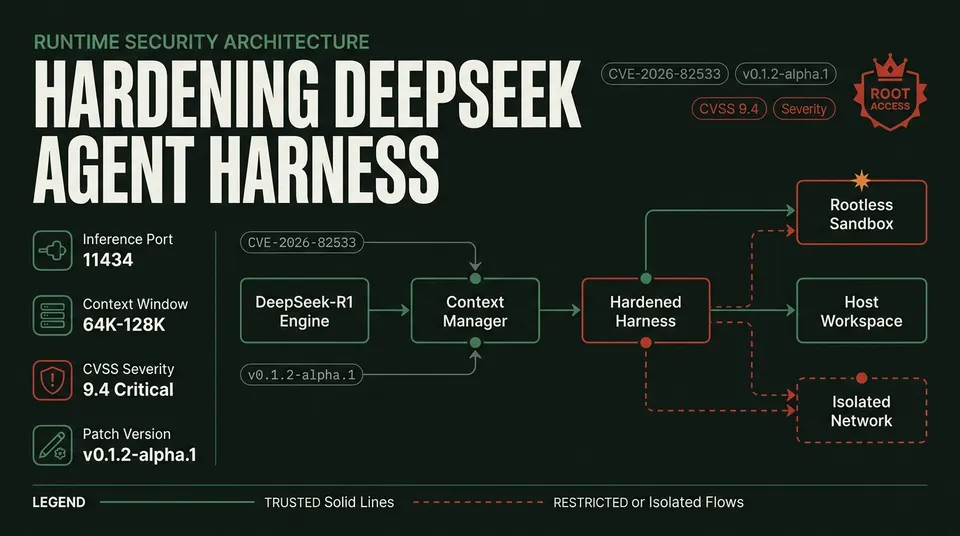
Deploying DeepSeek-R1 agent runtimes? Learn how to harden the harness architecture, configure local inference, mitigate CVEs, and enforce sandbox security.
Software engineering teams evaluating open-source alternatives to proprietary agentic stacks like Anthropic's Claude Code are increasingly turning to community runtimes powered by DeepSeek-R1. Yet migrating to self-hosted coding agents has exposed significant friction: namespace confusion between benchmark suites and execution engines, unpredictable context degradation, and severe host-level security vulnerabilities.
Executing a reliable deployment requires viewing the harness not as a single turnkey binary, but as an architectural pattern. Success hinges on clear separation between benchmarks and dynamic runtimes, deterministic tool execution, and defense-in-depth isolation. This DeepSeek harness setup tutorial walks through the architectural mechanics, local inference configuration, and production-grade sandboxing required to deploy safely.
Dissecting the Harness: Benchmarks Versus Dynamic Runtimes
Much developer friction stems from an unresolved namespace collision between two distinct software paradigms circulating under the label "DeepSeek Harness."
| Dimension | Official Benchmark Harness (deepseek-ai/deepseek-harness) | Community Agent Runtime (dsh / HarnessEngine) |
|---|---|---|
| Primary Objective | Standardized capability evaluation and static model scoring | Autonomous multi-step software engineering and task execution |
| Core Workloads | Academic benchmarks (MMLU, HumanEval, GSM8K, MBPP) | Codebase exploration, AST analysis, file editing, test execution |
| Execution Loop | Static batch inference: prompt $\rightarrow$ generation $\rightarrow$ score validation | Dynamic OODA loop: Observe, Orient/Think, Decide, Act |
| System Access | Pure compute; zero access to host shell or filesystem | Programmatic invocation of bash, Git, compilers, and test suites |
| State & Memory | Stateless per benchmark test case | Multi-turn persistence with rolling memory buffers and pinned state |
The official evaluation repository published by DeepSeek is a static scoring harness designed to benchmark raw model outputs against predefined academic test sets. It does not inspect local Git repositories or execute terminal commands.
Conversely, community frameworks such as dsh and modular HarnessEngine architectures act as dynamic orchestrators. They bridge DeepSeek-R1 with the host system, establishing an autonomous loop that parses reasoning traces and executes system-level tools.
Dynamic harnesses operate through a four-phase loop:
- Observe: Workspace states, file contents, and error outputs are gathered into structured context blocks.
- Think: DeepSeek-R1 outputs explicit planning tokens within
<think>tags, evaluating previous outputs and planning file refactors before producing machine-readable instructions. - Act: The engine extracts structured tool parameters, validates them against allowed system schemas, and executes the designated routine.
- Evaluate: Output streams (
STDOUT/STDERR) are captured. If an execution fails, the stack trace feeds directly into the subsequent reasoning step for automated self-correction.
Because multi-step tasks quickly saturate context windows (typically 64K to 128K tokens), production engines enforce rolling eviction for verbose logs beyond 50 lines, apply abstractive summarization when token utilization crosses 70 percent, and pin project directory trees across turns.
Environment Setup and Local Inference Configuration
Self-hosting an agent stack requires establishing a local inference pipeline using Ollama or an OpenAI-compatible remote endpoint.
1. Local Inference Setup (Ollama)
For complete data privacy and offline execution, pull and verify a quantized DeepSeek-R1 model:
# Install Ollama runtime
curl -fsSL https://ollama.com/install.sh | sh

# Pull quantized DeepSeek-R1 (14B for 16GB VRAM; 32B/70B for higher tiers)
ollama pull deepseek-r1:14b

# Verify the inference endpoint responds on default port 11434
curl -s http://localhost:11434/api/generate -d '{
 "model": "deepseek-r1:14b",
 "prompt": "Respond with OK if operational",
 "stream": false
}'
2. Runtime Environment Initialization
Configure an isolated Python runtime containing required dependencies:
python3 -m venv dsh-env
source dsh-env/bin/activate
pip install --upgrade pip
pip install httpx pydantic pyyaml docker openai
Implementing a Hardened Agent Engine
A reliable harness avoids unconstrained shell wrappers. It enforces explicit path containment, validates schemas, and eliminates arbitrary shell interpolation:
"""
dsh_core.py - Hardened Local Agent Harness for DeepSeek-R1
"""
import os
import subprocess
from typing import Dict, Any, List
from openai import OpenAI

class HardenedHarnessEngine:
 def __init__(self, base_url: str = "http://localhost:11434/v1", api_key: str = "ollama", model: str = "deepseek-r1:14b"):
 self.client = OpenAI(base_url=base_url, api_key=api_key)
 self.model = model
 self.workspace = os.path.abspath("./agent_workspace")
 os.makedirs(self.workspace, exist_ok=True)
 self.messages: List[Dict[str, str]] = [
 {"role": "system", "content": "Sandboxed assistant. Propose actions using valid JSON."}
 ]

 def tool_read_file(self, relative_path: str) -> str:
 """Path-traversal resistant file reader."""
 target_path = os.path.abspath(os.path.join(self.workspace, relative_path))
 if not target_path.startswith(self.workspace):
 return "ERROR: Security violation - path traversal outside workspace forbidden."
 if not os.path.exists(target_path):
 return f"ERROR: File '{relative_path}' not found."
 with open(target_path, "r", encoding="utf-8", errors="replace") as f:
 return f.read()

 def tool_run_sandboxed_command(self, command: List[str]) -> str:
 """Restricted process execution avoiding shell=True."""
 ALLOWED_BINARIES = {"pytest", "git", "ls", "grep", "cat", "python3"}
 if not command or command[0] not in ALLOWED_BINARIES:
 return f"ERROR: Command '{command[0]}' rejected by execution policy."

 try:
 res = subprocess.run(
 command,
 cwd=self.workspace,
 capture_output=True,
 text=True,
 timeout=30,
 shell=False
 )
 return f"STDOUT:\n{res.stdout}\nSTDERR:\n{res.stderr}"
 except subprocess.TimeoutExpired:
 return "ERROR: Process execution timed out after 30 seconds."
 except Exception as e:
 return f"ERROR: Subprocess invocation failed: {str(e)}"
Threat Modeling, Vulnerability Analysis, and Sandboxing
Connecting an autonomous reasoning model directly to host utilities introduces severe attack vectors that must be actively countered.
| Vulnerability / Threat | Severity | Mechanism | Impact & Mitigation |
|---|---|---|---|
| CVE-2026-82533 | CVSS 9.4 (Critical) | HTTP Host header spoofing in isTrustedApiRequest | Allowed arbitrary callers to bypass authentication, elevate to danger-full-access, and disable the sandbox. Mitigation: Upgrade to DeepSeek Harness v0.1.2-alpha.1 or later; bind local API endpoints strictly to loopback interfaces with TCP peer verification. |
| Docker Socket Misconfiguration | High | Mounting /var/run/docker.sock inside the container | Allows an agent or compromised dependency to issue direct Docker API calls to escape container boundaries. Mitigation: Never mount the Docker socket into the execution environment. |
| Indirect Prompt Injection | High | Malicious directives embedded in comments, test fixtures, or markdown files | Exploits agent read permissions to hijack execution flows and leak data. Mitigation: Strict schema enforcement and network isolation. |
| Host Command Injection | High | Insecure shell expansion (shell=True) | Permits command chaining (file.py; rm -rf /). Mitigation: Use parameter arrays with shell=False. |
To enforce strict containment, execute the agent runtime inside an isolated rootless container:
# Dockerfile.agent-sandbox
FROM python:3.11-slim
RUN groupadd -r agentgrp && useradd -r -g agentgrp -u 1001 agentuser
WORKDIR /workspace
RUN chown -R agentuser:agentgrp /workspace
USER agentuser
ENV PYTHONUNBUFFERED=1
Launch the runtime with explicit privilege revocation:
docker run --rm -it \
 --name agent-sandbox \
 --network none \
 --cap-drop=ALL \
 --read-only \
 --tmpfs /tmp:rw,noexec,nosuid,size=64m \
 --tmpfs /workspace:rw,size=512m \
 -v $(pwd)/project:/workspace/project:rw \
 agent-sandbox python3 -m dsh.agent
Isolating the network layer (--network none) prevents data exfiltration. Dropping Linux capabilities (--cap-drop=ALL) and mounting a read-only root filesystem blocks persistence mechanisms and unauthorized binary modification.
Field Assessment: Self-Hosted Stacks Versus Proprietary Ecosystems
Engineering teams evaluating self-hosted DeepSeek harness architectures against proprietary solutions must balance governance advantages against operational maintenance.
| Dimension | Community DeepSeek Harness (dsh) | Proprietary Coding Stacks (e.g., Claude Code) |
|---|---|---|
| Data Governance | Total Sovereignty: Runs entirely on-premises or air-gapped with zero telemetry egress. | Shared Responsibility: Codebase context and terminal sessions stream to vendor infrastructure. |
| Token Economics | Cost-Effective: Zero recurring subscription fees on local silicon; low per-token cost via API. | |
| Context Handling | Variable: Requires custom eviction and log truncation to sustain stability beyond 15 turns. | Advanced: Turnkey context management, repository-level caching, and workspace indexing. |
| Tool Calling Reliability | Moderate: Quantized models (14B/32B) exhibit syntax drift requiring strict validation. | High: Native fine-tuning yields dependable schema compliance across complex multi-file tasks. |
| Operational Overhead | High: Demands internal orchestration for GPU workloads, sandbox isolation, and patching. | Minimal: Managed CLI application with immediate enterprise support channels. |
Adopting community-driven DeepSeek harness runtimes liberates engineering teams from vendor lock-in and protects sensitive codebases. However, shifting from managed environments places the burden of security and runtime stability entirely on platform engineers. Treating the harness pattern with rigorous discipline—coupling deterministic tool schemas with hardened, patched isolation boundaries—ensures organizations capture the full reasoning power of DeepSeek-R1 without compromising infrastructure integrity.