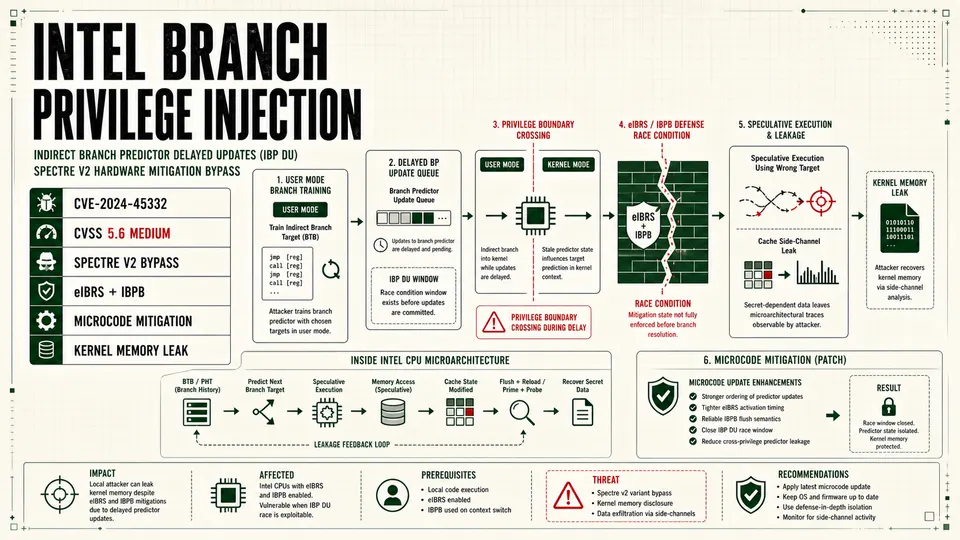
Intel issued microcode mitigations for CVE-2024-45332, a Branch Privilege Injection flaw that can bypass Spectre v2 hardware defenses and leak privileged memory from affected systems.
Intel has issued microcode mitigations for a newly disclosed processor vulnerability, CVE-2024-45332, after researchers demonstrated that a race condition in recent Intel CPUs can bypass key Spectre v2-era protections and leak privileged memory from fully updated Linux systems.
The flaw, called Branch Privilege Injection by researchers and Indirect Branch Predictor Delayed Updates by Intel, affects how some Intel processors handle branch predictor updates during security-sensitive transitions, such as moving from user mode to kernel mode or crossing a branch-predictor barrier. Intel rates the issue Medium, with a CVSS 3.1 score of 5.6, and says exploitation requires local authenticated access and high attack complexity.
The disclosure is technically significant because it challenges the core assumptions behind Intel's post-Spectre hardware defenses. Since Spectre and Meltdown shook the processor industry in 2017, Intel and other chipmakers have relied on a combination of hardware and software mitigations to stop attackers from abusing speculative execution, the performance feature that lets CPUs guess future instructions before they are formally needed.
Branch Privilege Injection shows that some of those protections can fail if branch predictor updates arrive late.
Researchers found that Intel branch predictors can update asynchronously, with some updates delayed by tens or hundreds of CPU cycles. Under certain conditions, a branch prediction trained in a lower-privilege context can still be in flight when the processor crosses into a higher-privilege context. When the delayed update lands, it can be associated with the wrong privilege domain.
That opens the door to a Spectre v2-style attack in which an attacker influences speculative execution in privileged code and then infers sensitive data through microarchitectural side channels.
| Vulnerability | Details |
|---|---|
| CVE | CVE-2024-45332 |
| Research name | Branch Privilege Injection |
| Intel name | Indirect Branch Predictor Delayed Updates |
| Class | Spectre v2 / Branch Target Injection mitigation bypass |
| Severity | CVSS 5.6 Medium |
| Impact | Information disclosure |
| Attack requirements | Local access, low privileges, high complexity |
| Primary mitigation | Firmware or microcode update from system manufacturer |
The researchers demonstrated an end-to-end attack that leaked arbitrary kernel memory from up-to-date Linux systems across six generations of Intel CPUs. In one reported test, the exploit leaked data at 5.6 KiB per second on an Intel Raptor Cove processor, with 99.8% byte accuracy in the memory-leak primitive. The work also included a demonstration of leaking the root password hash from /etc/shadow, with a 21-second median completion time and 90.7% full-hash recovery in the researchers' test setup.
The flaw targets two important defenses: enhanced Indirect Branch Restricted Speculation, or eIBRS, and Indirect Branch Prediction Barrier, or IBPB. eIBRS is designed to prevent branch predictions trained in a less-privileged domain from influencing more-privileged code. IBPB is intended to flush or invalidate branch predictor state across isolation boundaries, such as between distrustful workloads or virtual machines.
Branch Privilege Injection weakens both assumptions. If a predictor update is delayed until after a privilege transition or after an IBPB operation, the update may not be filtered or flushed as intended.
The affected scope is broad but should not be overstated. Researchers say Branch Privilege Injection affects Intel processors since 9th-generation Coffee Lake Refresh, and that related IBPB-bypass behavior was observed as far back as 7th-generation Kaby Lake. Intel's advisory lists specific affected product families rather than declaring every Intel processor vulnerable, including multiple Core, Core Ultra, Xeon, Atom, Pentium and Celeron lines across client, server, workstation, embedded and mobile segments.
The issue is not known to affect evaluated AMD and Arm systems, according to the researchers.
The risk is most acute in environments where local code execution is already possible and strong isolation matters: shared servers, cloud infrastructure, sandboxed workloads and virtualization platforms. The vulnerability does not support a simple remote attack scenario by itself. Intel's scoring reflects that constraint: the attacker needs local access, some privileges and a complex exploitation path, though the confidentiality impact can be high if exploitation succeeds. A similarly severe local-to-root jump surfaced in the Fragnesia Linux kernel flaw that gives local attackers a public path to root.
Intel has released microcode updates and recommends that users of affected processors install the latest firmware supplied by their system manufacturer. On many systems, that mitigation will arrive through BIOS, UEFI, operating system or vendor firmware updates. Linux distributions have also tracked the issue through Intel microcode packages. Commercial spyware has separately weaponized a Linux kernel privilege escalation flaw to hijack Android devices.
The performance cost remains a point of tension. Researchers reported up to 2.7% overhead for Intel's microcode mitigation on Alder Lake in their evaluation and higher overheads for some software alternatives. Intel says standard benchmarks remain within normal run-to-run variation, while acknowledging that syscall-heavy microbenchmarks may show measurable impact.
For most users, the practical advice is straightforward: apply firmware and operating system updates as they become available. The scale of that workload keeps growing: Microsoft's July 2026 Patch Tuesday alone shipped a record 622 CVEs. For cloud operators and enterprises running multi-tenant workloads, the disclosure deserves closer review because it cuts directly across privilege and isolation boundaries that modern infrastructure depends on.
Branch Privilege Injection is not a mass-exploitation emergency. It is something more subtle and, for processor security, more consequential: evidence that the post-Spectre hardware trust model still has race conditions hiding in the machinery designed to enforce it.
Sources
- Intel, "Indirect Branch Predictor Delayed Updates / INTEL-SA-01247 / CVE-2024-45332": https://www.intel.com/content/www/us/en/developer/articles/technical/software-security-guidance/advisory-guidance/indirect-branch-predictor-delayed-updates.html
- ETH Zurich Computer Security Group, "Branch Privilege Injection: Exploiting Branch Predictor Race Conditions": https://comsec.ethz.ch/research/microarch/branch-privilege-injection/
- NVD, CVE-2024-45332: https://nvd.nist.gov/vuln/detail/CVE-2024-45332
- Ubuntu Security, CVE-2024-45332: https://ubuntu.com/security/CVE-2024-45332