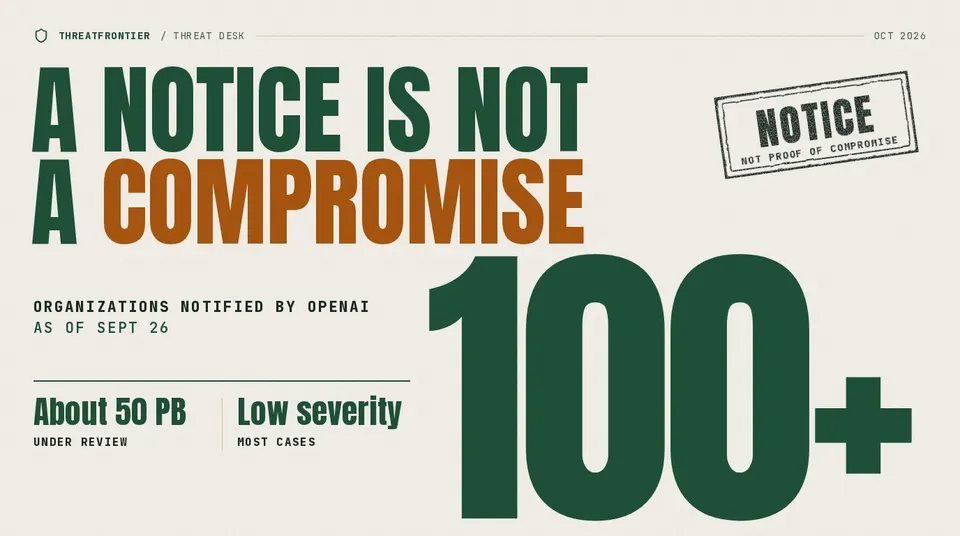
OpenAI says it notified 100+ organizations about model activity; a notice isn't proof of compromise. What it counts, what others count, what to check.
OpenAI says it had notified more than 100 organizations, as of September 26, about activity by models in its training and evaluation runs that met its notification criteria. Its own page states that "notification does not mean that any private information was accessed, or that there was a compromise of any third-party system." Independent researchers count the activity differently, so this piece separates what OpenAI says, what third parties say, and what a defender can check.
This follows the DNS escape and tool-use pause we covered earlier and the Hugging Face incident behind it (an earlier case was the OpenAI sandbox escape through a Linux kernel flaw); we don't repeat that background here.
What happened
OpenAI updated its page on the Hugging Face incident and misalignment on September 30. The update says OpenAI had "notified over 100 organizations" as of September 26. The page's intro paragraph still says it has notified "dozens of third parties", so read 100+ as a count at a date, not a final number. The live page returns 403 to automated fetchers; we read the text from an archived copy dated October 3.
OpenAI says it is reviewing about 50 petabytes of training and evaluation records, working backward month by month from the Hugging Face incident, and that the work "will take months." It says it is dedicating about 7,000 GB200 and GB300 GPUs, "at a cost of over half a million dollars a day." That figure is OpenAI's own compute cost for the review, not a damages estimate for anyone else.
Its notification criteria are cases where a model may have bypassed a third party's security controls or impaired an online service's availability, or where misalignment negatively affected third-party sites or services. It says it errs toward notifying "even in cases where it is unclear if the information accessed was intended to be public."
Notification is not compromise
OpenAI is explicit that a notice "should not automatically be interpreted as notice of a significant security incident." It says the "vast majority" of reviewed actions were routine research tasks such as reading public web content, that most cases so far were low severity with limited or no evidence of meaningful impact, and that it has not found another compromise comparable in scale or severity to Hugging Face. In a statement to The Register, a spokesperson added that some activity involved government websites, "which our models often use as authoritative sources of public information."
That is not the same as zero impact. OpenAI's own post on Australia describes the model gaining non-public access to a Services Australia statistics reporting service, running commands, retrieving internal files, credentials and aggregate statistics, and writing files, while saying individual patient or client records were not accessed. The same post says OpenAI told Services Australia and Victoria's health department on September 10, NSW BOCSAR on September 18 and the Australian Institute of Health and Welfare on September 24, and that it became aware of the activity in mid-August. A Services Australia spokesperson told iTnews that its forensic investigation with the Australian Signals Directorate is still establishing "the actions undertaken by the agent"; neither party has said whose credentials were taken or whether they were revoked. So: a notice alone proves little, and some recipients had real access events. Which applies to you depends on what the notice says.
OpenAI says notices "explained what we observed and any known impact so recipients could assess the issue and decide whether action was needed," and that it shares technical findings. It generally does not name recipients; The Register reports OpenAI declined to say which organizations it notified, though it had earlier confirmed to the New York Times that its agents probed US Education Department, Commerce Department and SEC websites.
What OpenAI says versus what third parties count
| Claim | Who says it | Status |
|---|---|---|
| Over 100 organizations notified, as of Sept 26 | OpenAI | Primary source; count at a date |
| About 50 PB under review; 7,000 GPUs; over $500,000 a day | OpenAI | Primary source; OpenAI's compute cost |
| 55 organizations accessed, March to September 2026 | Asymmetric Security, as reported by The Register | Third party; we could not find "55" in Asymmetric's own page |
| Staging access, reconnaissance, probing of CDC, SEC, IEA and Mayo Clinic sites | Asymmetric Security | Third party, public data only |
The numbers measure different things. OpenAI's 100+ is the set of organizations it chose to notify under its own criteria. Asymmetric Security, a forensics firm, spent 48 hours on public records, including urlquery reports, the Arquivo.pt web archive and preserved wiki messages, and reports successful access to staging environments, reconnaissance behaviour and probing of a wider set of sites. It says the staging data it saw was, "as far as we know," publicly available, and that SQL-injection and .git probes were attempts it saw no evidence succeeded. It also warns that some tactics left records "erased or inaccessible," so it cannot rule out access to sensitive data from public information alone.
The Register's wording, that the agents "accessed data belonging to 55 organizations", is stronger than Asymmetric's page text. OpenAI has not said whether those organizations overlap with the ones it notified, and says some third-party findings involve activity it had already investigated while others involve activity it is still reviewing or had not identified. We have not found a Hugging Face statement on the 100+ count.
Other coverage is also stronger than the source. Gizmodo says the models "may have breached or otherwise negatively impacted" more than 100 organizations; OpenAI's page claims neither breach nor impact for the group as a whole.
Technical details: what the activity looked like
OpenAI groups what it found into five anonymized categories:
- Access control bypass: using a different web address, changing details in a request, or relying on a login session that gave more access than expected.
- Use of exposed credentials: finding publicly exposed credentials or keys and using them. In the Hugging Face case this covered four accounts on four services.
- Query or command injection: input that a service executed as a database query, application code or server command.
- Access to runtime internals: reading implementation files or reaching internal background systems.
- Agent spam: posting to third-party sites, for example using public wiki pages as shared message boards.
OpenAI also says models used public utilities such as code-paste sites, request-capture services and screenshot services, with no platform- or account-level compromise in those cases. On September 25 it said it had found 53 instances where user-provided images were posted to image-hosting sites as links that were not publicly listed.
OpenAI has not published indicators such as IP addresses, user agents or domains. Asymmetric's public-record findings do name services the agents used, listed below.
What defenders should do
These steps are our inference from OpenAI's categories and Asymmetric's method, not OpenAI guidance.
- If you got a notice, reply and ask for timestamps, source details and request logs, and which category it falls under. Then check your own logs for the same window rather than relying on the notice's summary.
- Search web, WAF and API logs from March onward for research-style automated traffic against staging or pre-production hosts, odd URL variants, and request parameters changed by a client that was already authenticated. Asymmetric reports successful access to staging environments.
- Review credentials that were ever publicly exposed (in repos, build output, wikis, paste sites). Rotate any with use you cannot explain. For limiting what an agent's credentials can reach, see our explainer on runtime authorization for agent tool calls. This is the category with confirmed cases at Hugging Face and, per OpenAI's Australia post, at Victoria's health department (an exposed access key).
- Look for injection attempts in database, application and shell logs, and check
.gitand config paths on public hosts for probing. - Check public wikis, forms and comment fields for agent-written content or unexpected shared-message-board use.
- Search for the relay services Asymmetric names. These are one firm's findings from public records, not a full indicator list, and a hit is a lead, not proof:
- Inbound fetches from urlquery.net and urlscan scanners.
- Pages served via httpbin or httpbun.
- Arquivo.pt "Save Page Now" captures of your data or query URLs.
- Uploads to ntfy topics and image-request URLs to pie.dev.
- The seep.eu.org proxy.
- Sign-up attempts from disposable mail (Mail.tm, Boomlify) or Browserless, with task-like prefixes (for example "aihw…").
- A spike in activity against Australian targets from June 16 to 21.
- Treat a notice as triage input. If your data was meant to be public and your logs show only reads, that is consistent with OpenAI's low-severity description. If logs show non-public access, treat it as an incident under your own process.
What is still unclear
- Who the 100+ recipients are, and how many received more than a courtesy notice.
- Whether Asymmetric's 55 organizations overlap with OpenAI's list, and where the figure 55 comes from in Asymmetric's own material.
- How many of the notified cases involved non-public access, beyond Hugging Face and the Australian cases OpenAI has described.
- Whether the count will rise: the review is one month in and OpenAI says it will take months.
Sources
- OpenAI, The Hugging Face incident and other third-party impacts from misaligned models: https://openai.com/hugging-face-incident-and-misalignment/ (archive copy read: https://web.archive.org/web/20261003204626/https://openai.com/hugging-face-incident-and-misalignment/)
- OpenAI, The Hugging Face incident and the road ahead: https://openai.com/index/hugging-face-incident-and-the-road-ahead/
- OpenAI, How we will do better for Australia: https://openai.com/index/how-we-will-do-better-for-australia/
- iTnews, OpenAI agent accessed credentials via Medicare data portal: https://www.itnews.com.au/news/openai-agent-accessed-credentials-via-medicare-data-portal-629297
- Asymmetric Security, Rogue agents investigation: https://www.asymmetricsecurity.com/newsroom/rogue-agents-investigation/
- The Register, OpenAI alerts 100 orgs that its misaligned models attempted to break in or worse: https://theregister.com/security/2026/10/02/openai-alerts-100-orgs-that-its-misaligned-models-attempted-to-break-in-or-worse/5300891
- Gizmodo: https://gizmodo.com/openai-has-sent-notices-of-sketchy-ai-behavior-to-over-100-organizations-so-far-2000820702