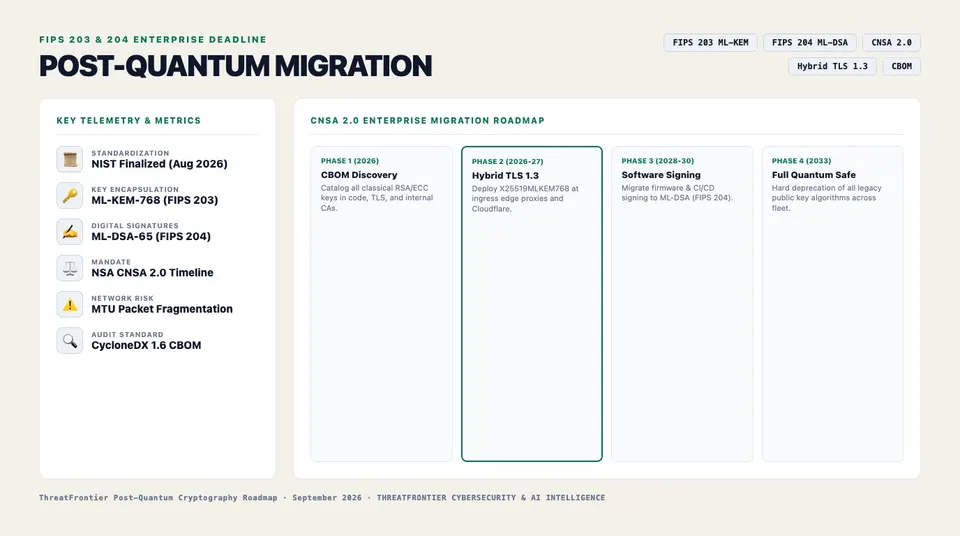
With NIST finalizing FIPS 203 and 204, enterprises face CNSA 2.0 deadlines. We break down hybrid TLS 1.3 handshakes, MTU packet fragmentation, and CBOM discovery.
The transition from classical public-key cryptography to post-quantum cryptography (PQC) has moved from theoretical research into strict regulatory enforcement. With the National Institute of Standards and Technology (NIST) releasing finalized standards for Federal Information Processing Standards—FIPS 203 (Module-Lattice-Based Key-Encapsulation Mechanism, or ML-KEM) and FIPS 204 (Module-Lattice-Based Digital Signature Algorithm, or ML-DSA)—enterprise security teams face binding compliance mandates under the National Security Agency (NSA) Commercial National Security Algorithm Suite 2.0 (CNSA 2.0).
For infrastructure and security architects, the primary operational threat is not a future cryptanalytically relevant quantum computer (CRQC) operating tomorrow, but the "Harvest Now, Decrypt Later" (HNDL) paradigm active today. State-sponsored adversaries routinely capture and retain encrypted corporate, financial, and government communications across internet backbones. When quantum hardware achieves fault-tolerant execution of Shor algorithm, all recorded Diffie-Hellman, ECDH, and RSA session traffic will be decrypted retrospectively.
The Regulatory Framework: CNSA 2.0 Timelines and Mandates
The NSA CNSA 2.0 guidelines establish rigid timelines for phasing out classical public-key algorithms (RSA, Diffie-Hellman, ECDSA, and ECDH) across National Security Systems (NSS) and commercial enterprise supply chains:
- 2025–2026: Software and firmware code signing must begin transitioning to PQC signature schemes (specifically ML-DSA-87 or stateful hash-based signatures like LMS/HSS per NIST SP 800-208).
- 2027: Web browsers, client applications, and cloud-hosted TLS termination endpoints must support hybrid post-quantum key exchange in production.
- 2030: Traditional classical key exchange and authentication schemes are deprecated across all new equipment and service deployments.
- 2033: Classical cryptographic algorithms are strictly disallowed for operational traffic across critical infrastructure and federal supply chains.
- 2035: Full exclusive post-quantum mandate enforced across all legacy systems, completing the transition.
Achieving compliance requires immediate action across corporate Public Key Infrastructure (PKI), TLS ingress controllers, API gateways, and software deployment pipelines.
Cryptographic Mechanics: FIPS 203 (ML-KEM) vs. FIPS 204 (ML-DSA)
Both FIPS 203 and FIPS 204 derive their mathematical security from the hardness of the Module Learning With Errors (M-LWE) problem over polynomial rings. Unlike RSA, which relies on integer factorization, and ECC, which relies on the discrete logarithm problem, lattice-based cryptography resists both classical search and quantum Shor/Grover algorithms.
FIPS 203: Module-Lattice Key Encapsulation (ML-KEM)
FIPS 203 defines three standardized parameter sets mapped to NIST security categories:
- ML-KEM-512 (Category 1, AES-128 equivalent): Public key 800 bytes, ciphertext 768 bytes.
- ML-KEM-768 (Category 3, AES-192 equivalent): Public key 1,184 bytes, ciphertext 1,088 bytes. This serves as the primary industry default for general enterprise TLS 1.3 key exchange.
- ML-KEM-1024 (Category 5, AES-256 equivalent): Public key 1,568 bytes, ciphertext 1,568 bytes. Mandated by CNSA 2.0 for top-tier national security systems.
The encapsulation and decapsulation cycle operates over structured quotient rings:
Alice (KeyGen)                     Bob (Encapsulate)
  (pk, sk) <-- ML-KEM.KeyGen()
         -------- pk (1184 B) ------->
                                     (c, K_shared) <-- ML-KEM.Encaps(pk)
         <------- c (1088 B) ---------
K_shared <-- ML-KEM.Decaps(c, sk)
FIPS 204: Module-Lattice Digital Signatures (ML-DSA)
FIPS 204 standardizes digital signatures across three parameter tiers:
- ML-DSA-44 (Category 2): Public key 1,312 bytes, signature 2,420 bytes.
- ML-DSA-65 (Category 3): Public key 1,952 bytes, signature 3,309 bytes. Standard enterprise identity tier.
- ML-DSA-87 (Category 5): Public key 2,592 bytes, signature 4,627 bytes. CNSA 2.0 requirement for code and certificate authority signing.
Contrast these dimensions with classical algorithms:
| Algorithm | Type | NIST Category | Public Key Size | Ciphertext / Sig Size |
|---|---|---|---|---|
| RSA-3072 | Classical Enc/Sig | Cat 1 | 384 bytes | 384 bytes |
| ECDSA P-256 | Classical Sig | Cat 1 | 64 bytes | 64 bytes |
| X25519 | Classical KEM | Cat 1 | 32 bytes | 32 bytes |
| ML-KEM-768 | PQC KEM | Cat 3 | 1,184 bytes | 1,088 bytes |
| ML-DSA-65 | PQC Signature | Cat 3 | 1,952 bytes | 3,309 bytes |
| ML-DSA-87 | PQC Signature | Cat 5 | 2,592 bytes | 4,627 bytes |
The dramatic expansion in key and signature footprints represents the single largest operational obstacle to post-quantum migration.
Hybrid Key Exchange in TLS 1.3
Because post-quantum lattice schemes have not endured decades of adversarial cryptanalysis in high-volume production, standards bodies (IETF, NIST) mandate hybrid key exchange during the transition window.
In a hybrid handshake, the client and server negotiate both an elliptic-curve Diffie-Hellman key share (e.g., X25519 or SecP256r1) and a post-quantum KEM key share (e.g., ML-KEM-768). The shared secret is derived through a dual-input Key Derivation Function (KDF):
Client                                                              Server
  |                                                                   |
  |  ClientHello                                                      |
  |    + SupportedGroups: [X25519MLKEM768 (0x11ec)]                   |
  |    + KeyShare:                                                    |
  |        - X25519 pubkey (32 bytes)                                 |
  |        - ML-KEM-768 pubkey (1184 bytes)                           |
  |  -------------------------------------------------------------->  |
  |                                                                   |
  |                                 ServerHello                       |
  |                                   + KeyShare:                     |
  |                                       - X25519 pubkey (32 B)      |
  |                                       - ML-KEM-768 ct (1088 B)    |
  |  <--------------------------------------------------------------  |
  |                                                                   |
  |  [Both Derive: SS = HKDF-Extract(0, SS_X25519 || SS_MLKEM768)]    |
The resulting session remains secure even if an attacker discovers a mathematical flaw in lattice assumptions (protected by X25519) or builds a quantum computer that breaks discrete logs (protected by ML-KEM-768).
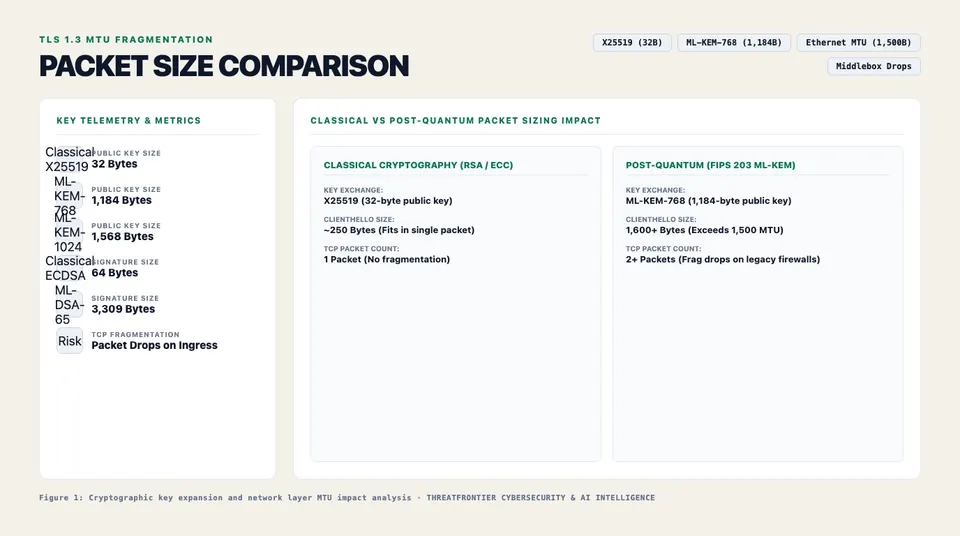
Figure 1: Architectural and benchmark overview for The Post-Quantum Enterprise Migration Deadline: Implementing FIPS 203 (ML-KEM) and FIPS 204 (ML-DSA) Ahead of CNSA 2.0.
Network Engineering Challenges: MTU Fragmentation and Middlebox Breakage
Deploying hybrid TLS 1.3 across production networks introduces physical networking friction. Classical TLS 1.3 ClientHello packets rarely exceed 400 to 600 bytes, fitting comfortably within the standard Ethernet Maximum Transmission Unit (MTU) of 1,500 bytes.
With X25519MLKEM768, the ClientHello payload expands:
- Base TLS parameters, extensions, SNI, ALPN: ~400 bytes
- X25519 public key share: 32 bytes + headers
- ML-KEM-768 public key share: 1,184 bytes + headers
- Total
ClientHellorecord size: 1,700 to 2,100 bytes
Because this exceeds the 1,500-byte Ethernet MTU, the initial handshake message must be segmented into multiple TCP packets or fragmented at the IP layer.
1. TCP Segmentation vs. Path MTU (PMTU) Blackholes
While TCP segmentation handles payloads exceeding MTU by splitting data across multiple segments, legacy middleboxes and application-layer firewalls often behave unpredictably:
- Many firewalls perform stateful inspection expecting the entire
ClientHelloand its SNI extension within the initial TCP segment. - If the SNI is split across segment boundaries, the middlebox drops subsequent packets or sends TCP RSTs.
- Networks that block ICMP Type 3 Code 4 ("Fragmentation Needed and DF set") cause Path MTU discovery (PMTUD) blackholes, hanging post-quantum TLS connections indefinitely.
2. Certificate Chain Bloat in Mutual TLS (mTLS)
When migrating mutual TLS (mTLS) or server identity certificates to ML-DSA:
- A standard 3-tier certificate chain with RSA-2048 spans approximately 3.5 KB.
- The equivalent chain using ML-DSA-65 exceeds 14 KB.
- The equivalent chain using ML-DSA-87 spans over 22 KB.
Transporting 22 KB of certificate data during initial handshake increases round-trip latency, triggers packet retransmissions over lossy cellular/WAN links, and exhausts kernel socket memory on edge load balancers handling hundreds of thousands of concurrent connections.
Network Mitigation Engineering Checklist
- TCP MSS Clamping: Configure perimeter routers to clamp TCP Maximum Segment Size (MSS) to 1,420 bytes on IPv4 and 1,400 bytes on IPv6 to prevent IP fragmentation.
- TLS Record Sizing: Configure web servers (Nginx, Envoy, HAProxy) to enforce strict TLS record buffer sizing (
ssl_buffer_size 4kin Nginx) to prevent handshake buffer overflows. - ClientHello Padding Tuning: Disable redundant TLS extensions and evaluate dynamic
client_hello_paddingto avoid pushing handshakes over multiple packet thresholds unnecessarily. - Intermediate Certificate Caching: Implement RFC 7924 (TLS Cached Information Extension) so returning clients verify signatures without re-downloading multi-kilobyte intermediate CA chains.
Cryptography Bill of Materials (CBOM) Discovery
Organizations cannot remediate cryptographic vulnerabilities without comprehensive discovery. A Cryptography Bill of Materials (CBOM) inventories all cryptographic assets across an enterprise, including algorithms, key lengths, certificates, and protocol configurations.
CBOM Generation Architecture
Implementing a CBOM relies on three discovery layers:
- Static Code Analysis (SAST): Scanning source repositories for hardcoded cipher suites, deprecated hash functions (SHA-1, MD5), and direct invocations of legacy libraries (e.g., standard
crypto/rsain Go,javax.cryptoin Java). - Dynamic Binary & Runtime Inspection: Using eBPF probes in Kubernetes clusters to trace calls to shared libraries (
libcrypto.so,libssl.so) and inspect cipher negotiation in real time. - Network Perimeter Probing: Automated network scanners performing active TLS handshakes against all internal and external endpoints, logging negotiated key exchange groups and certificate chains.
The CycloneDX 1.6 specification standardizes CBOM reporting:
{
  "$schema": "http://cyclonedx.org/schema/bom-1.6.schema.json",
  "bomFormat": "CycloneDX",
  "specVersion": "1.6",
  "components": [
    {
      "type": "cryptographic-asset",
      "name": "edge-ingress-tls",
      "cryptoProperties": {
        "assetType": "protocol",
        "protocolProperties": {
          "type": "tls",
          "version": "1.3",
          "cipherSuites": [
            "TLS_AES_256_GCM_SHA384",
            "TLS_CHACHA20_POLY1305_SHA256"
          ],
          "ikev2": {
            "keyExchangeGroups": [
              "x25519_mlkem768",
              "secp256r1_mlkem768"
            ]
          }
        }
      }
    }
  ]
}
Migration Execution Roadmap: Phase-by-Phase
Transitioning an enterprise to post-quantum readiness requires a phased, risk-prioritized deployment schedule aligned with CNSA 2.0.
Phase 1: Cryptographic Inventory & Hygiene (Months 1–6)
- Deploy automated CBOM discovery across all code repositories, container images, and edge gateways.
- Deprecate RSA keys under 2048 bits and SHA-1/SHA-256 signatures where SHA-384/512 can be deployed.
- Audit all external hardware security modules (HSMs) and smartcards for firmware compatibility with FIPS 203/204.
Phase 2: Hybrid Key Exchange at the Ingress Edge (Months 6–18)
- Update edge reverse proxies (Envoy, Cloudflare, AWS ALB) to support
X25519MLKEM768hybrid key exchange for inbound internet traffic. - Validate network path MTU compliance across intermediate firewalls and CDNs.
- Test internal microservice mTLS meshes with hybrid key exchange in pre-production staging clusters.
Phase 3: PQC Software Signing & Internal PKI (Months 18–36)
- Transition software artifact signing pipelines (Cosign, Sigstore, internal CAs) to ML-DSA-65 / ML-DSA-87 or stateful hash signatures (LMS).
- Establish parallel internal Sub-CAs issuing dual-signature certificates or composite hybrid certificates.
- Validate firmware update mechanisms for network appliances and IoT hardware against lattice signature verification runtimes.
Phase 4: Full Legacy Deprecation (Ahead of 2033 Deadline)
- Enforce strict CNSA 2.0 cipher policies disabling all classical non-hybrid key exchange.
- Decommission legacy appliances and third-party SaaS integrations unable to support FIPS 203/204 standards.
- Finalize cryptographic agility architecture, ensuring algorithms can be swapped via configuration without application redesign.