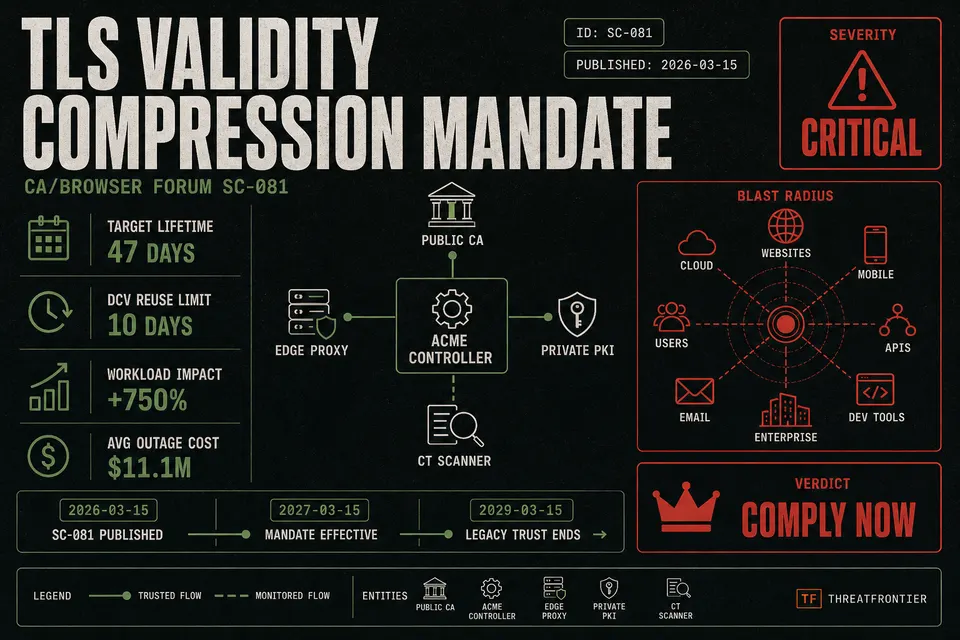
Prepare for the CA/B Forum mandate reducing TLS validity to 47 days. Learn how to automate certificate lifecycle management with our step-by-step ACME guide.
Public key infrastructure is facing its most aggressive operational shift in a decade. Under CA/Browser Forum Ballot SC-081, the maximum validity period for public TLS certificates will drop from 398 days to just 47 days by March 2029, accompanied by a strict 10-day limit for Domain Control Validation (DCV) data reuse.
This transition renders manual certificate management mathematically unsustainable. Engineering teams must transition from spreadsheet tracking and calendar reminders to fully automated, zero-touch certificate lifecycle management. Implementing the Automated Certificate Management Environment (ACME) protocol across hybrid infrastructure—spanning cloud-native clusters, legacy load balancers, and isolated private PKI environments—is now a critical operational requirement.
Regulatory Mandate: Phase-Down to 47-Day Lifespans
The CA/Browser Forum phase-down timeline compresses certificate lifespans across three distinct enforcement phases, effective every March 15 through 2029.
The mandate separates certificate lifespan from domain validation reuse. While certificate validity decreases in stepped intervals, the underlying DCV window drops to 10 days in the final phase. Organizations cannot rely on long-lived domain validation assertions to issue short-lived certificates; domain ownership must be programmatically re-proven every ten days.
| Enforcement Date | Maximum Certificate Lifetime | Domain Control Validation (DCV) Reuse | Subject Identity Information (SII) Reuse |
|---|---|---|---|
| Current Standard | 398 days | 398 days | 825 days |
| March 15, 2026 | 200 days | 200 days | 398 days |
| March 15, 2027 | 100 days | 100 days | 398 days |
| March 15, 2029 | 47 days | 10 days | 398 days |
Shortened validity windows dramatically reduce the exposure window of compromised private keys. That's the same logic driving the broader shift toward ephemeral, short-lived credentials over static API keys. However, the compression of validation reuse windows forces an immediate structural redesign of enterprise domain validation mechanisms.
Operational Risk: Calculating Outage Costs and Renewal Frequency
Reducing certificate validity from 398 days to 47 days represents an 8.5-fold increase in annual renewal frequency, translating to a 750% increase in operational workload for PKI engineering teams. For an enterprise managing 10,000 active TLS certificates, manual management requires processing approximately 212 certificate renewals every day (over 1,490 renewals per week).
At this volume, human-in-the-loop models fail statistically. Spreadsheet tracking systems inevitably miss expirations, triggering severe outages. Industry data places the average unplanned certificate expiry outage cost at $11.1 million, with complex enterprise recovery efforts exceeding $15 million.
A single expired certificate in core management software can disconnect millions of subscribers across major telecom networks. Beyond downtime, expired certificates break API integrations, halt CI/CD pipelines, and incentivize dangerous security bypasses during emergency recoveries.
Architecture Blueprint: Deploying ACME, EST, and SCEP
Achieving zero-touch renewal requires matching the correct automation protocol to specific operational trust domains. The same automation discipline applies to the coming cryptographic transition covered in the post-quantum migration blueprint for NIST FIPS 203–205. Public-facing endpoints and internal enterprise workloads demand distinct architectural strategies.
| Attribute | ACME (RFC 8555) | EST (RFC 7030) | SCEP |
|---|---|---|---|
| Primary Target | Public Web, Edge Proxies, K8s | Enterprise Devices, Private PKI | Legacy Workloads, IoT Devices |
| Authentication Model | Challenge-based (HTTP/DNS) | Existing mTLS Client Certificate | Pre-Shared Key (PSK) / Secret |
| Wildcard Support | Yes (via DNS-01 challenge) | No (Device-centric enrollment) | No |
| Automation Fitness | Native, zero-touch | Requires bootstrapping cert | Manual re-enrollment bottlenecks |
| Multi-CA Portability | High (Open standard) | Vendor/PKI-dependent | High vendor lock-in risk |
For public-facing applications, ACME (RFC 8555) is the standard protocol, using programmatic challenge-response mechanisms to verify domain control without manual intervention.
For internal environments where public domain validation is impossible, platform engineers should deploy Enrollment over Secure Transport (EST) or run a private ACME server instance (such as step-ca) connected to an internal Corporate Authority. EST leverages mutual TLS (mTLS) for authentication, bypassing public domain challenge requirements. Misconfigured internal certificate authorities carry their own risk, as shown by a HashiCorp Vault flaw that let SSH certificates grant root access.
Solving Edge Cases: Legacy Appliances and Isolated Networks
While cloud-native environments run cert-manager inside Kubernetes seamlessly, legacy Application Delivery Controllers (ADCs) and internal networks isolated from port 80 require specialized handling.
1. Hardware ADCs (F5 BIG-IP / Citrix NetScaler)
Restricted hardware appliances often prevent running native ACME binaries on their management plane. Teams must implement custom automation scripts or out-of-band proxy control planes.
#!/usr/bin/env bash
# Production ACME Deployment for F5 BIG-IP (dehydrated integration)
DOMAIN="app.example.com"
CERT_DIR="/config/ssl/ssl.crt/${DOMAIN}"
KEY_DIR="/config/ssl/ssl.key/${DOMAIN}"

/shared/acme/dehydrated --cron --domain "${DOMAIN}" --challenge http-01 --config /shared/acme/config

tmsh install sys crypto cert "${DOMAIN}_cert" from-local-file "${CERT_DIR}/fullchain.pem"
tmsh install sys crypto key "${DOMAIN}_key" from-local-file "${KEY_DIR}/privkey.pem"
tmsh modify client-ssl "clientssl_${DOMAIN}" cert "${DOMAIN}_cert" key "${DOMAIN}_key"
tmsh save sys config
For appliances restricting local execution (such as Citrix NetScaler ADC), a central orchestrator executes the ACME transaction externally and pushes certificate bundles via REST APIs (e.g., Citrix Nitro API).
2. Internal Services & Wildcards (DNS-01 CNAME Delegation)
HTTP-01 validation requires public port 80 reachability, rendering it unusable for internal subdomains or wildcard certificates.
To overcome this, deploy DNS-01 validation with CNAME delegation. Delegating individual challenge subdomains to an isolated DNS server avoids granting application nodes write permissions to primary DNS zones.
apiVersion: cert-manager.io/v1
kind: ClusterIssuer
metadata:
 name: acme-dns01-issuer
spec:
 acme:
 email: pki-admin@example.com
 server: https://acme-v02.api.letsencrypt.org/directory
 privateKeySecretRef:
 name: acme-issuer-account-key
 solvers:
 - dns01:
 rfc2136:
 nameserver: "192.168.100.53:53"
 tsigSecret:
 name: tsig-secret
 tsigAlgorithm: HMACSHA512
 tsigKeyName: "acme-zone-key"
Security Mandate: Never store primary DNS provider credentials on application nodes. Delegate
_acme-challenge.subdomain.example.comvia CNAME to an isolated challenge zone to restrict compromised node impact.
Continuous PKI Auditing and CT Discovery
Automation is incomplete if unmapped "shadow" TLS certificates persist across enterprise subnets. Comprehensive PKI management requires continuous external and internal discovery.
Teams should query public Certificate Transparency (CT) logs to detect rogue subdomains created outside deployment pipelines:
curl -s "https://crt.sh/?q=%.example.com&output=json" | jq -r '.[].name_value' | sort -u | grep -v '\*'
Because private CA certificates are excluded from public CT logs, internal networks require automated subnet scanning across port 443.
Monitoring Rule: Recalibrate alert thresholds. Under a 47-day validity cycle, traditional 30-day expiration warnings trigger immediately after issuance. Monitoring systems must flag renewal failures if certificates fail to rotate by day 25.
Strategic Implementation Roadmap
Organizations must approach the 47-day mandate as a structured, phased migration: It follows a similar phased-deadline pattern to the FIPS 140-2 sunset migration to FIPS 140-3.
- Audit and Inventory: Deploy CT log monitoring and subnet scanners to establish a unified certificate inventory.
- Standardize Protocol Pipelines: Standardize cloud workloads on ACME via
cert-managerand deploy API push pipelines for hardware load balancers. - Isolate DNS Access: Implement CNAME delegation for DNS-01 challenges to protect authoritative DNS infrastructure.
- Enforce Policy Gates: Block manual certificate uploads in production, forcing workloads onto automated pipelines well ahead of the March 2029 deadline. Enterprises are absorbing several such compliance deadlines at once, including the Cyber Resilience Act's Article 14 reporting mandate.