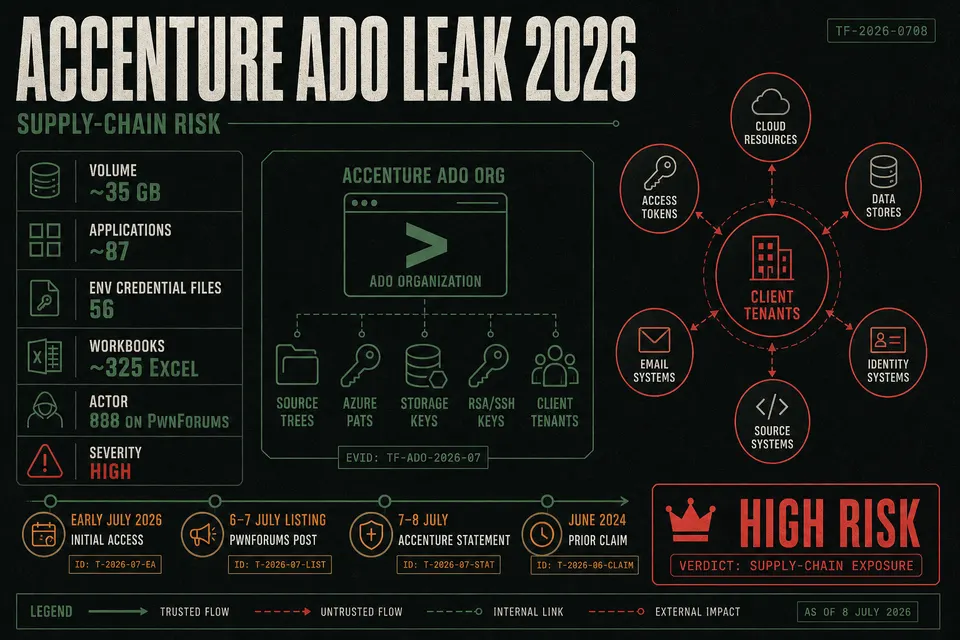
Accenture confirms an isolated Azure DevOps breach after 35GB of source code, PATs, keys and credentials were listed for sale—raising major supply-chain risk for clients.
A threat actor advertising roughly 35 GB of material stolen from a private Accenture Azure DevOps organization has forced the consulting giant to acknowledge an “isolated” security incident. The listing, posted in early July 2026 on PwnForums by the handle “888,” claimed source code, RSA and SSH keys, Azure Personal Access Tokens, Azure Storage access keys, and configuration files taken from an accenture.com-linked production environment. Accenture confirmed awareness of the matter, said it had remediated the source, and asserted no impact on operations or service delivery—while declining to confirm volume, artifact classes, client impact, or the initial access path.
Timeline and Confirmed Facts
In early July 2026 the actor claimed intrusion and exfiltration of “just over 35gb of source codes.” Around 6–7 July a PwnForums listing appeared with a screenshot consistent with cloning a private Azure DevOps repository under an accenture.com domain, plus a large directory listing offered as proof. Independent review of the recursive directory listing (≈250 MB, 6.17M+ lines) enumerated roughly 87 applications, 56 environment-specific credential files, client-branded folders, TLS artifacts for *.accenture.com hosts, and hundreds of Excel, CSV, and JSON files containing names, emails, and roles.
By 7–8 July Accenture told multiple outlets it was “aware of this isolated matter” and had “remediated its source,” with “no impact to Accenture operations and service delivery.” The firm has not confirmed the 35 GB figure, whether PATs or storage keys remained live, personal-data exposure, sale completion, or any client notifications. As of mid-July the public record still lacks a post-mortem, detailed IOCs beyond the domain, or named clients.
The same handle previously advertised Accenture-linked employee data in June 2024; Accenture said only three individuals were real. Accenture’s history also includes 2017 unsecured AWS S3 buckets and a 2021 LockBit ransomware claim that was contained—underscoring that large professional-services firms remain high-value targets sitting close to client code and identity planes. Third-party suppliers create the same exposure in critical infrastructure, as shown by the Kudankulam nuclear plant data leak.
What Is Known—and Unknown—About the Compromise Path
Public evidence stops at successful access to private Azure DevOps content containing high-value secrets. Confirmed observables include the accenture.com production-style URL, a private-repo clone screenshot, and the independently reviewed directory tree matching project naming. Claimed and listing-supported artifact classes include source trees, RSA/SSH keys, Azure PATs, Azure Storage access keys, .env.production / .env.development / .env.staging files, SQL dumps, admin-account material, TLS certs and CSRs, and spreadsheets with identity-adjacent data. Scale markers from the tree include ~87 applications, 56 with environment credential files, and roughly 325 Excel workbooks plus additional datasets.
Critical gaps remain. Accenture has not disclosed the initial access vector—no public evidence of phishing, PAT theft, OAuth abuse, compromised developer workstation, CI/CD runner takeover, misconfigured public project, or zero-day. A comparable CI/CD compromise turned a trusted scanner into a secret-stealing supply-chain threat earlier in 2026. Privilege escalation and lateral movement paths are likewise undisclosed. The heavy presence of committed .env and credential files suggests either poor secret hygiene inside source trees or exfiltration from a developer workspace rather than a clean, secret-scanned remote clone. Whether tokens and keys remain valid after remediation is unknown.
Analyst mappings to MITRE ATT&CK techniques such as data from cloud storage objects, unsecured credentials in files, and exfiltration are reasonable inferences for the observed theft, not a verified kill chain. Organizations should treat the incident as confirmed access and exfiltration of private ADO content while refusing to invent an unproven intrusion path.
Mapping Leaked Assets to Downstream Client Exposure
| Artifact class | Reuse path against client tenants | Residual-risk signal |
|---|---|---|
| Source code + configs | Logic review, hardcoded secrets, vuln discovery, reverse-engineering of client customizations | Client-branded folders; SaaS/CDN integration references |
| Azure PATs | Clone repos, read/write pipelines, pull variable-group secrets, trigger builds | Org- or project-level scopes (Code/Build/Release) |
| Azure Storage access keys | Direct read/write of blobs, artifacts, backups, data lakes | Keys inside .env or variable groups |
| RSA / SSH keys | Access to build agents, jump hosts, Git remotes, deployment targets | Keys committed or present in agent config |
| Variable groups / pipeline secrets | Credential stuffing into client Azure/Entra, databases, third-party APIs | .env.* and admin files in tree |
| Service connections / service principals | Reconstructable SP access into client subscriptions if present | Scopes not publicly visible |
| SQL dumps / role files / PII-adjacent spreadsheets | Credential stuffing, social engineering, regulatory exposure | Personal-data indicators |
Any client whose projects, code, or shared service principals lived inside Accenture-managed Azure DevOps organizations—especially those whose branded application folders appear in the tree—faces elevated residual risk until credentials are proven rotated and scopes audited. Cascading impact hinges on whether PATs, storage keys, and co-located client secrets remained valid after Accenture’s remediation. No public named client list exists.
Control-Plane Gaps and Shared Responsibility
Accenture has published no post-mortem and confirmed no specific control failures. Observable gaps include ineffective or missing secret scanning (large numbers of committed .env and key files), insufficient least-privilege and lifetime policies on PATs and storage keys that enabled bulk clone, and multi-tenant isolation practices that co-located client-branded work inside provider ADO trees.
Clients that outsource development or platform work retain residual risk for their own secrets, service principals, and data even when the provider “owns” the ADO organization. Contractual right-to-audit and continuous third-party risk monitoring become the practical levers when technical isolation is incomplete.
72-Hour Playbook for Client Security Teams
Treat the following as precautionary until Accenture confirms non-inclusion for your environment.
Hours 0–24 — Assume credential compromise
Inventory every Azure DevOps org/project, PAT, service connection, service principal, managed identity, and Storage account that Accenture or Accenture-managed identities can touch. Immediately revoke and rotate PATs associated with Accenture work, Azure Storage account keys, RSA/SSH keys used in pipelines or agents, and any client secrets stored in Accenture variable groups or .env files. Force rotation of shared Entra ID app registrations, client secrets, and certificates. Disable or tightly re-scope remaining service connections. Engage the Accenture account team in writing for confirmation whether your code, projects, or credentials appear in the exposed set and for the timeline of token invalidation.
Hours 24–48 — Detect and contain Hunt Entra ID sign-in and audit logs, ADO audit streams, Storage analytics, and CI/CD agent logs for anomalous PAT usage, clone-volume spikes, unknown IPs/geos, new service connections, pipeline definition changes, and agent registration. Review branch protection, pipeline permissions, and “Allow scripts to access OAuth token” settings. Scan your own repos and artifact stores for secrets that may have been pushed to or pulled from Accenture. If client-branded code or data may be present, prepare legal, communications, and regulatory notification analysis under applicable GDPR, CCPA, or sector rules.
Hours 48–72 — Harden and document
Enforce short-lived, scoped PATs or, preferably, workload identity federation / OIDC; ban long-lived production PATs. Mandate pre-commit and pipeline secret scanning that blocks on high-severity findings and prohibit .env files in source. Apply Conditional Access, compliant-device requirements, and phishing-resistant MFA to all ADO and Entra identities used by vendors. Snapshot evidence—logs, rotation tickets, Accenture correspondence—for insurers, regulators, and the board. Update the incident ticket with residual risk score and a board-ready one-pager.
No product patch applies; response is identity, configuration, and supply-chain driven.
Implications for TPRM and Contracts
Enterprises should reclassify provider-side Azure DevOps, GitHub, or GitLab organizations as tier-0 attack surface equivalent to production identity. The same tier-0 treatment applies to third-party data exchange portals after the Stadler Rail breach. Continuous evidence requirements should cover secret-scanning coverage, PAT and service-connection inventory and lifetime, Conditional Access policies for vendor identities, and multi-tenant isolation design. Demand named client isolation—separate ADO orgs or strong project-plus-RBAC boundaries—and prohibit co-mingling of client secrets in shared trees. Add a scenario-based tabletop: “Provider ADO fully cloned—what is our 72-hour runbook?”
Contract language needs explicit right to audit DevOps security controls beyond SOC 2 Type II summaries; mandatory 24–72-hour breach notification that states whether the client’s assets or credentials appear in any dump; right to force credential rotation and to obtain redacted directory listings or hash lists for matching; and liability alignment for supply-chain credential reuse. EU financial-sector boards now face personal liability for exactly these gaps under DORA's board liability audits.
The July 2026 Accenture Azure DevOps incident leaves clients with a clear operational imperative: treat every shared credential and co-located secret as potentially exposed until proven otherwise, inventory vendor access with the same rigor applied to production identity, and rewrite contracts so provider “isolated matter” language no longer leaves residual risk unmeasured.