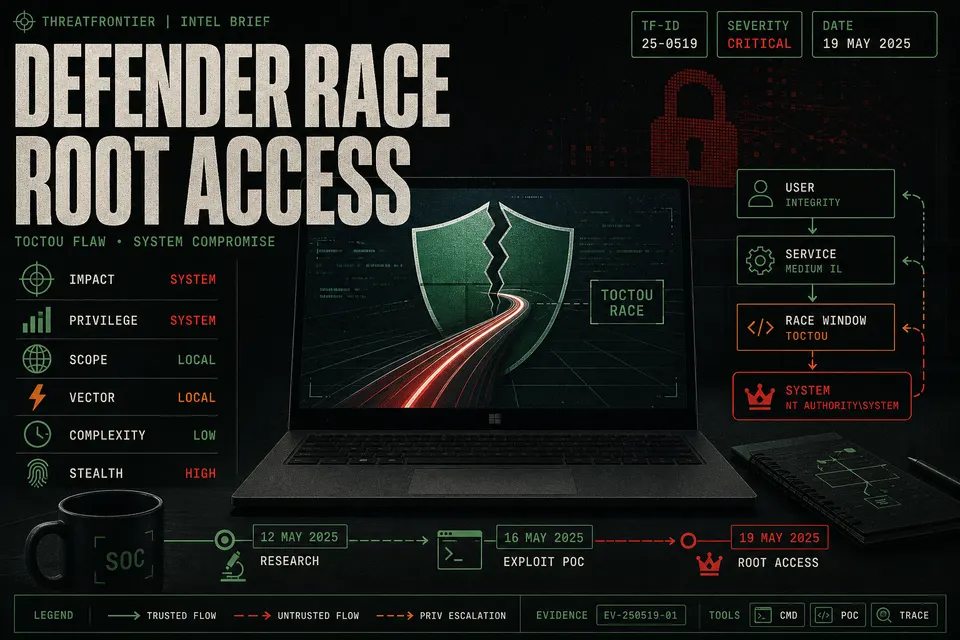
BlueHammer is a time-of-check to time-of-use race, not memory corruption. Estates below Antimalware Platform 4.18.26030.3011 face an operational deadline.
In April 2026, CISA elevated CVE-2026-33825—the BlueHammer local privilege escalation in Microsoft Defender—into its Known Exploited Vulnerabilities catalog, later flagging confirmed ransomware campaign use. A low-privilege local user can race Defender’s update and remediation workflows, freeze the engine mid-operation, redirect privileged file access, and land NT AUTHORITY\SYSTEM. From there, operators dump credentials, starve definition updates, and clear the path for encryption. Estates still running Microsoft Defender Antimalware Platform before 4.18.26030.3011 face an operational deadline, not abstract risk.
How the Race Turns Defender Into the Elevator
BlueHammer is not classic kernel memory corruption. It is a time-of-check to time-of-use (TOCTOU) design flaw that chains legitimate Windows features—Volume Shadow Copy Service, Cloud Files callbacks, opportunistic locks (oplocks), NTFS junctions, and Defender’s own privileged I/O—into a SYSTEM foothold. Microsoft’s formal description is abstract: insufficient granularity of access control (CWE-1220). Independent analyses fill in the concrete chain.
An attacker stages or forces a Defender definition/update path, then baits scan or remediation so Defender creates a VSS snapshot exposing hive material locked on the live volume. Batch oplocks (for example on RstrtMgr.dll or staged definition content) mark when the engine is “in the window.” A fake Cloud Files sync root and placeholder freeze MsMpEng / WinDefend on a callback, holding the snapshot open. The later ShieldCrash Defender zero-day abused the same Cloud Files callbacks to read arbitrary files as SYSTEM. NTFS junctions and Object Manager symbolic links then redirect the path Defender expects so a trusted SYSTEM read or write lands on the attacker’s target—classically SAM material inside the shadow copy, or protected System32 paths in closely related remediation-race variants. Offline-style SAM parsing, a temporary password change (a known PoC string is $PWNed666!!!WDFAIL), token manipulation, and a short-lived GUID-named service complete elevation; the original hash is often restored to reduce noise.
The same researcher alias—Chaotic Eclipse / Nightmare-Eclipse—released related tools RedSun (another LPE path) and UnDefend (definition degradation). Treat BlueHammer as the named CVE and the broader toolkit as a composable technique set.
Timeline, Wild Exploitation, and the Kill Chain
| Date (2026) | Event |
|---|---|
| ~2–3 Apr | Public BlueHammer PoC (uncoordinated disclosure) |
| 14 Apr | Microsoft Patch Tuesday publishes CVE-2026-33825 and ships the fix |
| Mid-Apr | Huntress sees Nightmare-Eclipse tooling in customer intrusions, including pre-patch use |
| 22 Apr | CISA adds CVE-2026-33825 to KEV (FCEB due 6 May 2026) |
| Later | KEV entry updated for ransomware campaign use; named family not public |
Huntress cases were hands-on-keyboard, not mass PoC spray: whoami /priv recon, staging in user-writable paths (Pictures, short Downloads folders; names such as FunnyApp.exe, RedSun.exe, or z.exe), elevation via BlueHammer or RedSun, then credential abuse and tunneling. One environment showed suspicious FortiGate SSL VPN access from a Russia-geolocated source before endpoint activity. After SYSTEM, operators dump or reuse credentials, create services, optionally starve definitions, move laterally, and proceed to impact.
CISA’s ransomware flag is high-confidence at the agency-catalog level; public attribution to a specific brand is not established. Reporting has noted it remains unclear which ransomware group is chaining the flaw. For SOCs, BlueHammer is a post-compromise accelerator that turns a mundane user foothold into full host control before encryption. On-prem collaboration software saw the same accelerator pattern days later, when SharePoint's missing-authentication zero-day was chained into RCE and IIS key theft.
Who Is Exposed
| Item | Detail |
|---|---|
| CVE | CVE-2026-33825 (BlueHammer) |
| CVSS 3.1 | 7.8 HIGH — AV:L/AC:L/PR:L/UI:N/S:U/C:H/I:H/A:H |
| CWE | CWE-1220 (analysts also map TOCTOU / CWE-367) |
| Affected | Microsoft Defender Antimalware Platform before 4.18.26030.3011; supported Windows 10/11 and Server 2016/2019/2022/2025 estates shipping that platform |
| Fixed floor | Platform ≥ 4.18.26030.3011 |
| Public exploit window before patch | ~11–12 days; Huntress confirms pre-patch exploitation |
| KEV | Added 22 Apr 2026; FCEB due 6 May 2026 |
Classic PoC needs real-time protection, a standard local user, often a definition-version gap, and no admin rights to start. Pre-public zero-day duration is unknown. Pre-public exploitation windows have proven costly elsewhere too: the cPanel authentication bypass that fueled a global ransomware wave ran undetected for roughly two months before disclosure.
Detection Signals That Matter
Signature hits on the original binary (Exploit:Win32/DfndrPEBluHmr.BB) are easy to evade. Prioritize behavioral signals:
| Signal | Why it matters |
|---|---|
Unexpected Cloud Files sync root / SyncRootManager entries by non-provider processes | Freeze primitive; under-monitored |
Exclusive / batch oplocks on RstrtMgr.dll or definition .vdm files | Race synchronization |
Non-LSASS load of samlib.dll / rapid password change → logon → restore | PoC finisher and self-clean |
| Short-lived GUID-named temporary services | SYSTEM service stage |
| Junctions / Object Manager links redirecting update or System32 paths | Path swap |
Staging under %USERPROFILE%\Pictures or short Downloads paths | Delivery hygiene |
Public packs such as BlueHammerFix (Sigma/YARA covering samlib loads, password restore, junctions, temp services, oplocks, Cloud Files abuse, LSA boot-key access, and Defender update RPC) give a ready starting set. EDR/ETW depth for oplocks, junctions, and Cloud Files is mandatory; pure AV is not enough. NDR and identity baselines help when the endpoint agent itself is the target.
Patch Status and Compensating Controls
Microsoft shipped the security update for CVE-2026-33825 on 14 April 2026. The hard floor is Defender Antimalware Platform ≥ 4.18.26030.3011. CISA’s KEV required action follows standard vendor-mitigation language under BOD 22-01 for FCEB; all organizations should prioritize the same. Microsoft advisory language emphasized that exploitation is “more likely”; Huntress and CISA supply the stronger public confirmation of active use.
The April fix closes the BlueHammer path tracked as CVE-2026-33825. Related public techniques (RedSun, UnDefend) and composable primitives were still relevant in mid-to-late April reporting—patch the CVE, then keep hunting the class of behavior. Signature detection of one PoC is not a class fix.
Three must-dos first:
- Inventory and force Defender platform plus OS cumulatives to ≥ 4.18.26030.3011 fleet-wide; verify versions.
- Application control (WDAC/AppLocker enforcement) blocking unsigned execution from TEMP, Downloads, and user-profile paths—the strongest non-patch break of PoC delivery.
- Behavioral hunt and EDR tuning for Cloud Files anomalies, GUID services, samlib/password-restore, and junction abuse.
Also keep Tamper Protection on, tighten definition cadence (for example every 4–8 hours), hunt historical SyncRootManager and PoC-path artifacts plus VPN anomalies matching Huntress-style access, monitor definition age independently of the agent, and treat confirmed LPE as isolate-and-rotate: services created in the window, credential artifacts, then tabletop the LPE → defense-disable → ransomware sequence.
Architecture Lesson: The Agent Is Attack Surface
When the security agent runs as SYSTEM and performs trusted file operations against update and remediation paths, a race in that trust boundary becomes a privilege-escalation API for anyone who already has a local foothold. That foothold increasingly starts with a stolen password rather than an exploit: compromised credentials have overtaken vulnerabilities as ransomware's leading entry point in recent incident-response data. “Defender is on” is not control-plane hygiene against modern post-compromise playbooks.
Patch the version floor. Enforce application control. Instrument Cloud Files, junctions, temporary services, and credential-finisher behavior. Keep visibility that does not depend on endpoint-agent integrity alone. Defender's own fix for a separate flaw needed a second look too, after ShieldCrash bypassed the ShieldBreak patch to read arbitrary SYSTEM files via a similar TOCTOU race. CISA’s KEV listing—and the later ransomware note—make official what responders saw in April: once BlueHammer or its cousins run, Defender is no longer the door guard. It is the door.