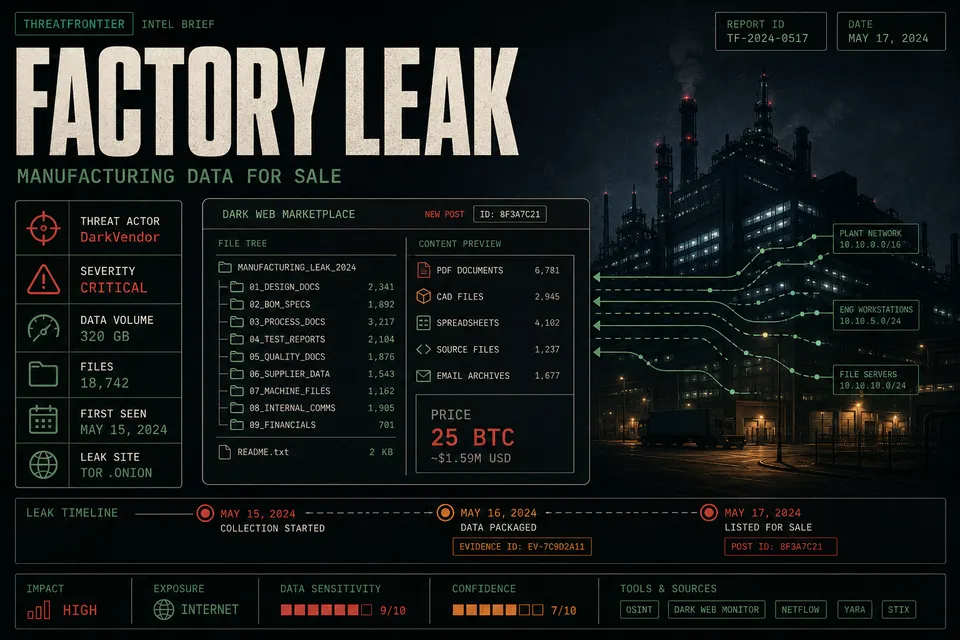
Tata said production was unaffected, but the 630GB dump shows pure-extortion crews extracting leverage from contract manufacturers instead of encrypting them.
Tata Electronics confirmed a June 2026 cybersecurity incident after pure-extortion group World Leaks published roughly 204,000 files (~630 GB) allegedly containing Apple and Tesla manufacturing material. The company said production was unaffected; researchers said the dump was live from at least June 10.
Tata Electronics Private Limited, a core Indian partner assembling iPhones and supplying Tesla parts, publicly acknowledged the breach on June 22 after detecting the intrusion “a few weeks” earlier and activating response protocols. Manufacturing operations across businesses remained unaffected, the company said. World Leaks—a rebrand of the former Hunters International ransomware operation that shifted to data-only extortion in 2025—posted the corpus on its dark-web leak site. Tata declined to discuss any ransom demand; a source familiar with the matter said one was received. Wire services repeatedly noted they could not independently verify the entire dump.
What Was Leaked and How It Reached the Dark Web
Independent researchers reviewing samples described a mix of high-value client engineering material and corporate records. Apple-linked folders carried titles such as com.apple.factorydata and material-specification papers. Among them was a 52-page quality-inspection standard for iPhone circuit-board components that carried proprietary Apple footers. Dozens of files referenced the Hosur plant in Tamil Nadu, Tata’s main iPhone assembly site.
Secondary analysis of samples pointed to drop-test criteria, battery and camera component details, board layouts, color options, and packaging or processor-related material tied to unreleased Pro models. Primary wire reporting remained more cautious, describing “purported” design and specification papers.
Tesla material included a folder labeled “NV36 Chargeport Controller – North America” and a 2023 document marked “TRADE SECRET” containing drawings for Project Highland, the internal codename for the Model 3 refresh, plus manufacturing and assembly specifications. The dump also held purported TSMC reliability-test material marked “Secret,” an Apple Silicon Engineering Group part-number mapping, and Qualcomm mechanical and power-management IC documents watermarked as confidential trade secrets. Corporate holdings ranged across multi-year event logs, Outlook mailboxes, SAP-associated data, and passport copies of employees, including foreign nationals.
The exact initial access vector remains undisclosed. Analytical reconstructions with medium confidence point to spear-phishing or exploitation of edge appliances such as VPN or firewall gateways, followed by living-off-the-land reconnaissance, multi-week dwell, and bulk exfiltration from email gateways, ERP stores, and engineering file shares. No evidence has emerged of encryptors, Manufacturing Execution System compromise, or production-line stoppage. World Leaks simply published the data and applied extortion pressure. Data-only extortion can also target individuals, as in the Vastaamo patient extortion case. Once material sits on a leak site, payment cannot recall public copies. Content should be treated as alleged and sample-reviewed.
Consequences for Apple, Tesla, and the Broader Client Ecosystem
Hardware intellectual property does not behave like software. Schematics, quality standards, bills of materials, supplier maps, and process tolerances cannot be “patched” or rotated into oblivion. Exposure accelerates competitor reverse-engineering, counterfeit matching, and supply-chain mapping.
Multi-OEM co-location turns a single supplier breach into a shared-intelligence event: Apple factorydata, Tesla charge-port drawings, TSMC reliability data, and Qualcomm PMIC details left the same environment together. Manufacturing and test artifacts rarely yield a remote zero-day, yet component tolerances, inspection criteria, and packaging choices inform both counterfeiters and sophisticated hardware attackers. Any certificates or cryptographic material would require rotation.
Contractual and reputational exposure for Tata is real; Apple’s security team engaged in near-term containment and longer-term supplier hardening. Soft official messaging that commercial parameters suffered little loss sits uneasily beside the tech-press framing of a major trade-secret event—both can be partially true when strategic value is high but not immediately monetizable.
The incident fits a pattern. In May 2026 the Nitrogen group claimed multi-terabyte theft from Foxconn facilities that included design-related material tied to Apple and other OEMs. Tier-1 electronics manufacturers have become preferred targets precisely because they aggregate irreversible blueprints that attackers would struggle to extract from hardened OEM cores.
Security Protocols That Appear Weak
Tata’s own post-incident actions supply the clearest evidence of gaps. Before detection, remote access to sensitive internal tools—including purchase-order systems—was more liberal. Afterward the company restricted such access company-wide to select employees, hardened network access from outside facilities, hired a global consultant for a forensic audit, reported to the Indian government and clients, and collaborated with Apple’s security team. Work-from-home continued under tighter gates.
Inferred weaknesses that fit the evidence (but are not proven root causes) include insufficient least-privilege remote access, absent client-program data isolation, immature egress detection capable of missing multi-hundred-gigabyte transfers, and incomplete segmentation between corporate IT stores and design repositories. Identity and edge hygiene failures remain common in World Leaks affiliate campaigns but unconfirmed here. No public admission names a specific CVE, phishing lure, or OT breach. Root cause speculation beyond the available evidence is unwarranted. Across wider incident data, compromised credentials now lead ransomware entry points.
Hardware Manufacturing Versus Software Supply Chains
Hardware IP protection diverges sharply from software. Core artifacts—schematics, layouts, process recipes, quality standards, tooling parameters—are assets whose confidentiality, once lost, is effectively permanent across long product cycles. Software can re-key secrets, rebuild binaries, and ship patches. Aggregation risk concentrates at Tier-1 EMS and ODM partners that hold full OEM blueprints for multiple brands simultaneously. The Kudankulam nuclear supplier data leak showed the same third-party concentration in a shared engineering document store.
Software supply chains weaponize transitive code trust. Hardware supply chains weaponize co-located trade secrets living inside manufacturer corporate IT. Design/PLM systems, shared file stores, vendor portals, and email attachments function as the hardware equivalent of repositories, often with weaker provenance controls than modern software organizations apply to CI pipelines. The Tata dump itself pointed to ERP, email, and engineering directories rather than an npm-style dependency compromise. A software-side example is the Accenture Azure DevOps source code breach.
Actionable Isolation and Control Measures
Companies that place hardware IP at manufacturing partners should implement:
- Client-program data isolation — separate storage, keys, and administrative domains per OEM program so Apple, Tesla, and chip-partner secrets never share a general engineering lake.
- Zero-trust remote access and PAM — default-deny to ERP, purchase-order, and PLM systems with just-in-time privileged sessions.
- Egress DLP and anomaly detection — alert on multi-gigabyte transfers to cloud or SFTP destinations under pure-exfiltration assumptions. The Stadler Rail breach defense blueprint covers DLP for shared CAD files.
- IT–design–OT segmentation — preserve production uptime while protecting CAD and PLM repositories.
- Contractual supply-chain security — right-to-audit, continuous assessment, breach-notification SLAs, and cryptographic-material inventories for every supplier holding factorydata.
- Assume leak permanence — pre-plan certificate rotation, dark-web monitoring, legal-hold processes, and customer notification under regimes such as India’s DPDP Act.
- Reduce secret sprawl — watermarking, classification, and need-to-know distribution of inspection standards and BOMs.
The takeaway for CISOs and supply-chain security managers is blunt. If irreversible hardware IP lives at a manufacturing partner’s corporate IT layer without strict client isolation and egress control, attackers do not need to crack the OEM crown-jewels network. They only need the supplier that already holds the blueprints. The Tata Electronics cyberattack is not an outlier; it is a high-signal illustration of where modern hardware supply-chain risk actually concentrates.