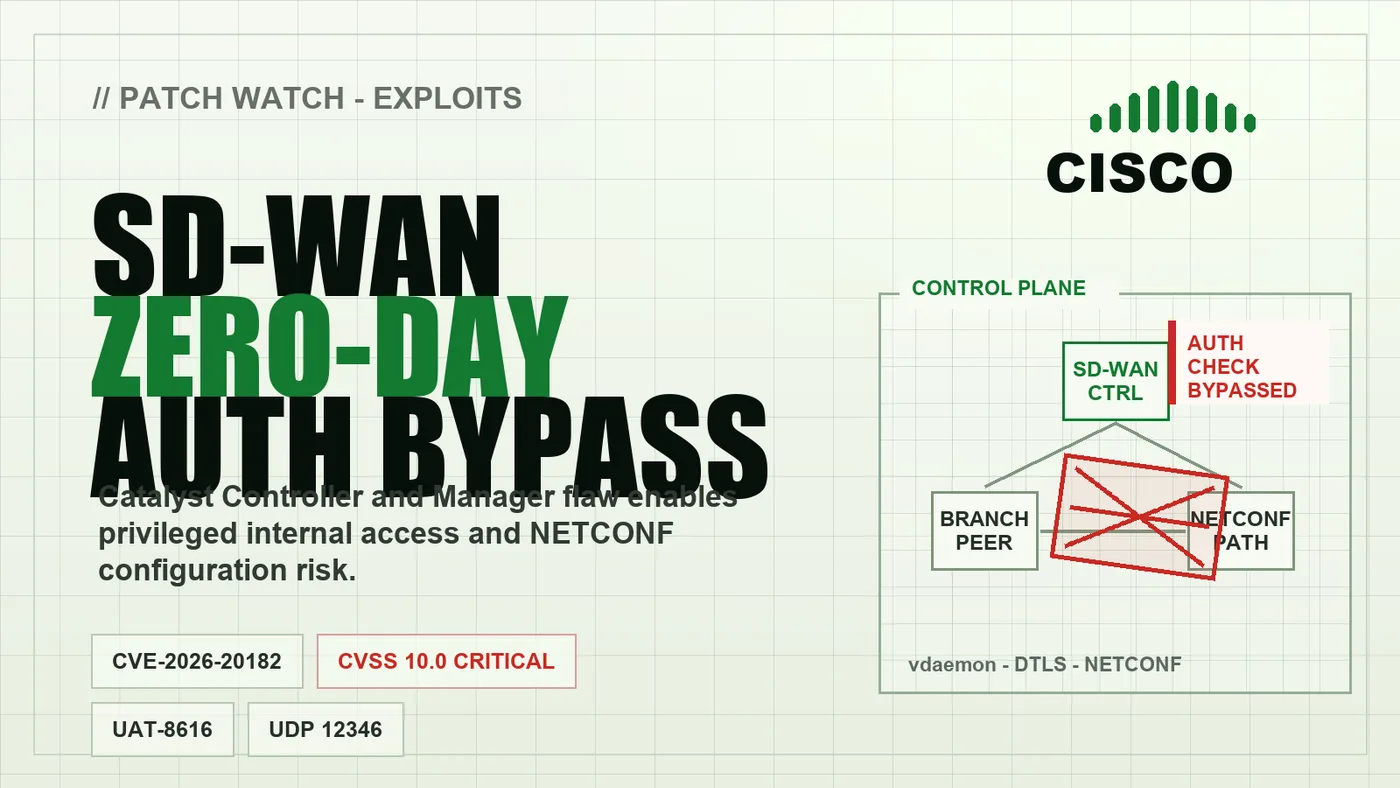
Cisco patched CVE-2026-20182, a critical Catalyst SD-WAN Controller and Manager zero-day that can let remote attackers bypass authentication and manipulate SD-WAN fabric configuration.
Cisco has patched a critical zero-day vulnerability in its Catalyst SD-WAN Controller and Manager after confirming limited exploitation in the wild, warning that the flaw could let remote attackers bypass authentication, reach privileged internal access and manipulate the network fabric.
The vulnerability, tracked as CVE-2026-20182, carries the maximum CVSS 10.0 severity rating and affects Cisco Catalyst SD-WAN Controller, formerly vSmart, and Cisco Catalyst SD-WAN Manager, formerly vManage. Cisco disclosed the flaw on May 14 and said there are no workarounds, making software updates the only full remediation.
Cisco's threat intelligence arm is tracking exploitation of the flaw under the activity cluster UAT-8616, which it assesses as a highly sophisticated cyber threat actor. The company said exploitation of CVE-2026-20182 appears to have been limited so far, but the vulnerability lands amid a broader wave of attacks against Cisco SD-WAN infrastructure involving several earlier flaws and multiple threat clusters.
At its core, CVE-2026-20182 is an authentication-bypass bug in the peering mechanism used by SD-WAN control components. Cisco said an unauthenticated remote attacker could exploit the weakness by sending crafted requests to an affected system. A successful attack could allow the intruder to log in as an internal, high-privileged, non-root user and then access NETCONF, a management protocol that can be used to alter SD-WAN fabric configuration.
That impact makes the flaw more consequential than a simple appliance login bypass. SD-WAN controllers sit at the center of enterprise wide-area networking, distributing control-plane information and enforcing network configuration across branches, cloud connections and data centers. If an attacker can tamper with the control plane, the risk can extend from a single device to the integrity of the routing and configuration fabric. Telecom SD-WAN management systems were also the target when Chinese state hackers exploited a Versa zero-day.
Security researchers who analyzed the flaw said it affects the vdaemon DTLS control-plane service over UDP port 12346, the same service family involved in an earlier exploited SD-WAN vulnerability, CVE-2026-20127. They stressed, however, that CVE-2026-20182 is a separate issue, not a patch bypass of the February vulnerability.
The newly disclosed bug appears to stem from device-type-specific authentication logic in the control-plane handshake. In high-level terms, a malicious peer can claim a device role that falls through expected certificate verification checks and is then treated as authenticated. Once that happens, the attacker can become a trusted control-plane peer and potentially move toward persistent access through SSH key injection and NETCONF access.
Cisco said affected systems include on-premises deployments, Cisco SD-WAN Cloud-Pro, Cisco-managed cloud deployments and Cisco SD-WAN for Government/FedRAMP environments. The flaw affects Catalyst SD-WAN Controller and Manager regardless of device configuration.
The first fixed releases vary by software train. Cisco listed 20.9.9.1 for the 20.9 train, 20.12.7.1 for 20.10 and 20.11, 20.12.5.4, 20.12.6.2 or 20.12.7.1 for 20.12, 20.15.5.2 for 20.13 and 20.14, 20.15.4.4 or 20.15.5.2 for 20.15, 20.18.2.2 for 20.16 and 20.18, and 26.1.1.1 for 26.1. Releases earlier than 20.9 must be migrated to a fixed release. Cisco said the cloud-based Cisco SD-WAN Cloud/Cisco Managed Release 20.15.506 addresses the issue and requires no user action in that specific managed-service case.
The U.S. Cybersecurity and Infrastructure Security Agency added CVE-2026-20182 to its Known Exploited Vulnerabilities catalog on the day of disclosure, citing evidence of active exploitation. The move effectively puts federal agencies and many private-sector security teams on an accelerated remediation footing. Cisco's ISE zero-day CVE-2026-76460 is another CVSS 10.0 flaw in its products to come under active attack.
Cisco Talos said UAT-8616 attempted post-compromise actions after exploiting CVE-2026-20182, including adding SSH keys, modifying NETCONF configurations and escalating privileges to root. Talos also said infrastructure associated with the activity overlaps with Operational Relay Box networks it monitors. State-backed attackers also held root access through the Palo Alto CVE-2026-0300 zero-day for 26 days before disclosure.
The attribution is narrower than the broader SD-WAN exploitation story. Talos has separately reported widespread exploitation of earlier Cisco SD-WAN Manager vulnerabilities -- CVE-2026-20133, CVE-2026-20128 and CVE-2026-20122 -- on unpatched systems after public proof-of-concept code became available in March. Those older flaws are distinct from CVE-2026-20182, though attackers have used them in the same general technology ecosystem.
That broader activity has included webshell deployment and offensive tooling such as Godzilla, Behinder, XenShell, AdaptixC2, Sliver, XMRig, scanning tools and credential-extraction scripts. Ransomware crews have also gone after Cisco management software, as in Interlock's use of the Cisco FMC flaw CVE-2026-20131. In contrast, Cisco's clearest wording for the new zero-day is "limited exploitation," with Talos clustering the observed CVE-2026-20182 activity under UAT-8616.
For defenders, Cisco's guidance begins with evidence preservation. The company advised customers to run request admin-tech on each SD-WAN control component before upgrading, where feasible, so potential forensic artifacts are not lost during remediation. After collecting that data, Cisco said organizations should upgrade at the earliest opportunity.
Cisco also urged customers to examine /var/log/auth.log for entries showing Accepted publickey for vmanage-admin from unknown or unauthorized IP addresses. Administrators should compare suspicious addresses against known SD-WAN system IPs and authorized infrastructure.
Other recommended checks include reviewing control-connection events for unexpected peer types, timestamps, public IP addresses and system IPs. Cisco said administrators can use show control connections detail or show control connections-history detail and investigate cases where a connection shows state: up with challenge-ack: 0, while cautioning that some indicators may also appear during normal operations and require manual validation.
| Item | Detail |
|---|---|
| CVE | CVE-2026-20182 |
| Severity | CVSS 10.0 (Critical) |
| Affected products | Cisco Catalyst SD-WAN Controller and Manager |
| Attack type | Remote unauthenticated authentication bypass |
| Primary impact | NETCONF access and SD-WAN fabric configuration manipulation |
| Exploitation | Limited in-the-wild exploitation confirmed |
| Threat activity | Tracked as UAT-8616 |
| Workaround | None; fixed software required |
The vulnerability adds to a difficult year for organizations running Cisco SD-WAN, where control-plane exposure has become a high-value target for both sophisticated operators and more opportunistic actors. Arista's VeloCloud Orchestrator zero-day CVE-2026-16812 is another CVSS 10.0 flaw in SD-WAN management. The immediate task for network and security teams is clear: preserve evidence where possible, patch affected systems quickly, and hunt for signs that attackers established rogue peering, inserted SSH keys, altered NETCONF configuration or tampered with logs before the fix was applied.