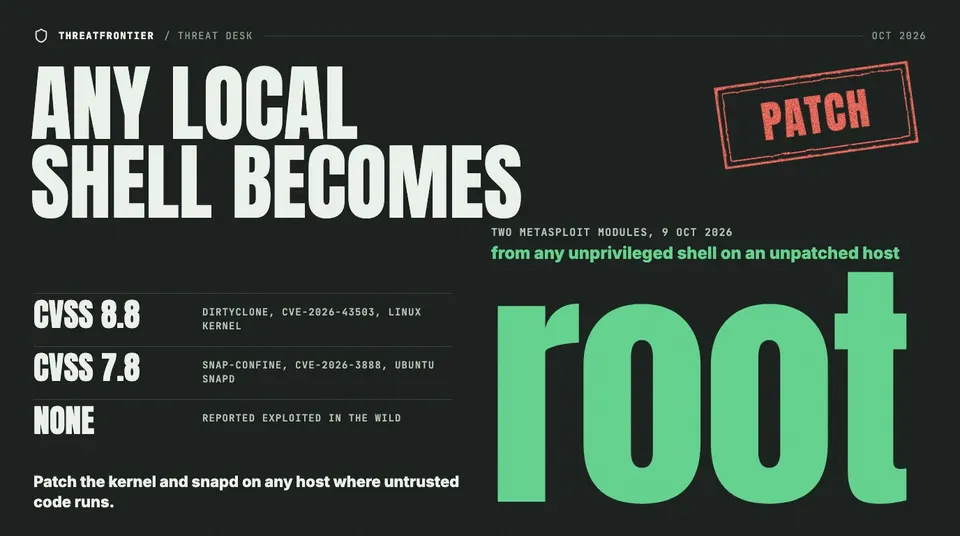
Metasploit now ships modules for DirtyClone (CVE-2026-43503, Linux kernel) and CVE-2026-3888 (Ubuntu snapd). Any local shell on an unpatched host can reach root.
Rapid7 added two local privilege escalation modules to Metasploit Framework in its 9 October 2026 wrap-up: one for DirtyClone (CVE-2026-43503), a Linux kernel flaw, and one for CVE-2026-3888, a race in Ubuntu's snapd. Both turn a shell as an ordinary user into root. With public, point-and-click modules, any foothold on an unpatched host (a web shell, a stolen low-privilege login, a compromised container user) now has a ready route to full control.
What shipped
Rapid7 lists linux/local/dirtyclone_cve_2026_43503 (authors Eddy Tsalolikhin, Or Peles and msutovsky-r7; pull request #21613, contributed by eipoverflow) and linux/local/cve_2026_3888 (authors the Qualys Security Advisory Team and msutovsky-r7; pull request #21532). The post does not state targets or requirements for either module.
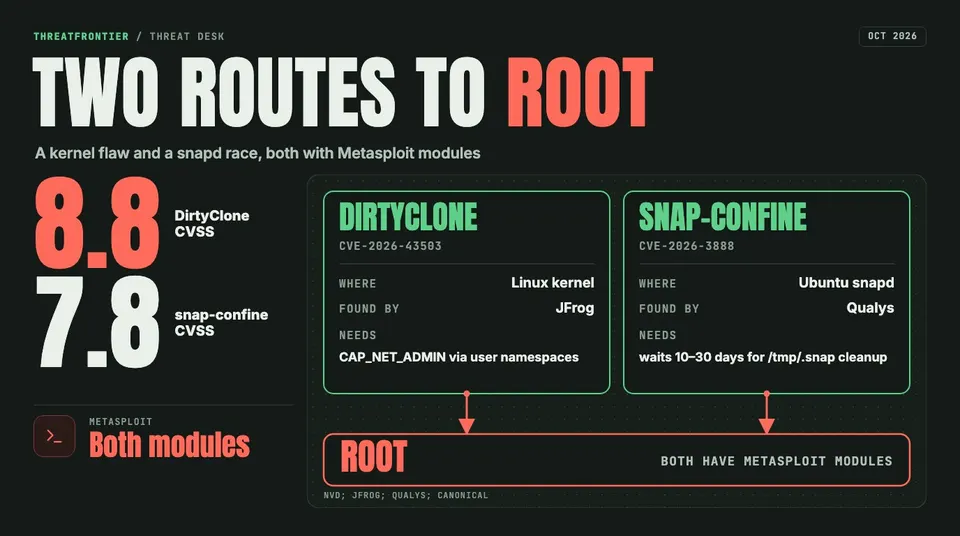
Two routes to root, both now Metasploit modules.
DirtyClone (CVE-2026-43503)
JFrog Security Research, Eddy Tsalolikhin and Or Peles, found the flaw independently on 19 May 2026 and reported it to kernel maintainers. Hyunwoo Kim, who found the original DirtyFrag bug, had filed a broader report on 16 May. The patch was merged into mainline on 21 May, the CVE was published on 23 May, and Linux v7.1-rc5 (24 May) was the first fixed tag. JFrog published its write-up on 25 June 2026 and kept its proof of concept private; it reported no in-the-wild exploitation at that time.
It is the fourth member of the DirtyFrag family (DirtyFrag is CVE-2026-43284 and CVE-2026-43500; Fragnesia is CVE-2026-46300). All make the kernel treat read-only, file-backed page-cache memory as writable network buffers. In DirtyClone, __pskb_copy_fclone() and skb_shift() fail to carry over the SKBFL_SHARED_FRAG flag. An iptables mangle OUTPUT rule with the TEE target duplicates UDP packets to port 4500, and the clone is routed through a loopback ESP configuration, where in-place decryption writes into the page-cache copy of a file such as /usr/bin/su. The file on disk is unchanged, which makes the tampering hard to spot with file-integrity checks.
The attacker needs only a local unprivileged account plus CAP_NET_ADMIN, which unprivileged user namespaces provide (unshare -Urn). JFrog confirmed Debian, Ubuntu and Fedora where those namespaces are enabled, and says RHEL 9 and 10 are affected while RHEL 6 to 8 are not.
NVD lists the kernel as fixed in 5.10.257, 5.15.208, 6.1.174, 6.6.141, 6.12.91, 6.18.33 and 7.0.10 (and 7.1 from rc5). The CVSS 3.1 score is 8.8 (High). JFrog advises confirming the full four-CVE chain is applied, not just this one.
snap-confine (CVE-2026-3888)
Qualys's Threat Research Unit (blog byline Saeed Abbasi) disclosed the bug on 17 March 2026. Canonical is the CNA, and the CVSS 3.1 score is 7.8 (AV:L/AC:H, CWE-268). The attack is slow by design. An attacker waits for systemd-tmpfiles to delete /tmp/.snap (after 30 days on Ubuntu 24.04, 10 days on 25.10), recreates it with malicious files, and on the next sandbox setup snap-confine bind-mounts them as root.
Canonical says default installations of Ubuntu 24.04 LTS and 25.10 are affected; older releases got the same hardening as a precaution. Fixed snapd versions:
| Release | Fixed snapd |
|---|---|
| 16.04 | 2.61.4ubuntu0.16.04.1+esm2 |
| 18.04 | 2.61.4ubuntu0.18.04.1+esm2 |
| 20.04 | 2.67.1+20.04ubuntu1~esm1 |
| 22.04 | 2.73+ubuntu22.04.1 |
| 24.04 | 2.73+ubuntu24.04.2 |
| 25.10 | 2.73+ubuntu25.10.1 |
The first 24.04 build, 2.73+ubuntu24.04.1, shipped a typo in snapd.conf that caused a tmpfiles error; take .2.
What defenders should do
- Patch the kernel to your distribution's build carrying the CVE-2026-43503 fix and the earlier DirtyFrag-family fixes, then reboot.
- Run
dpkg -l snapdon Ubuntu hosts and compare with the table above. - Until patched, DirtyClone can be blunted by disabling unprivileged user namespaces (
kernel.unprivileged_userns_clone=0on Debian/Ubuntu,user.max_user_namespaces=0on Fedora) or blacklistingesp4,esp6andrxrpc. JFrog warns this breaks container runtimes and non-root Chrome and Firefox. - For snapd, Canonical's last-resort mitigation is replacing
/usr/lib/tmpfiles.d/snapd.confwith the advisory's content and restartingsystemd-tmpfiles-clean.service; it can block unattended upgrades until restored. - Prioritise hosts where untrusted users or services already run code: shared servers, CI runners, container hosts, internet-facing apps.