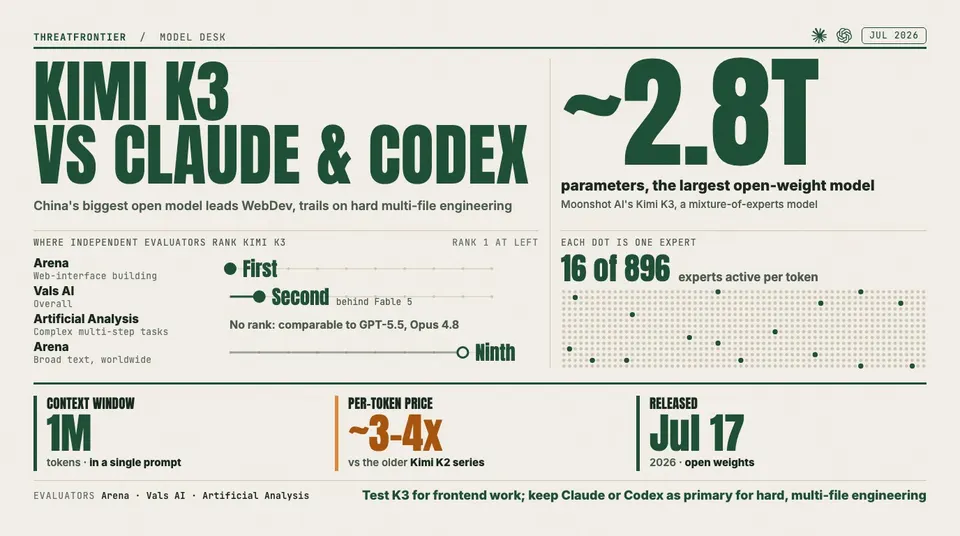
Moonshot AI's Kimi K3, the world's largest open-weight model at 2.8T parameters, tops WebDev benchmarks but can it really replace Claude and Codex? A team-by-team verdict.
Chinese startup Moonshot AI released Kimi K3 on Friday, July 17, 2026, calling it the world's largest open-weight model at roughly 2.8 trillion parameters and the first to approach the 3-trillion mark. The launch reframed a question engineering leaders can no longer defer: is a Chinese frontier model now a credible replacement for the entrenched Western coding assistants—OpenAI's Codex line and Anthropic's Claude—that most teams currently pay for?
The answer is nuanced. On a narrow but commercially important slice of coding—frontend and web development—K3 is genuinely at or near the top. On hard, multi-file software engineering and on day-to-day reliability, the Western incumbents still hold the line. And the compliance calculus for Western enterprises has, if anything, grown more complicated.
What Kimi K3 actually is
Moonshot describes K3 as a long-horizon agent model built for software engineering, reasoning and knowledge work. It uses a Mixture-of-Experts design the company calls Stable LatentMoE, activating 16 of 896 experts per token, alongside two new components: Kimi Delta Attention and Attention Residuals. It ships with a 1 million-token context window—large enough to hold sprawling codebases in a single prompt—and can pair software tasks with visual reasoning for game development, frontend engineering and computer-aided design.
The model is open-weight, with full weights and a technical report slated for July 27, 2026. But "open" does not mean "runnable." Ryan Fedasiuk, a fellow at the American Enterprise Institute, estimated that running a 2.8-trillion-parameter model locally would require hundreds of thousands of dollars of computing equipment. Alibaba's 2.4-trillion-parameter Qwen 3.8-Max raises the same hardware question. In practice, nearly everyone will access K3 through a hosted endpoint—a fact that shapes the entire adoption debate. Self-hosted open-weight alternatives that dodge that dependency are covered in self-hosted open-weight stacks that actually replace ChatGPT.
Notably, Moonshot is candid about its ceiling. While it said K3 "demonstrated frontier-level performance across our evaluation suite," the company conceded that overall performance "still trails the most powerful proprietary models" from Anthropic and OpenAI.
The benchmark reality check
Independent evaluations support a "close, not clearly ahead" reading—with one standout. On Arena, the crowd-comparison platform built by UC Berkeley researchers, K3 topped the coding leaderboard shortly after launch and ranked first specifically for web-interface building—the strongest independent evidence in its favor. Vals AI placed K3 second overall, behind Anthropic's frontier Fable 5 and ahead of GPT-5.6 Sol. Artificial Analysis judged it comparable to OpenAI's GPT-5.5 and Claude Opus 4.8 on complex, multi-step tasks. For a fuller three-way benchmark comparison, see GPT-6 Astra vs Claude Fable 5.1 vs Opus 5.5 on coding tasks. On broad text queries, though, Arena ranked K3 only ninth worldwide—a reminder the model is not uniformly frontier.
Moonshot's own figures follow the pattern. The company claimed K3 "performed competitively with Fable 5 (with fallback) and substantially outperformed Opus 4.8, GPT 5.6 Sol, and GPT 5.5" on GPU kernel optimization—vendor numbers run across mixed harnesses that should be treated as marketing until independently reproduced. Ethan Mollick, a University of Pennsylvania professor, offered a representative practitioner verdict: "Kimi K3 seems really good, closest to the frontier yet," while noting it still "cannot write a good murder mystery (though neither can any other model)."
The honest synthesis: K3 leads on frontend/WebDev, is top-tier on agentic coding, and trails—by Moonshot's own admission—on the hardest real-world software engineering and on production polish.
The pricing question: cheap tool or expensive plan?
Here is the nuance most coverage misses. Moonshot runs two distinct products, and the "cheap Chinese coding tool" narrative applies mainly to the older one. K3 itself is not a budget model. It is priced at the frontier tier, roughly three to four times more expensive per token than the older Kimi K2 series it succeeds—the series that powered Moonshot's affordable "Kimi Code" subscriptions and CLI. The premium K3-era offering targets agencies, enterprises and heavy agentic users, and its economic pitch is cost-per-completed-task, not a cheap rate card.
That pitch has a caveat. K3's reasoning is always on, and independent testers flag it as verbose—generating far more output tokens than peer models on the same evaluations. Because output is the costly side of any API bill, verbosity erodes rate-card savings on long agentic loops. Speed is also middling: Artificial Analysis clocked K3 below the market-average token throughput.
By contrast, the sharpest cost story in Chinese coding models belongs to a rival. Testing by cybersecurity firm Semgrep found Z.ai's open-weight GLM-5.2 scored 39% on the IDOR vulnerability benchmark—beating Claude Opus 4.6 (32%) and Opus 4.8 (28%)—at roughly one-sixth the cost, or about $0.17 per vulnerability found. The lesson for cost-sensitive teams: the cheapest credible option may not be K3 at all. DeepSeek's own agent-benchmark story is worth the same scrutiny; see DeepSeek V4-Flash's agent benchmarks and security playbook.
The switching costs Western teams can't ignore
For engineering leaders, capability is only half the decision. The other half is whether they are allowed—and able—to deploy a Chinese model at all.
Compliance and security top the list. All Chinese models operate under Chinese law requiring alignment with "Core Socialist Values," and studies repeatedly find they refuse or distort politically sensitive prompts far more than Western models. A WIRED investigation of DeepSeek found post-training biases that persist even when application-level filters are bypassed. For regulated, IP-sensitive or government-adjacent work, that alone is often disqualifying.
Procurement risk is real and rising. The Trump administration this year briefly used export-control authority to pull Anthropic's frontier cybersecurity models Fable 5 and Mythos 5 from public access—the first known use of export controls to yank AI software rather than chips—before restoring access to both Fable 5 and Mythos 5 on July 1, 2026, after Anthropic agreed to new safeguards. That episode underscores how fast frontier-AI rules can change. When Anthropic tested the jailbreak at the center of the dispute, the same technique worked against OpenAI's GPT-5.5 and Moonshot's Kimi K2.7—evidence that capability, and risk, is now broadly distributed.
Reliability and lock-in round out the picture. Because self-hosting a 2.8-trillion-parameter model is impractical for nearly everyone, teams fall back to a hosted endpoint—which, for Kimi, re-triggers the data-residency concern. K3's slower throughput and verbosity add latency, and practitioners trialing Chinese models frequently cite opaque rate limits and downtime relative to Claude and Codex.
A moment, or another wave?
The launch drew explicit "DeepSeek moment" comparisons, and the market reacted: shares of Hong Kong-listed rivals Zhipu and MiniMax fell 21.9% and 13.8% intraday, according to Reuters. K3 also follows GLM-5.2, whose strong showing undermined the Western consensus—an edge U.S. officials themselves put at roughly eight months earlier this year—that Chinese models trailed by six months or more.
Yet scale is not supremacy. Omdia chief analyst Lian Jye Su noted Chinese models can run "at a fraction of the cost" of U.S. systems but cautioned that K3's size "doesn't necessarily mean you have the best performance by default." K3 is best read as a wave with one genuinely new peak: Chinese open-weight models are now credibly at the frontier on some coding tasks and on cost-per-task, but K3 itself abandoned the cheap-price advantage, and UX, reliability and hard-SWE gaps remain in a crowded field of GLM, Qwen, DeepSeek and MiniMax.
The verdict, by team type
- Solo developers and startups doing frontend-heavy work, no compliance constraints: Worth adopting as a secondary. K3's Arena WebDev result is the real deal, and a hybrid pattern—cheap model executes, a stronger model reviews—is increasingly common.
- Cost-sensitive, high-volume agentic shops: Test it, but watch verbosity and price. On pure economics, GLM-5.2 and the older K2-series tiers may win.
- Enterprises with data-residency, IP or government-adjacent exposure: Not via a hosted Chinese endpoint, and self-hosting is impractical.
- Defense, critical-infrastructure and contractor teams: Effectively off the table given current U.S. posture.
- Teams needing reliability on hard, multi-file engineering: Keep Claude or Codex as primary. If Claude is that primary, see whether Claude Max is still worth it now.
Kimi K3 proves China's open-weight ecosystem has reached the frontier on real, verifiable axes—and that alone should reshape how teams benchmark their tools. But "at the frontier on some tasks" is not the same as "ready to replace your stack." For most Western engineering organizations this quarter, K3 is a compelling model to test and a difficult one to fully trust—exactly the position a maturing competitor occupies on its way up.