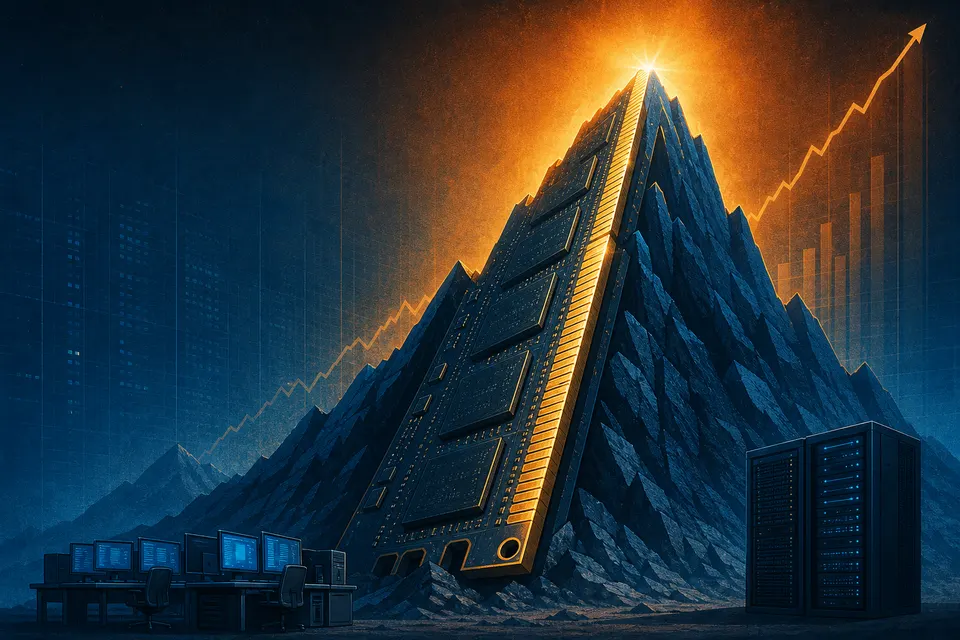
A benchmark 16Gb DDR5 chip went from $6.84 in September 2025 to about $27.20 by December, and retail kits roughly doubled inside a single quarter.
The most expensive component in your next server, laptop, or graphics card isn't the processor. It's the memory — and its price has gone vertical.
DRAM contract prices climbed roughly 171.8% year-over-year in the third quarter of 2025, a rise steep enough to outpace gold. Across the current cycle, aggregate DRAM and NAND pricing has jumped somewhere between 200% and 400%, depending on the segment. The most telling single data point: a benchmark 16Gb DDR5 chip that traded around $6.84 in September 2025 sold for roughly $27.20 by December — close to a 300% move in three months. On the retail shelf, a Corsair Vengeance 2×16GB kit that cost about $91 in July was listed near $183 by November.
This is not the 2020–2023 pandemic chip crunch, which was a supply-chain breakage. This time the factories are running flat out. The problem is where their output is going.
The demand shock is artificial intelligence
The global DRAM market is effectively a three-firm oligopoly — Samsung, SK Hynix, and Micron control an estimated 90–95% of supply. All three are aggressively reallocating wafer capacity toward high-bandwidth memory (HBM), the stacked, high-margin DRAM that feeds AI accelerators. Fab utilization already sits above 90%, leaving almost no slack.
HBM is enormously capacity-hungry. Industry estimates suggest every HBM wafer displaces roughly three wafers' worth of conventional DDR5 — a "3-to-1" rule of thumb that is approximate but directionally consistent with what manufacturers describe. The result is a strict allocation hierarchy:
That leaves consumer and mainstream server buyers fighting over what's left. The underlying reason AI workloads are so memory-hungry in the first place is the bandwidth ceiling our primer on the memory wall in AI training and inference explains. The single largest demand absorber cited in the market is OpenAI's Stargate program, which reached a preliminary arrangement with Samsung and SK Hynix for up to 900,000 DRAM wafers per month — equivalent to roughly 40% of global DRAM output, against total capacity near 2.25 million wafer starts per month in 2025. That figure comes with an important caveat: it was reported as non-binding letters of intent, and some analysts argue the LOIs themselves helped inflate prices before any real purchases cleared. The capital behind that scale is now flowing through securitized debt too, with Nvidia and Wall Street structuring a $500 billion AI compute financing plan.
Other absorbers are concrete. Micron's HBM capacity is fully sold out for calendar 2026 under fixed-price contracts, with the company guiding to roughly 20% bit-shipment growth because it is capacity-constrained. Hyperscaler cloud buildouts from AWS, Google, and Microsoft are pulling server DDR5 forward. The squeeze has spilled into NAND flash, enterprise hard drives, and CPUs.
The memory types under the most pressure, in order: HBM (tightest, sold out), enterprise RDIMM and server DDR5 (hit hardest on price), then consumer DDR5, with legacy DDR4 also squeezed as older process nodes retire.
The pain is already in the P&L
Hardware makers are absorbing a shock they cannot fully pass on. HP reported that memory jumped from 15–18% to about 35% of a PC's bill of materials in a single quarter and warned of a double-digit margin decline. Dell's operations chief, Jeff Clarke, said he had "never witnessed costs escalating at the current pace"; Morgan Stanley cut Dell from Overweight to Underweight. Lenovo's finance chief called the environment "unprecedented" and disclosed inventory running about 50% above normal.
Consumer brands are repricing too. Apple raised prices across several product lines, and its shares slid more than 6% around the news. That matters directly for local AI builds, since our picks for running open-weight models on a 128GB Apple Silicon Mac assume that memory ceiling stays affordable. Micron pulled back from its consumer-facing Crucial brand, and Samsung reportedly paused new DDR5 orders to reset pricing. Gartner and IDC now expect the worldwide PC market to contract 10–11% and smartphones 8–9% in 2026; TrendForce cut its PC forecast from +1.7% to −2.6%.
Supply is coming — but not soon
The producers are spending enormously. Combined Samsung and SK Hynix capital expenditure is running near $500 billion across 2026–27, with longer-range plans cited far higher. That capex race tracks the labs it is meant to feed: Alibaba has already confirmed Qwen 4 training toward a 10-trillion-parameter roadmap, among other frontier pushes. Yet the physics of fab construction are unforgiving: a new memory plant takes three to five years to plan, build, and equip.
| Capacity item | Detail |
|---|---|
| Samsung 1c DRAM (HBM4) | Targeting ~60,000 wafers/month |
| SK Hynix 1c DRAM | Targeting roughly an 8× ramp |
| Micron New York fab | ~$9.3B; production targeted Q3 2028 |
| Broader Micron NY megafab | Pushed to roughly H1 2030 |
| Meaningful new cleanroom capacity | Not before H2 2027, mostly late 2027–2028 |
The implication for buyers is stark: near-term relief cannot come from new bricks and mortar. It has to come from efficiency gains and from reallocating wafers back from HBM to DDR5 — which won't happen while AI memory remains the highest-margin product on the line.
The five-year thesis — and what analysts actually say
The optimistic framing making the rounds is that this is a cyclical shortage that normalizes over roughly a five-year horizon. The evidence supports a more nuanced read.
Manufacturers are strikingly bearish on relief — while acknowledging they have an incentive to talk supply tight. SK Hynix CEO Kwak Noh-jung has called 2027 potentially "the worst year in the industry's history" and suggested the shortage could persist to 2030. Micron CEO Sanjay Mehrotra sees tightness through 2027 with supply gradually improving in 2028. Consultancy Kearney's PERLab likewise points to 2030.
Analysts converge earlier. TrendForce, Sourceability, and IDC broadly see normalization most likely in 2027, worst case into 2028. TrendForce projects the global memory market reaching $1.28 trillion by 2027, and — critically — expects the first meaningful deceleration to appear by the third quarter of 2026, when quarter-on-quarter price gains are forecast to cool to 15–18% from the roughly 90% peaks seen in server-grade memory in late 2025. A widely cited scenario model assigns a 60% probability to a base case in which prices decline from Q3 2026 through mid-2027.
In short: no named analyst frames a clean five-year curve. The base case is peak around 2027, normalization across 2027–2028. The five-year, to-2030 view is the conservative upper bound — the manufacturers' story, not the analysts'.
The lithium analogy: useful, but imperfect
The comparison to lithium is instructive as a pattern, not a prophecy. Battery-grade lithium carbonate spiked to roughly $77,000 per tonne in late 2022 — more than 1,000% above 2020 levels — as EV demand surged and buyers locked in long-term contracts at the top. Then new supply flooded in, demand undershot forecasts, and prices fell about 90% from peak through the end of 2024.
The template rhymes: demand shock, price spike, capacity rush, correction. But the analogy breaks down in three ways that matter to a procurement decision.
- Market structure. DRAM's three-firm oligopoly has a demonstrated history of disciplined capacity restraint — the same producers deliberately cut supply in 2022–23 to lift prices. Lithium's fragmented mining base floods faster. This argues memory stays elevated longer on the way down. (A collusion lawsuit against the three DRAM makers is circulating; treat it as an allegation.)
- Lead time. Idled lithium capacity can restart in months; memory fabs need years and specialized packaging.
- Demand durability. AI compute may be structurally memory-hungry in a way EV demand never quite was — but it carries a unique escape valve. If the DRAM-to-SRAM cost ratio compresses, or memory-compression breakthroughs like Google's reported TurboQuant technique gain traction, AI designs could consume less DRAM per unit of compute. Efficiency gains are demand destruction lithium never faced.
What buyers should do now
The honest answer to "buy now or wait" depends on need. With consensus pointing to a 2027 peak, near-term relief is unlikely, and procurement teams are already locking 2027 supply. For essential refreshes, contracting sooner hedges against a Q1 2026 price peak; genuinely discretionary upgrades may find better pricing in 2027–2028. Remember that contract prices lag spot by one to two quarters. Individual AI users face a smaller version of the same buy-now-or-wait math; see our break-even analysis of ChatGPT API vs Plus pricing.
The two-sided risk is real. Prices could stay elevated if oligopoly discipline holds, multi-year contracts lock in tightness, and AI demand outstrips supply through 2030. Or the correction could overshoot: an AI-capex pullback colliding with the 2028 capacity wave would produce a glut — a scenario Samsung itself has flagged. Watch three signals: the pace of quarter-on-quarter deceleration, the health of AI capital spending, and news on the 2028 fab ramp. They will tell you which cycle you're actually in.