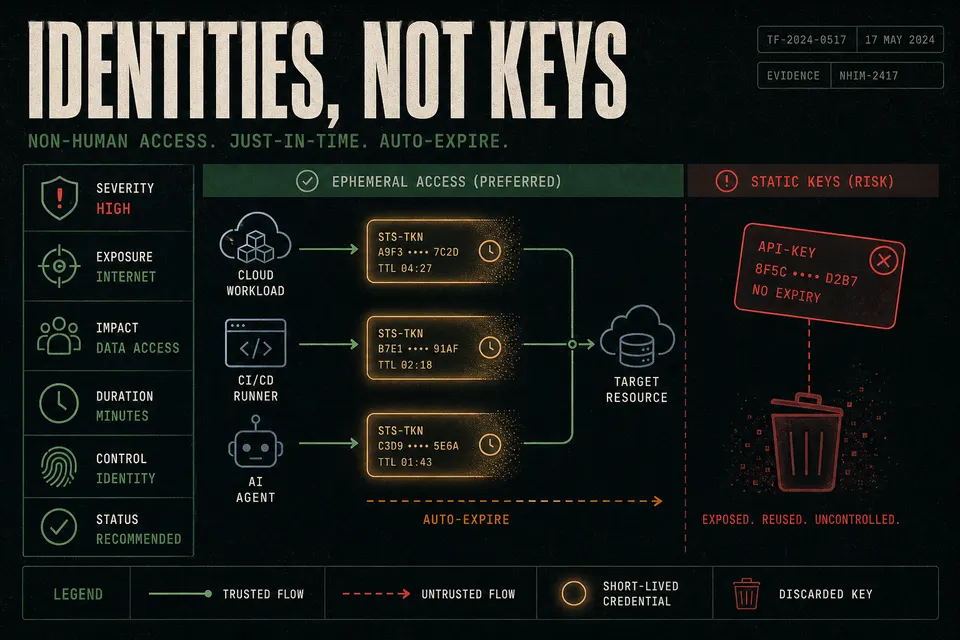
Service accounts, CI/CD runners, workload certificates and AI-agent principals form a sprawl traditional joiner-mover-leaver programs never governed.
Non-human identities now outnumber human users by roughly 45 to 1 on average—and as high as 144 to 1 in cloud-native environments—while growing about 44 percent year over year. Service accounts, API keys, OAuth tokens, CI/CD runners, workload certificates, IoT credentials, and AI-agent principals form a sprawling attack surface traditional identity programs never fully governed. Static and long-lived secrets remain a primary breach vector. Ephemeral credentials—short-lived, auto-expiring access issued after attestation and policy checks—are becoming the practical foundation of modern non-human identity management.
The Scale of the Problem
Human identities sit inside HR-driven joiner-mover-leaver workflows, multi-factor authentication, and periodic access reviews. Non-human identities often lack a named owner, outlive the project that created them, authenticate with cryptographic material rather than passwords plus MFA, and operate at machine speed. Visibility is fragmented across cloud IAM, Kubernetes, vaults, SaaS OAuth apps, code repositories, and agent registries.
Attack surfaces multiply: secrets hard-coded into git, tickets, chat, container images, and AI training data; high-privilege keys reused across apps; no continuous authentication once stolen; orphaned and former-employee tokens that remain active; and AI agents that request new scopes and expand blast radius at runtime. Detection is hard because legitimate machine traffic is high-volume and bursty.
Public data underlines the risk. Roughly 28.65 million new hardcoded secrets appeared in public GitHub commits in 2025 alone—a 34 percent jump year over year—while AI-service credentials surged 81 percent. A single leaked long-lived credential has powered high-impact incidents, including the CircleCI customer-secrets exposure in early 2023, Microsoft shared-access-signature token issues, GitHub Actions supply-chain scrapes that pulled secrets from runner memory into public logs, and repeated cloud-key leaks from personal or misconfigured repositories. That pattern now shows up in the data too: compromised credentials have overtaken software vulnerabilities as the leading ransomware entry point.
Why Static Keys Fail
Long-lived secrets fail modern environments in concrete, repeatable ways. Validity measured in months or years turns a one-time leak into persistent access. Roughly 70%+ of NHIs are not rotated on schedule. Over-permissioning is the norm—often reported above 70 percent and in some studies near 90-plus percent. Secrets are duplicated across vaults, code, and tickets. Third parties and mutable CI dependencies expand exposure. Compliance narratives around least privilege, timely revocation, continuous monitoring, and audit trails collapse when secrets are static, shared, and unowned. Even “ephemeral” downstream tokens often rest on a static secret-zero bootstrap.
OWASP’s Non-Human Identities Top 10 flags long-lived secrets (NHI7:2025) as widespread with severe technical impact. Prevention guidance is unambiguous: automate rotation where static secrets must remain, prefer short-lived cloud-native credentials, re-authenticate high-risk actions, and enforce least privilege.
How Ephemeral Credentials Work
Ephemeral credentials reverse the model. A workload receives temporary, task-scoped access that auto-expires—often in minutes to a few hours—only after the platform answers three questions: Who is this workload? What may it access now? Is it safe to issue?
Key enablers include:
| Mechanism | Role | Typical lifetime |
|---|---|---|
| SPIFFE / SPIRE | Issues SVIDs (X.509 or JWT) after platform attestation; identity of the form spiffe://trust-domain/path; enables mTLS without stored secrets | Minutes to hours; auto-renew |
| OAuth 2.0 / OIDC short-lived tokens | Client credentials, JWT bearer, token exchange for scoped SaaS and API access | Minutes to ~1 hour |
| Cloud IAM temporary credentials | AWS STS AssumeRole / IRSA, Azure Managed Identities, GCP service-account tokens | Configurable sessions (e.g., 15 min–12 h) |
| Workload Identity Federation | External OIDC/SAML identity exchanged for short-lived cloud tokens—no long-lived service-account keys | Matches cloud session TTL |
The widely recommended hybrid pattern uses SPIFFE/SPIRE for internal “who is this workload” attestation and mTLS, then a workload IAM broker or STS exchange that turns the SVID into a short-lived OAuth or cloud token for external or multi-cloud access. Federation flows typically look like this:
Native platform options—GitHub Actions OIDC to cloud workload identity federation, EKS IRSA, Azure Workload Identity, GCP Workload Identity—already make secretless CI and service paths practical. Dynamic secrets from vaults can serve as a bridge while pure identity federation matures.
Ephemeral is not magic. A mis-issued short token still works until expiry. Short-lived tokens have their own blind spot: Entra ID's Continuous Access Evaluation leaves a 28-hour token-theft gap even after revocation. Bootstrap trust roots, attribute conditions, policy quality, and monitoring determine whether the model actually reduces risk.
Benefits and Migration Patterns
The measurable gains are architectural: compromise window shrinks from years to minutes; standing privilege falls; mass manual rotation theater declines; each issuance leaves an attestation-plus-policy audit trail; developers gain paved-road secretless paths; and high-churn AI-agent principals become governable.
Successful migration starts cloud-native: replace long-lived IAM access keys with instance profiles, IRSA, Lambda roles, Managed Identities, or GKE Workload Identity. Move CI/CD to OIDC federation and pin Actions to commit SHAs rather than mutable tags. Deploy SPIRE or a service mesh for internal mTLS. Broker SVIDs into short OAuth tokens for SaaS. Use vault dynamic secrets only as a transitional layer. Always discover, prioritize by privilege and age, dual-run ephemeral alongside static, then decommission the static path.
Independent public “we cut breaches by X percent” studies remain scarce; the stronger evidence is before-and-after architecture: keys eliminated, median TTL measured in minutes, policy coverage of high-privilege paths, and secrets-in-code trends turning down.
From Inventory to Board Metrics
Legacy apps that only accept static API keys, SaaS products without federation, secret-zero bootstrap, multi-cloud attribute risks, and incomplete inventory are real obstacles—compounded by weak NHI ownership and AI agents that create identities faster than governance. Start by continuously inventorying NHIs across cloud IAM, Kubernetes, vaults, CI, SaaS OAuth apps, and code scanners, then classify owner, privilege, age, and exposure. Convert one CI pipeline to OIDC federation and one service from static cloud keys to a managed identity or role; enable short TTLs and full issuance logging. Ban new long-lived keys for greenfield work without exception, pin every CI dependency that can touch secrets, and treat every secret finding as priority until proven expired. Report board-level metrics: percentage of machine access that is ephemeral versus static, median credential TTL, count of remaining long-lived high-privilege secrets, and share of NHIs with a named owner.
Non-human identities must become first-class principals under zero trust: always verify identity, posture, and context; re-attest continuously; and pursue zero standing privilege for machines exactly as for humans. Secrets managers remain useful for residual static cases and dynamic short leases, but the strategic goal shifts from storing more secrets better to issuing fewer secrets, for shorter periods, after cryptographic proof of identity. Even vault-based secret storage is not immune to flaws, as shown by a HashiCorp Vault bug allowing root host takeover via blank SSH certificates. Identity governance must extend ownership and recertification to NHIs and define explicit lifecycles for AI agents—create, scope, monitor, expire or kill. Runtime authorization for those agents is its own emerging layer; see how an agent control plane governs MCP tool calls.
Unmanaged non-human identities are no longer a niche cloud hygiene issue; they are the largest and fastest-growing identity population enterprises own. Non-human identity management built on ephemeral credentials—SPIFFE, short-lived OAuth, cloud temporary roles, and workload identity federation—shrinks blast radius, restores auditability, and aligns machine access with zero-trust principles. Organizations that keep treating API keys as permanent fixtures will continue to discover that the keys they never rotated still work for whoever finds them.
Related reading
- Jenkins Plugin Security: Hardening the CI/CD Supply Chain Before Attackers Do
- Deepfake Phishing MFA Bypass: How Real-Time Voice-Video Fraud Defeats Video KYC and Conventional Authentication
- GitLab Unauthenticated Arbitrary File Read Exposes Critical Secrets: Full Blast Radius and Incident Recovery Runbook