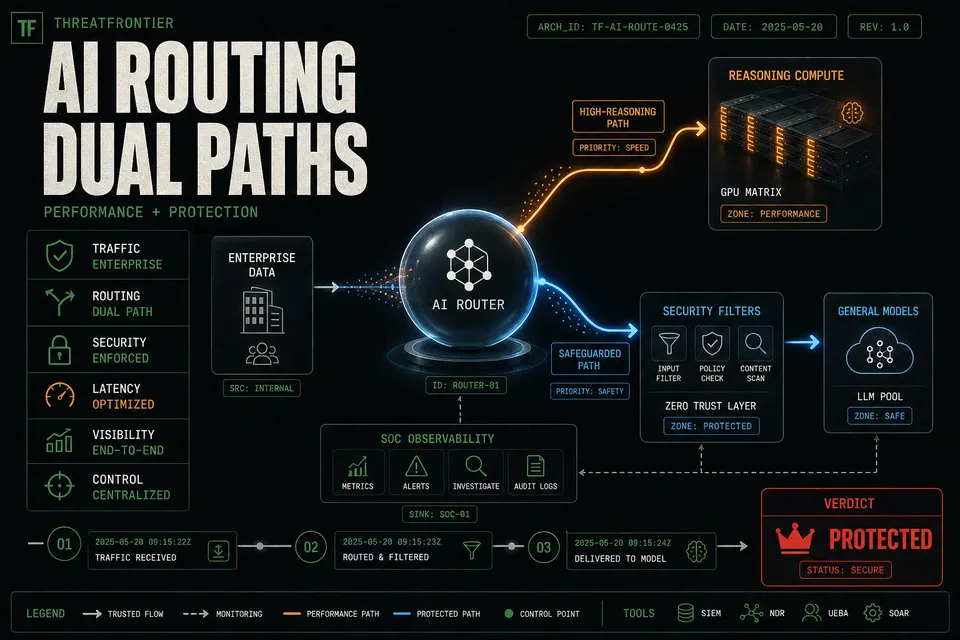
For vulnerability auditing, incident response and threat hunting, the routing catch matters as much as the price — and it is not visible in the pricing table.
Anthropic has introduced Claude Opus 5, delivering near-frontier intelligence at half the per-token cost of its flagship Claude Fable 5 model. By maintaining its prior generation pricing structure of $5.00 per million input tokens and $25.00 per million output tokens, Opus 5 provides enterprise technology leaders and CISOs with compelling economic leverage for high-reasoning workloads. However, enterprise security teams deploying the model for automated vulnerability auditing, incident response, and threat hunting face critical operational trade-offs, including automated safety rerouting mechanisms and strict data retention policies.
The structural pricing gap between Anthropic’s frontier Fable tier ($10.00/$50.00 per MTok) and Opus 5 effectively grants enterprise buyers a 50% cost reduction for high-complexity compute without sacrificing core analytical capabilities. While this shift enables scalable deployment of autonomous agents, security architects must navigate a landscape where high-risk cybersecurity queries are programmatically diverted away from frontier models to safeguarded fallback layers.
Enterprise security operations centers face complex architectural decisions balancing model reasoning depth, token economics, and automated safety routing.
Financial and Technical Pricing Breakdown
The deployment economics of Opus 5 rest on a multi-tiered pricing architecture. While Fable 5 serves as Anthropic's top-tier frontier model, Opus 5 achieves near-parity on complex reasoning tasks at half the expense.
The following table details the current API rate schedules across the model family:
| Model Tier | Input Rate ($/MTok) | Output Rate ($/MTok) | Prompt Cache Hit ($/MTok) | Operational Focus |
|---|---|---|---|---|
| Claude Fable 5 | $10.00 | $50.00 | $1.00 | Frontier reasoning & complex multi-agent orchestration |
| Claude Mythos 5 | $10.00 | $50.00 | $1.00 | Specialized cyber operations (Restricted access) |
| Claude Opus 5 | $5.00 | $25.00 | $0.50 | Near-frontier code auditing & deep reasoning |
| Claude Opus 4.8 | $5.00 | $25.00 | $0.50 | Legacy high-reasoning fallback tier |
| Claude Sonnet 5 | $2.00 | $10.00 | $0.20 | Balanced enterprise automation & general production |
| Claude Haiku 4.5 | $1.00 | $5.00 | $0.10 | High-throughput low-latency utility tasks |
Beyond headline rates, total cost of ownership (TCO) is governed by specific platform mechanics:
- Prompt Caching: Cache-hit reads receive a 90% discount ($0.50/MTok on Opus 5), while five-minute cache writes incur a 1.25x multiplier and one-hour persistence charges a 2.0x write multiplier.
- Granular Effort Control: An adjustable effort parameter (
lowtomax) allows engineering teams to dynamically constrain reasoning loops and token output based on query complexity. - Geographic Data Residency: Enforcing US-only inference (
inference_geo: "us") incurs a 1.1x price multiplier across all token usage. - Tokenizer Efficiency Adjustments: The updated tokenizer generates 25% to 30% more tokens per volume of source code compared to prior architectures, partially offsetting per-token savings during static analysis.
The Cybersecurity Routing Catch and Gated Capabilities
For security operations centers (SOCs) and application security teams, the primary operational challenge of Opus 5 lies in safety guardrails and query routing. Under Anthropic's safety protocols, requests submitted to frontier endpoints that trigger internal risk thresholds for offensive cyber logic or dual-use research are automatically rerouted.
When a query is flagged, the platform routes execution to a lower-capability fallback tier. Anthropic's later Opus 5.5 update made this explicit, sending most cybersecurity work to Opus 4.8 by default. Although enterprises are billed at the lower fallback rate rather than frontier pricing, the request may fail to deliver the depth of analysis required for complex exploit parsing. Concurrently, Anthropic's primary offensive cyber engine—Claude Mythos 5—remains gated under restricted deployment programs such as Project Glasswing, leaving general enterprise customers reliant on public Opus 5 endpoints.
To maintain service continuity when automated safeguards engage, enterprise integration pipelines must implement programmatic fallback handlers: Other vendors publish their own security-specific comparisons, such as GLM 5.3's cybersecurity benchmarks for enterprise security teams.
import os
import anthropic

client = anthropic.Anthropic(api_key=os.environ.get("ANTHROPIC_API_KEY"))

def execute_security_audit(code_snippet: str) -> str:
 try:
 response = client.messages.create(
 model="claude-opus-5-20260724",
 max_tokens=4096,
 thinking={"type": "enabled", "budget_tokens": 2048},
 system="You are an automated static analysis engine. Identify logic flaws and memory corruption risks.",
 messages=[{"role": "user", "content": f"Audit code:\n{code_snippet}"}]
 )
 return response.content[0].text
 except anthropic.APIError as err:
 if err.status_code == 422 or "safety_routing" in str(err):
 response = client.messages.create(
 model="claude-opus-4-8-20250514",
 max_tokens=4096,
 messages=[{"role": "user", "content": f"Audit code (Standard Mode):\n{code_snippet}"}]
 )
 return response.content[0].text
 raise err
Enterprise Competitive Landscape
Evaluating Opus 5 against current enterprise flagships requires balancing raw per-token costs against autonomous agent performance and code generation efficiency.
| Provider & Model | Input ($/MTok) | Output ($/MTok) | Cache Read ($/MTok) | Context Window | Key Strength |
|---|---|---|---|---|---|
| Anthropic Claude Opus 5 | $5.00 | $25.00 | $0.50 | 200K / 128K Out | Agentic coding & deep logic verification |
| Anthropic Claude Fable 5 | $10.00 | $50.00 | $1.00 | 200K / 128K Out | Frontier multi-step reasoning |
| OpenAI GPT-5.5 | $5.00 | $30.00 | $0.50 | 250K / 64K Out | Broad multimodal & enterprise ecosystem integration |
| Google Gemini 3.1 Pro | $2.00 | $12.00 | $0.20 | 2M / 64K Out | Massive context window & log ingestion |
While Google Gemini 3.1 Pro maintains a lower nominal price per token, benchmark evaluations in autonomous software engineering indicate that Opus 5 completes complex bug-fixing and vulnerability remediation tasks in fewer iterative attempts. This higher completion efficiency frequently results in lower net spend per resolved security issue despite higher per-token list rates.
Data Governance, Privacy, and Compliance Frameworks
Enterprise deployment of Opus 5 mandates strict adherence to organizational data retention and privacy policies:
Data Governance Requirement: Enterprise tier inference through dedicated API keys does not utilize customer data for model training. However, requests processed under frontier safety monitoring frameworks carry a mandatory 30-day transient data retention period for post-hoc safety audits.
Key compliance considerations for security operations include:
- Zero Data Retention (ZDR) Options: Standard API contracts default to 30-day logging for abuse prevention; enterprises processing regulated data must request explicit ZDR exceptions or utilize localized VPC endpoints.
- Encryption and Routing Controls: Customer-managed encryption keys (CMEK) protect persistent prompt caches, while explicit region tagging prevents telemetry and cache state from replicating outside designated geographic boundaries.
Strategic Action Plan for CISOs and AI Architects
To maximize economic and security benefits while mitigating operational risk, enterprise leadership should implement a structured five-step routing framework:
- Establish Multi-Tier Workload Routing: Direct routine threat log analysis to Sonnet 5 or Gemini 3.1 Pro, reserving Opus 5 for high-reasoning tasks such as deep vulnerability analysis, smart contract verification, and incident root-cause synthesis. Anthropic froze Sonnet 5's own pricing when it launched Opus 5, keeping that routing tier's cost stable.
- Apply Dynamic Effort Parameters: Configure API
thinkingbudgets tolowormediumduring real-time triage to constrain costs, escalating tomaxbudget tokens only during automated post-mortem refactoring. - Maximize Prompt Caching: Structure system prompts, threat intelligence feeds, and corporate codebases into standardized static headers to leverage 90% input token discounts across repetitive SOC workflows.
- Deploy Programmatic Fallback Handlers: Wrap API calls in exception-handling code to capture safety-routing redirects, ensuring security pipelines complete execution without dropping monitoring threads.
- Enforce Token Consumption Guardrails: Establish hard per-task spend caps and rate limits at the API gateway layer to prevent autonomous agent loops from generating unexpected financial overruns.