
Claude Code now compacts idle 200K-token sessions before the prompt cache expires and warns Pro and Max users before costly resumes. Here is what changed.
Between versions 2.1.299 and 2.1.311, released October 14 to October 26, 2026, Claude Code changed how long sessions behave. The terminal client now compacts large idle conversations on its own. Sessions that go over 200K tokens no longer stop on a usage-credit error. Pro and Max users get a warning before resuming an old conversation that would use a noticeable share of their 5-hour limit.
This article rests on a single source: the official Claude Code changelog. Anthropic has not published anything else on these changes.
Idle compaction (2.1.299)
A conversation of 200K tokens or more that sits idle for about 54 minutes is now compacted before its one-hour prompt cache expires. The changelog gives the reason: your next message "doesn't reprocess it all". Before this change, a long conversation resumed after the cache lapsed was read again without the cache.
Controls:
CLAUDE_CODE_IDLE_COMPACT_MIN_TOKENSchanges the 200K minimum."idleCompaction": falsein settings.json turns the feature off. Both need v2.1.290 or later.- From 2.1.302,
/confighas anIdle compactionrow.
The trade-off: compaction replaces the history with a summary, so detail is lost whether or not you were about to continue. If your work depends on exact earlier context, consider turning it off.
A related cache fix landed in 2.1.304: self-paced /loop wakeups scheduled at the 1-hour maximum no longer fire just after the cache expires.
Compact and continue past 200K (2.1.311)
Standard-context sessions used to stop with "Usage credits required for 1M context" when a request went over 200K tokens. As of 2.1.311, Claude Code compacts the conversation and continues instead.
Usage credits and fast mode
- 2.1.300: fast mode stayed on after usage credits ran out, so every request was refused and re-sent. It now turns off until you turn it back on, with an error notice. The changelog lists this fix for the VS Code extension.
- 2.1.301: when you switch to a smaller-context model and the conversation is too long for it, the previous model summarizes it first. A case where that summary could spend usage credits without asking was fixed.
- 2.1.302: prompt suggestions are skipped after a reply billed to credits, on models your plan pays for only with credits.
Resume warning for Pro and Max (2.1.304)
On Pro and Max plans, Claude Code now warns when resuming an inactive conversation would use a noticeable share of your 5-hour usage limit. You can resume anyway, or start a new conversation and refer to the previous one. The changelog does not define "noticeable share" or give a threshold.
For how the 5-hour window and the Max tiers work, see Claude Code Max Plan Limits $100 vs $200: 5× vs 20× Shared Caps Explained and Claude Pro vs Max for Claude Code: Is $20 Enough After Opus 5.5?.
Visibility in /usage (2.1.311)
/usage now shows large prompt-cache misses under "What's contributing to your limits usage?". /effort also warns of a cache miss in plan mode when the plan model differs from the session model. Together with idle compaction, this points at the prompt cache as a main driver of how fast limits are used.
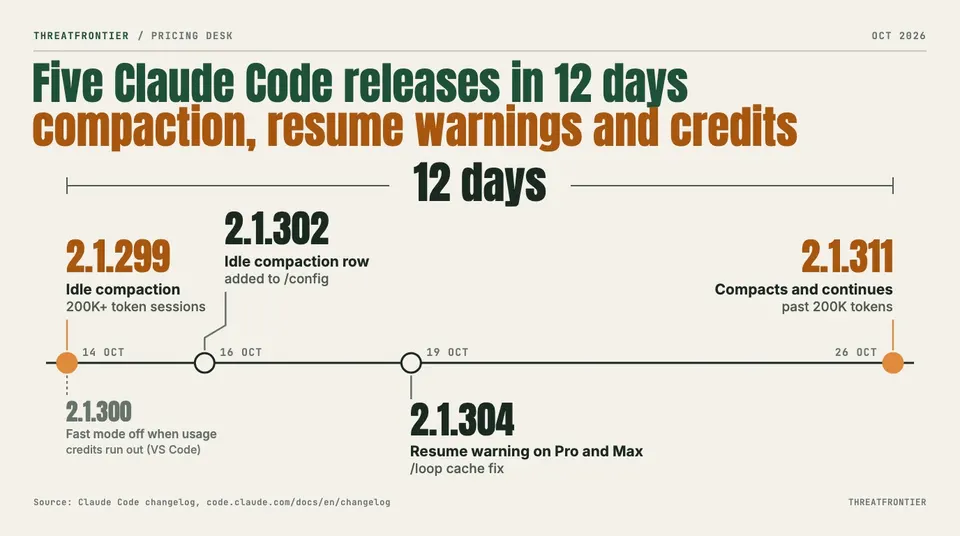
Five Claude Code releases from 14 to 26 October changed how idle sessions, usage credits and limits behave.
What it means for limits
The changelog does not say how cached and uncached tokens count against Pro or Max limits, so any exact saving is unconfirmed. The direction is clear: these changes aim to avoid re-reading a large context without the cache after a break, and to show you the cost when you do.
What to do
- Keep idle compaction on unless you need verbatim history; adjust the 200K minimum if needed.
- Take the resume warning seriously on old sessions, and start fresh for unrelated work.
- Check
/usagefor prompt-cache misses. - Update to 2.1.311 or later to get compact-and-continue past 200K.