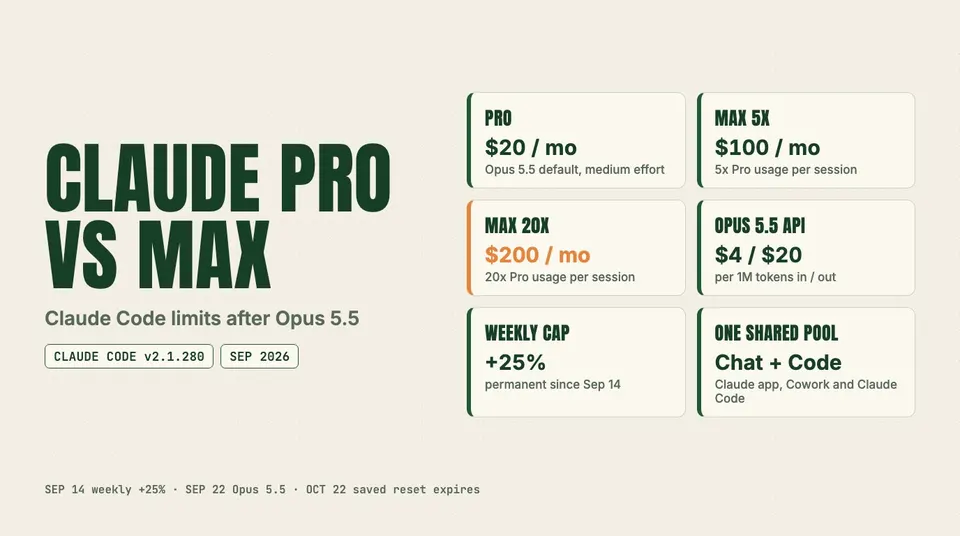
Opus 5.5 is now Claude Code's default on Pro. What a $20 plan's 5-hour window really covers, where it runs dry, and when Max 5x or 20x pays off.
The short answer: Claude Pro at $20 a month is enough for Claude Code if you code in focused bursts of an hour or two a day, keep sessions short, and drop to Sonnet 5 for routine edits. It stops being enough if you run long agentic sessions on Opus 5.5, work across a large repo all afternoon, or want Fable 5.1 without paying extra. At that point Max 5x at $100 is the upgrade that pays for itself; Max 20x at $200 is for people who hit the Max 5x weekly cap, not the 5-hour window.
One change makes this question more pressing than it was a month ago. Since Claude Code v2.1.280 (released September 22, 2026), the default model on Pro resolves to Opus 5.5. Before that release, Pro defaulted to Sonnet 5. If you updated and your Pro sessions suddenly feel shorter, that is the first thing to check.
This guide was last checked against Anthropic's Opus 5.5 announcement, the Claude API pricing page, the Claude Code model-configuration and cost docs, and the Claude Help Center plan and Fable articles on September 24, 2026.
Quick summary
- Pro ($20/month, or $17/month billed annually at $200) includes Claude Code and Opus 5.5. Its session limit resets every 5 hours, and a separate weekly cap applies across all models.
- Max 5x ($100) gives 5 times Pro's usage per 5-hour session. Max 20x ($200) gives 20 times.
- One pool. Chat on claude.ai, Cowork and Claude Code all draw from the same limits on every plan.
- Opus 5.5 is now the default in Claude Code on Pro, at medium effort. It is cheaper per token than Opus 5 but still costs more than Sonnet 5.
- Fable 5.1 is not in Pro's limits. On Pro it runs only on pay-as-you-go usage credits. Max can spend up to 50% of its weekly limit on Fable at no extra cost.
- Limits moved twice in September. Since September 14, Claude Code weekly limits sit permanently 25% above their pre-promotion level, which is still below August's temporary boost. At the Opus 5.5 launch Anthropic also raised 5-hour limits and handed every subscriber one saved reset (usable until October 22).
What changed with Opus 5.5
Anthropic released Opus 5.5 on September 22, 2026. Here is what matters for a subscription decision:
| Item | Opus 5 | Opus 5.5 | Source |
|---|---|---|---|
| API input / output (per million tokens) | $5 / $25 | $4 / $20 | Claude API pricing page |
| Cache reads (per million tokens) | $0.50 | $0.20 | Claude API pricing page |
| Context window in Claude Code | 1M | 1M | Claude Code docs and 2.1.280 changelog |
| Default effort in Claude Code | high | medium | Claude Code model-config docs |
| Default model on Pro in Claude Code | No (Sonnet 5 was) | Yes, since v2.1.280 | Claude Code model-config docs |
Anthropic says Opus 5.5 costs about 40% less than Opus 5 on typical workloads and generates output more than 30% faster. The cache-read price matters most for Claude Code. Most of an agent session's input is the same conversation being re-read from cache on every tool call, and Opus 5.5 bills those reads at 5% of the base input price instead of the usual 10%. That matches Sonnet 5's $0.20 cache-read rate.
Anthropic has not published how much more of your plan limit an Opus 5.5 turn uses than a Sonnet 5 turn. Its docs do say model choice and effort level both affect how fast you use up your limit, and that Sonnet "handles most coding tasks well and costs less than Opus."
The limit changes, and what is still unclear
Three separate changes landed in 2026. They are easy to confuse:
| Date | Change | Status |
|---|---|---|
| May 6, 2026 | Claude Code 5-hour limits doubled on Pro, Max, Team and seat-based Enterprise; peak-hour reduction removed for Pro and Max | Official (Anthropic announcement) |
| May 13 to Sept 13, 2026 | Temporary 50% boost to Claude Code weekly limits | Ended (Help Center) |
| Sept 14, 2026 | Claude Code weekly limits permanently 25% above the pre-promotion level | Official (Help Center) |
| Sept 22, 2026 | 5-hour limits raised on Pro, Max, Team and seat-based Enterprise, plus one saved rate-limit reset | Official; size and duration not stated by Anthropic |
The September 14 change reads like a raise, but compared with the promotion that ended the day before it is a drop. If the old baseline is 100, the promotion took you to 150 and you now sit at 125, about 17% less weekly headroom than in August. Pro users who remember August as fine may hit the weekly cap sooner now.
On the Opus 5.5 boost: several outlets, including MakeUseOf, report it as a 20% increase to 5-hour limits. Anthropic's own announcement says it is "increasing five-hour usage limits" but gives no percentage and does not say whether the increase is permanent. Treat the 20% figure as reported, not confirmed. The saved reset is a one-time item. Press reports say it can be used any time up to October 22.
What a Pro 5-hour window gets done in Claude Code
Anthropic does not publish a prompt count for Pro. The figure you will see quoted most often is roughly 45 prompts per 5-hour window, and that number comes from short chat messages, not agent sessions. It is a rough third-party estimate, not an Anthropic number.
A Claude Code prompt is different. One instruction such as "add pagination to the orders endpoint and update the tests" can trigger many model calls as Claude reads files, runs tests, edits and re-runs, and each call re-sends the conversation, mostly from cache. Think about a Pro window in tasks, not messages.
Based on the factors Anthropic lists and what developers commonly report, here is a realistic picture. These are illustrative ranges, not measurements:
| Workload in one 5-hour window | Pro on Sonnet 5 | Pro on Opus 5.5 (default) |
|---|---|---|
| Small fixes in a small repo (bug, test, refactor one file) | Comfortable for a full working block | Usually fine for 1 to 2 hours of steady use |
| One medium feature across 5 to 10 files with tests | Usually fits | Often fits, sometimes runs out near the end |
| Long agentic session, subagents, big monorepo | Tight | Likely to hit the limit mid-task |
| Heavy chat use in claude.ai the same morning | Shared pool, less left for code | Shared pool, less left for code |
What runs Pro dry is rarely one big request. It is a session that has been open for hours. As Claude Code's cost docs put it, "a one-line question in a session that has been open all day still draws usage for the whole conversation." Your first message after a long break also misses the cache and reprocesses everything.
Where Pro runs out first
- Opus as the default. If you updated to v2.1.280 and never picked a model, you are on Opus 5.5. That is the right choice for hard problems and a waste for renaming variables.
- Long sessions without
/clear. Context grows, and every tool call re-reads it. - Big repos and broad prompts. "Improve this codebase" triggers wide file scanning. A specific file-and-function prompt does not.
- Subagents and agent teams. Each one runs its own context. Anthropic's docs put agent teams at roughly 7 times the tokens of a standard session when teammates run in plan mode.
- Fable. On Pro, any Fable 5.1 use goes straight to paid usage credits at API rates ($10 input / $50 output per million tokens).
Pro vs Max 5x vs Max 20x at a glance
| Pro | Max 5x | Max 20x | |
|---|---|---|---|
| Price | $20/month ($17 annual) | $100/month | $200/month |
| Usage per 5-hour session | 1x (baseline) | 5x Pro | 20x Pro |
| Price per "Pro-session" of capacity | $20 | $20 | $10 |
| Weekly cap | Yes, across all models | Yes, across all models | Yes, across all models |
| Claude Code | Included | Included | Included |
| Opus 5.5 | Included | Included | Included |
| Fable 5.1 | Usage credits only | Up to 50% of weekly limit included | Up to 50% of weekly limit included |
| Shared with chat and Cowork | Yes | Yes | Yes |
The "price per Pro-session" row uses Anthropic's per-session multipliers only. Max 5x costs five times Pro and gives five times the session usage, so you pay the same rate for more headroom. Max 20x is the first tier that actually halves the unit price. Anthropic does not publish weekly multipliers in the same way, so do not assume the weekly caps scale exactly 5x and 20x.
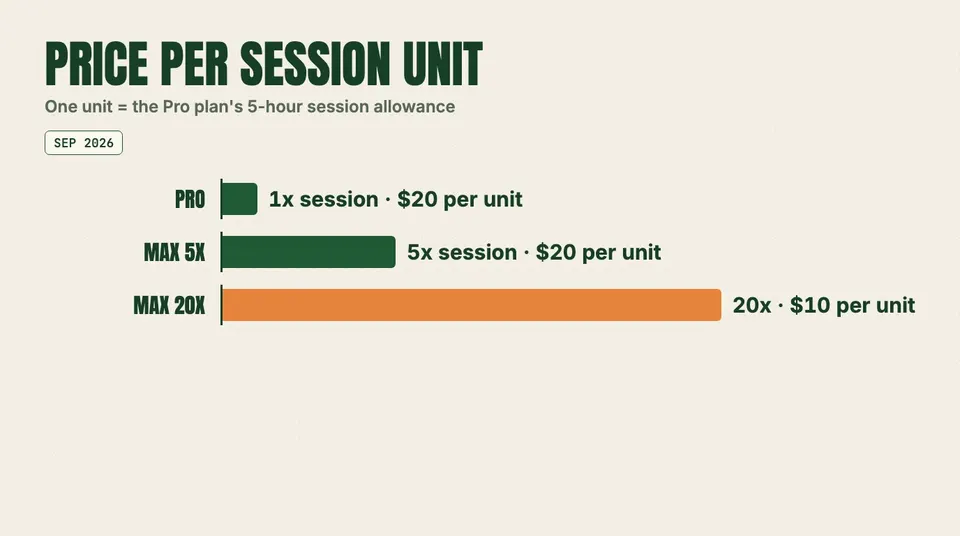
One unit = the Pro plan's 5-hour session allowance
For a deeper look at the two Max tiers, see our breakdown of Claude Max $100 vs $200 for Claude Code and the explainer on how the 5x and 20x shared caps work.
Cost per unit of work: subscription vs API pay-as-you-go
The API is the only place Claude Code usage has a public dollar price, so it is the cleanest yardstick. Anthropic's Claude Code cost docs say that across enterprise deployments the average is about $13 per developer per active day and $150 to $250 per developer per month, with 90% of users under $30 per active day.
Against those averages:
| Plan | Monthly price | Average API-priced active days it matches |
|---|---|---|
| Pro | $20 | about 1.5 days |
| Max 5x | $100 | about 8 days |
| Max 20x | $200 | about 15 days |
That favours subscriptions heavily for anyone who codes most days, as long as the limits do not stop you. Past Pro's weekly cap you wait, pay usage credits, or upgrade.
To make the model choice concrete, here is one illustrative Claude Code task priced at API list rates: 3 million tokens read from cache, 150,000 tokens written to a 5-minute cache, and 60,000 output tokens (thinking counts as output). These token counts are an assumption for illustration, not a benchmark:
| Model | Cache reads | Cache writes | Output | Total at list price |
|---|---|---|---|---|
| Opus 5 | $1.50 | $0.94 | $1.50 | about $3.94 |
| Opus 5.5 | $0.60 | $0.75 | $1.20 | about $2.55 |
| Sonnet 5 | $0.60 | $0.38 | $0.60 | about $1.58 |
Two takeaways. First, Opus 5.5 is about 35% cheaper than Opus 5 on this cache-heavy shape, in line with Anthropic's "40% less on typical workloads." Second, Sonnet 5 is still about 40% cheaper than Opus 5.5 for the same work, and the gap comes from output and cache writes, since both models charge the same $0.20 for cache reads. So a session with lots of reading and little writing narrows the difference, and one with long plans and big diffs widens it. We cover the full token math in Claude Code pricing and token economics.
Which plan should you pick?
Stay on Pro if
- You use Claude Code for 1 to 2 focused hours a day, mostly on small and medium tasks.
- You are willing to switch to Sonnet 5 for routine work and keep Opus 5.5 for the hard parts.
- You rarely hit the weekly cap, and when you hit the 5-hour limit you can take a break.
- You do not need Fable 5.1, or you are fine paying credits for the occasional Fable run.
Move to Max 5x ($100) if
- You hit the 5-hour limit more than two or three times a week, or hit the weekly cap at all.
- You want Opus 5.5 as your everyday model without rationing it.
- You run multi-hour agentic sessions, subagents, or work in a large monorepo.
- You want Fable 5.1 included. On Max, up to half your weekly limit can go to Fable at no extra cost. Our Claude Max worth-it analysis covers that trade-off in detail.
Move to Max 20x ($200) if
- You are on Max 5x and still hitting the weekly cap.
- You run several Claude Code sessions in parallel, or agent teams, on most days.
- Claude Code is effectively your full-time pair programmer and downtime costs you more than $100 a month.
Use the API instead if
- You code with Claude only a few days a month, or need team billing and workspace spend limits.
If you are weighing Anthropic against other vendors at the same price points, see Google AI Ultra vs Claude Max vs ChatGPT Pro for developers. For the models themselves, our GPT-6 Astra vs Fable 5.1 vs Opus 5.5 coding comparison looks at output quality rather than limits.
How to stretch Claude Pro in Claude Code
Most of these come straight from Anthropic's Claude Code cost guidance.
- Pick the model on purpose. Run
/model sonnetfor routine edits, tests and refactors, and/model opuswhen you hit a hard design or debugging problem. Theopusplanalias uses Opus for planning and switches to Sonnet for execution, which is a good default on Pro. - Leave Opus 5.5 at medium effort unless you need more. Opus 5.5 starts at
mediumin Claude Code. Raising it with/effort highorxhighspends more thinking tokens, which count as output. You cannot turn thinking off on Opus 5.5, so effort is your only dial. - Use
/clearbetween unrelated tasks. It costs nothing. Use/renamefirst so you can/resumelater. - Use
/compactwith a focus, and do it early./compact Focus on the failing tests and the diffkeeps what matters. Compacting a huge context is itself a large request, so do not wait until the window is nearly full. - Avoid long idle gaps in a big session. On a subscription the prompt cache lasts an hour. After a longer break, the next message reprocesses everything. Claude Code offers to resume from a summary in that case; take it.
- Check
/usageand/context. On Pro,/usageshows plan bars and flags behaviours such as long context or cache misses when they account for 10% or more of recent use. - Trim always-on context. Keep CLAUDE.md short, move workflow instructions into skills, and disable MCP servers you are not using.
- Write specific prompts. Name the file and function. Use plan mode (Shift+Tab) for bigger changes so a wrong direction is caught before Claude writes code.
- Keep heavy chat out of coding windows. claude.ai and Cowork draw from the same pool.
- Spend the saved reset on a deadline day, before it expires on October 22.
If you want to know why long sessions cost so much, our walkthrough of how Claude Code works internally shows the request loop that re-sends context on every tool call.
Caveats
- No published numbers. Anthropic does not publish Pro's 5-hour or weekly allowance in prompts or tokens, and does not publish per-model weights. Every "prompts per window" figure you see, including ours, is an estimate.
- The Opus 5.5 limit boost is not fully specified. The 20% figure comes from press coverage; Anthropic's post confirms an increase but not its size or duration.
- The weekly cap is lower than in August. The permanent +25% replaced a temporary +50%.
- Security work is a separate question. If you use Claude Code for offensive or defensive security tasks, read our note on Opus 5.5 and why most security work goes to Opus 4.8 before choosing a plan around Opus 5.5.
FAQ
Is Claude Pro enough for Claude Code?
For part-time or focused use, yes. Pro includes Claude Code and Opus 5.5. It works well for a couple of hours of targeted work a day, especially if you use Sonnet 5 for routine edits. Full-day agentic sessions on Opus 5.5 will usually hit the 5-hour limit, and daily heavy use will hit the weekly cap.
Why are my Claude Pro limits too low after the Opus 5.5 update?
Two likely reasons. Claude Code v2.1.280 made Opus 5.5 the default model on Pro, where Sonnet 5 used to be the default. And the temporary 50% weekly boost ended on September 13, replaced by a permanent 25% increase, which leaves about 17% less weekly headroom than in August. Run /model to check what you are on.
What is the difference between Claude Pro vs Max weekly limits?
All three plans have a weekly cap that applies across all models and resets at a fixed time assigned to your account. Anthropic describes Max 5x and Max 20x as 5 and 20 times Pro's usage per 5-hour session, but does not publish the weekly allowances as numbers.
Claude Pro vs Max 5x vs Max 20x: which is best value for coding?
Per session, Pro and Max 5x cost the same per unit of capacity ($20 per Pro-session), and Max 20x halves it ($10). Pick Pro if you rarely hit limits, Max 5x if you hit them weekly or want Fable 5.1 included, and Max 20x only if Max 5x's weekly cap is what stops you.
Do Claude Code and the Claude app share the same usage limits?
Yes. On Pro and Max, claude.ai on web, desktop and mobile, Cowork and Claude Code all count against the same 5-hour and weekly limits.
Can I use Fable 5.1 in Claude Code on Pro?
Only through pay-as-you-go usage credits at API rates. Fable models are not part of Pro's included limits. Max plans can spend up to 50% of their weekly limit on Fable at no extra cost, then continue on credits.