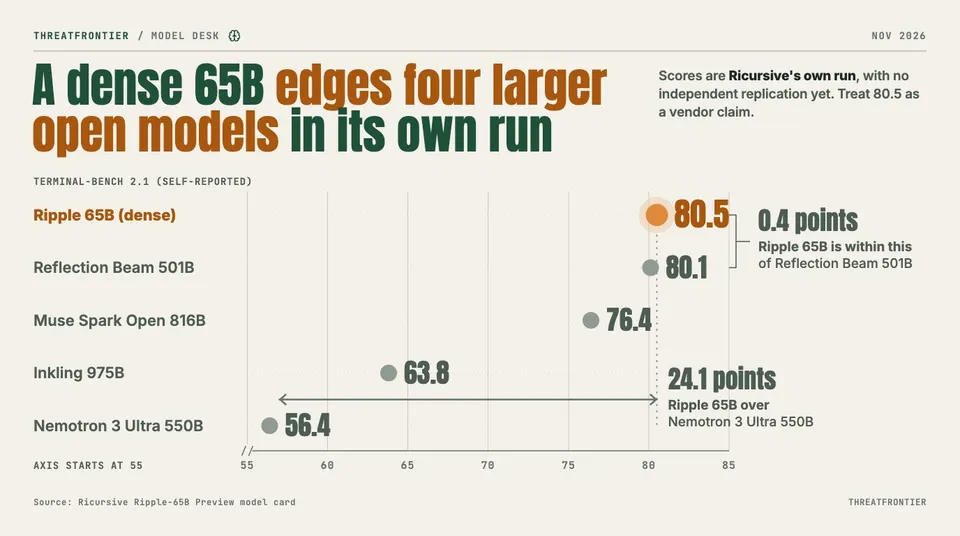
Ricursive's Apache-2.0 dense 65B posts self-run agentic-coding scores ahead of 501B–975B open MoEs. A 57.2 GB NVFP4 build fits one 128 GB DGX Spark.
Ricursive Intelligence released Ripple-65B Preview on Hugging Face on 4 November 2026 under Apache 2.0. It is a dense 65B-parameter model (64.78B counted in the checkpoint metadata), and Ricursive claims it scores 80.5 on Terminal-Bench 2.1. That figure is ahead of four open mixture-of-experts models of 501B to 975B parameters in the card's own table. A 57.2 GB NVFP4 checkpoint sits in a separate repo, small enough for a single 128 GB DGX Spark. Anyone choosing a local coding-agent model should read the scores with the caveats below.
What is in the release
- Dense transformer, 80 layers, hidden size 5120, 65B total and active parameters. Pretrained on 12T text-only tokens, mostly English and code. Post-training is described as light and aimed at agentic coding.
- Context up to 1,048,576 tokens. The checkpoint supports up to 2Mi positions.
- Repos: BF16 instruct, NVFP4 instruct, BF16 base, and a DFlash2 speculative-decoding draft model.
- NVFP4 recipe: NVFP4 for the MLP layers, attention kept in BF16.
| Checkpoint | Size on disk | Shards |
|---|---|---|
| BF16 instruct | 129,565,519,472 bytes (about 129.6 GB) | 16 |
| NVFP4 instruct | 57,213,852,024 bytes (about 57.2 GB) | 6 |
Hugging Face reports about 39.6B "parameters" for the NVFP4 repo. That is a count of packed storage elements, not a smaller model.
Benchmarks
All numbers below come from Ricursive's model card. Cells marked † are italicized in the card, which says italics come from its in-house eval flow rather than from the other vendors' published scores. Ricursive says every model was run at full BF16 and maximum effort.
| Benchmark | Ripple-65B | Nemotron 3 Ultra 550B | Inkling 975B | Muse Spark Open 816B | Reflection Beam 501B |
|---|---|---|---|---|---|
| Architecture | Dense | MoE | MoE | MoE | MoE |
| Total / active params | 65B / 65B | 550B / 55B | 975B / 41B | 816B / 42B | 501B / 23B |
| Pre-training tokens | 12T | 20T | 45T | N/A | 23.8T |
| MMLU | 89.6 | 92.0† | 91.3† | 92.6† | 92.4† |
| MMLU-Pro | 84.2 | 86.8 | 87.3† | 87.9† | 76.5† |
| GPQA Diamond | 85.2 | 87.0 | 87.2 | 89.0 | 90.6 |
| AIME 2024 | 97.1 | 94.2† | 97.5† | 97.9† | 96.7† |
| AIME 2025 | 98.3 | 94.2† | 91.7† | 100.0† | 99.6† |
| AIME 2026 | 95.0 | 95.4† | 97.1 | 98.3† | 97.7 |
| HMMT Feb 2026 | 90.5 | 80.3† | 86.3 | 93.9† | 93.9† |
| Terminal-Bench 2.1 (self-reported) | 80.5 | 56.4 | 63.8 | 76.4 | 80.1 |
| Terminal-Bench 2.1 (Terminus 2) | 80.5 | 55.1† | 56.2† | 78.7† | 70.8† |
| SWE-bench Verified | 76.5 | 71.9 | 77.6 | 78.7† | 81.6 |
| SWE-bench Pro v1.0 | 61.42 | 46.9† | 54.3 | 58.2† | 66.1 |
| SWE-bench Pro v2.0 Hard | 79.1 | 30.7† | 39.6† | 72.4† | 76.5 |
| DeepSWE 1.1 | 44.3 | 0.2† | 1.8† | 60.0 | 43.3 |
| SciCode (Inspect AI) | 39.4 | 44.6 | 46.1 | 58.5 | 49.2 |
| τ³-bench banking | 31.27 | 22.6 | 23.7 | 14.4† | 36.1 |
| AutomationBench (Public) | 36.4 | 8.4† | 14.6† | 42.4† | 39.3 |
| MCP Atlas | 71.67 | 62.2† | 76.0 | 89.2 | 80.8 |
| FORTRESS Adversarial | 83.8 | 79.3† | 78.0 | 94.2 | 92.1† |
| FORTRESS Benign | 95.5 | 89.1† | 95.9 | 82.6† | 86.4† |
| StrongREJECT | 97.5 | 98.2† | 98.6 | 94.7† | 95.8† |
| IFBench | 79.2 | 81.7 | 79.8 | 78.6† | 79.6 |
| AA-LCR | 75.0 | 65.4 | 78.3† | 80.7† | 78.2 |
The table is not a clean sweep. Ripple trails on general knowledge (MMLU, MMLU-Pro, GPQA Diamond), SciCode, MCP Atlas and FORTRESS Adversarial, and Muse Spark Open leads DeepSWE 1.1 (60.0 vs 44.3). Ripple's lead is concentrated in agentic coding evals.
Read the Terminal-Bench number carefully
- The 80.5 headline is Ricursive's own run. The card does not explain the two Terminal-Bench rows, but the "Terminus 2" row is mostly † (in-house), while the "self-reported" row is mostly not. The two rows disagree by up to 7.6 points for Inkling (63.8 vs 56.2) and 9.3 for Beam (80.1 vs 70.8).
- Harnesses are mixed. Ripple used Terminus 2 for SWE-bench Pro v2.0 Hard and DeepSWE 1.1, and OpenCode where the card names no harness. Scores from different harnesses are not directly comparable.
- The card itself says Terminal-Bench 2.1 scores were generally lower under the official Terminus 2 harness (128K, with summarization), with Muse Spark Open the exception, and calls the comparison "best-effort". It also says agentic evals are hard to replicate.
- The NVFP4 card repeats 80.52 but does not say whether BF16 or NVFP4 produced it, and publishes no NVFP4-vs-BF16 accuracy comparison.
- This is a Preview, with no independent replication yet.
The base model has its own table (MMLU 83.7, MMLU-Pro 61.5, GPQA Diamond 38.4, HumanEval 70.9, GSM8K 88.5) against Laguna M.1 225B, DeepSeek V3.1 671B, DeepSeek V4 Flash 284B and Nemotron 3 Ultra 550B. It was run on an internal fork of Olmes, and most cells are in-house numbers. It trails the larger models on knowledge-heavy tasks such as SimpleQA-Verified (10.1) and C-Eval (69.6).
What fits on a DGX Spark, and on two
The sizes below are file sizes. The memory figures are our arithmetic, not vendor-measured numbers. They exclude the OS, runtime overhead, the KV cache and the optional DFlash2 draft model.
| Setup | Memory | BF16 (129.6 GB) | NVFP4 (57.2 GB) |
|---|---|---|---|
| One DGX Spark | 128 GB unified | No: weights alone exceed memory | Yes: about 70 GB left for OS, KV cache and draft |
| Two DGX Sparks | 256 GB combined | Weights fit with about 126 GB left, but need tensor-parallel across the link | Fits with large headroom; a single node is likely simpler |
- Ricursive says the model was co-designed for NVIDIA hardware, with simple sharding and no custom kernels, and that it "can fit on consumer hardware such as the NVIDIA DGX Spark". The NVFP4 repo ships
inference/local/spark.py, built on SGLang, and a Colab notebook. It expects NVFP4 MLPs, BF16 attention and a BF16 DFlash2 draft. - Ricursive publishes no Spark throughput. Its only speed figure is about 250 tokens/s on 2x B200 at batch size 8 for the BF16 model with DFlash2, before quantization or custom kernels, so it does not transfer to a Spark.
- The model has sliding-window attention on most layers, which should reduce KV-cache growth at long context. The card gives no memory figures for the 1Mi context, so treat long-context claims on a Spark as untested.
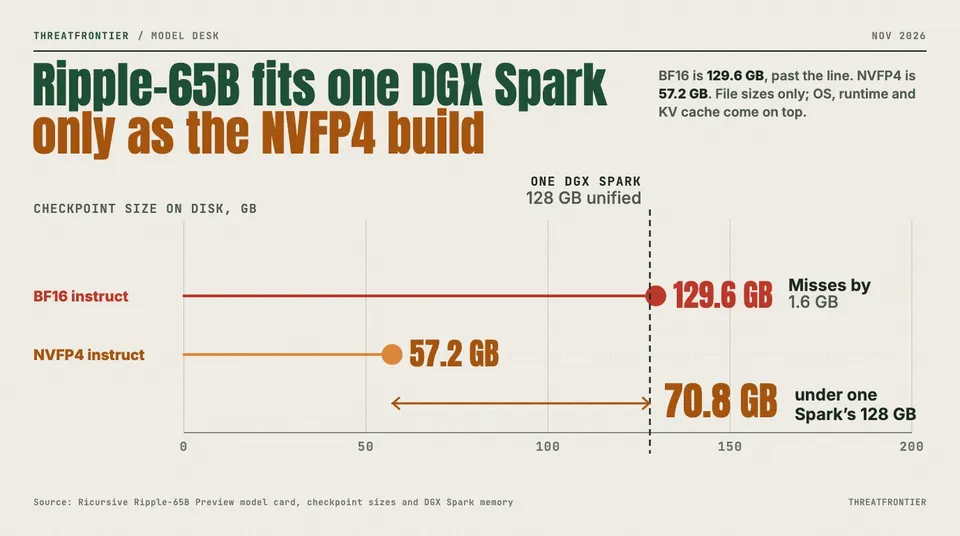
The BF16 checkpoint is larger than one 128 GB DGX Spark; the NVFP4 build is 57.2 GB.
For other hardware guidance, see our best local AI models to run on your DGX Sparks, Multi-Node DGX Spark: Tensor-Parallel Sizing for 2x and 4x Clusters and Run DeepSeek V4.1 Flash on Three DGX Sparks.
What to do
- Treat 80.5 as a vendor claim. Run your own repository tasks under your harness before replacing a current model.
- Pull the NVFP4 repo for a single Spark, and check task accuracy against the BF16 numbers if you can, since Ricursive does not publish that gap.
- The release uses
custom_code, so the repo ships Python modeling code. Review it before running it, and pin a revision. See fake Qwen2 models on Hugging Face that ran miners through trust_remote_code for how that mechanism gets abused. - Check the license file and the Preview label before depending on it in production.