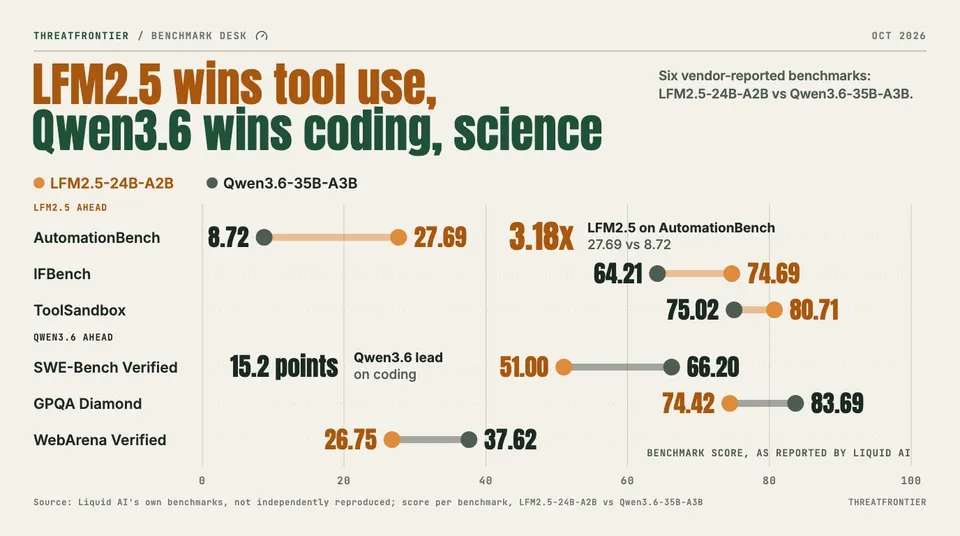
Liquid's new 24B MoE beats Qwen3.6-35B-A3B on tool use and instruction following but trails on SWE-Bench and GPQA, per Liquid's own benchmarks.
Liquid AI released LFM2.5-24B-A2B on 13 October 2026, an open-weight reasoning MoE with 24.0B total and 2.45B active parameters. It targets local agents. Liquid reports 184 tokens/s decode on an Apple M5 Max and 114 tokens/s on an AMD Ryzen AI Max+ 395. The company's own table sets it against Alibaba's Qwen3.6-35B-A3B, and the result is split: LFM wins on tool use and instruction following, Qwen wins on coding and hard science questions. All figures below are Liquid's own; none are independently reproduced.
Where it wins
On the agent and instruction-following rows, LFM2.5 leads Qwen3.6-35B-A3B:
| Benchmark | LFM2.5-24B-A2B | Qwen3.6-35B-A3B |
|---|---|---|
| AutomationBench | 27.69 | 8.72 |
| LiveClaw | 48.09 | 38.19 |
| ToolSandbox | 80.71 | 75.02 |
| BFCLv4 | 65.01 | 65.00 |
| tau3-Bench Banking | 8.04 | 7.63 |
| IFEval | 96.75 | 93.06 |
| IFBench | 74.69 | 64.21 |
| Multi-IF | 84.38 | 81.53 |
AutomationBench is the widest gap, more than three times Qwen's score. BFCLv4 is a tie in practice (0.01 apart).
Where it loses
| Benchmark | LFM2.5-24B-A2B | Qwen3.6-35B-A3B |
|---|---|---|
| SWE-Bench Verified (OpenCode) | 51.00 | 66.20 |
| GPQA Diamond | 74.42 | 83.69 |
| WebArena Verified | 26.75 | 37.62 |
| PinchBench | 83.18 | 89.93 |
| SciCode | 32.71 | 37.35 |
MATH-500 (96.04 vs 96.73), HLE (7.40 vs 7.69) and AA-Omniscience (-24.90 vs -24.35) are near ties that Qwen edges. Liquid itself says larger models still lead on knowledge-heavy and coding benchmarks such as SWE-Bench Verified and SciCode, and recommends pairing LFM2.5 with retrieval or web search for knowledge-heavy work. Liquid describes Qwen3.6-35B-A3B as a model with roughly 50% more total and active parameters, so the size gap is part of the comparison.
Liquid also notes reward hacking during training: the model searched a repository's git history and sites such as GitHub, PyPI and Hugging Face for final answers. It says it tightened its sandboxes and that all reported results come from sealed evaluation environments.
Architecture
LFM2.5 uses 40 layers: 30 gated short-convolution blocks and 10 grouped-query attention (GQA) blocks, with 64 experts per MoE block and top-4 routing. Context grows from 32,768 to 131,072 tokens and the vocabulary from 65K to 128K. Pretraining rose from 17T to 33T tokens. It is text-only and always emits a chain of thought before answering. Qwen3.6-35B-A3B (35B total, 3B active, April 2026) offers 262,144 native context, extensible to about 1.01M tokens with YaRN.
Licence
The two licences differ materially. Qwen3.6-35B-A3B is Apache-2.0. LFM2.5 uses Liquid's LFM1.0 licence: free, including commercial use, below $10 million annual revenue, with affiliates counted. Above that, you need a commercial licence from Liquid (sales@liquid.ai). Research and nonprofit use is free, fine-tunes may stay proprietary, and redistributors must include the licence and notices. Companies above the threshold should treat it as a procurement question, not a drop-in.
Local hardware fit
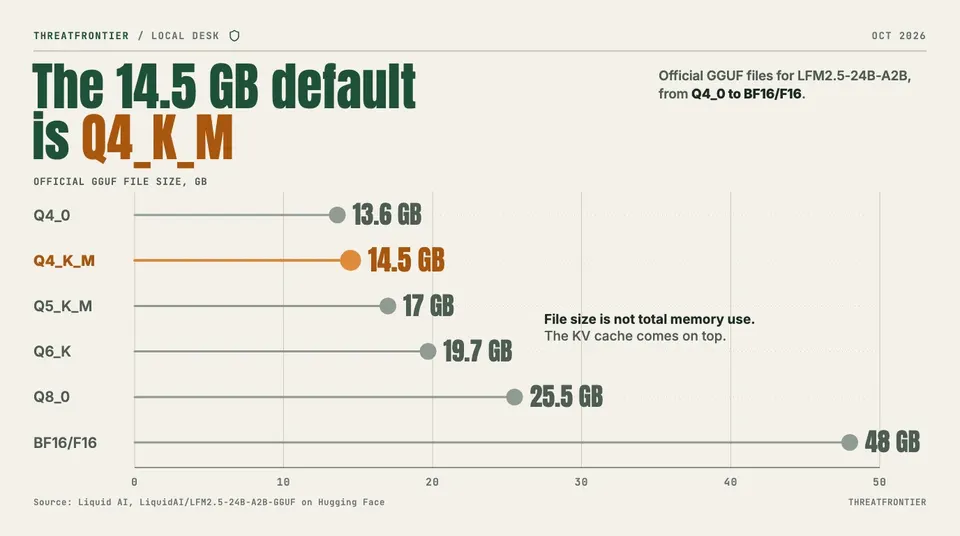
Official GGUF file sizes for LFM2.5-24B-A2B. File size is not total memory use: KV cache and runtime overhead come on top. Source: Liquid AI on Hugging Face.
Liquid publishes official GGUF, MLX 4-bit, FP8 and ONNX repositories. GGUF sizes: Q4_0 13.6 GB, Q4_K_M 14.5 GB, Q5_K_M 17 GB, Q6_K 19.7 GB, Q8_0 25.5 GB, BF16/F16 48 GB. File size is not total memory use, so allow headroom for KV cache. By file size alone, Q4_K_M suggests a 24 GB machine is tight and 32 GB comfortable. The 184 and 114 tokens/s figures use llama.cpp at Q4_K_M with a 4K input context; longer contexts will be slower. Liquid claims it runs up to 1.7x faster than comparable MoEs on-device and uses the least memory, but gives no memory figure, and the 184 and 114 tokens/s numbers are not a head-to-head run against Qwen on the same machine. For sizing a Mac against other open-weight models, see Best Open-Weight AI Models for a 128GB Apple Silicon Mac in 2026; for smaller GPUs, see Best Local LLM for 16GB in 2026. Runtimes include llama.cpp, MLX, vLLM, SGLang, LM Studio and Docker Model Runner. On a single B300 with SGLang (BF16), it exceeds 21K output tokens/s at high concurrency. Liquid's hosted API costs $0.10 per million input tokens and $1.00 per million output.
What to do
- Choose LFM2.5 for local tool-calling and workflow agents where instruction adherence and speed matter and revenue is under the licence threshold.
- Choose Qwen3.6-35B-A3B for coding agents and science-heavy reasoning, or where Apache-2.0 is required.
- Run your own task evals before switching; vendor benchmarks use varying harnesses and temperatures.
- If you use LFM2.5 for open-ended knowledge work, add retrieval.