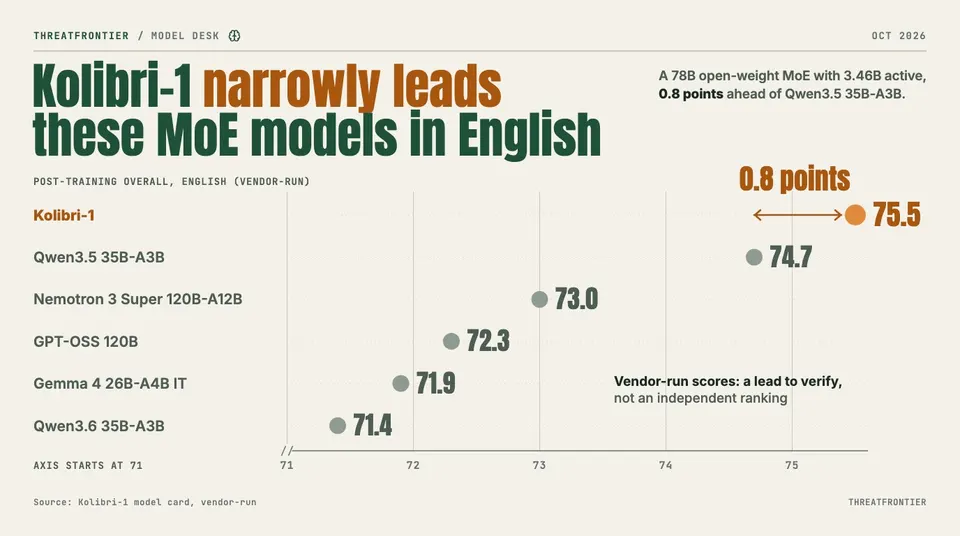
Aleph Alpha's Kolibri-1 is an Apache-2.0, German-English 78B MoE with 3.46B active parameters and a 1M-token context that fits on a single H200.
Aleph Alpha released Kolibri-1 on 3 October 2026 as open weights on Hugging Face under Apache 2.0. It is a bilingual German and English mixture-of-experts reasoning model with 78B total parameters, of which 3.46B are active per token, and a context window of 1,048,576 tokens. The FP8 weights take about 78 GB, so the vendor lists one H200, B200 or B300, or two 80 GB A100 or H100 cards, as the minimum. Teams that want to run a sovereign model on their own hardware, particularly in the EU, are the target audience.
What was released
The card describes a 50-layer transformer with 384 routed experts plus one shared expert per layer and top-6 routing. Attention alternates sliding-window and full GQA at a 4:1 ratio, with a 512-token window. Weights are FP8 (e4m3, 128x128 blocks); embeddings, LM head, norms and router stay in BF16. The model has a reasoning mode with selectable effort and supports tool calling.
Training used 20T tokens (the card says about 62.5% English, 23.9% German, 13.6% code; the blog gives 21.3% German, so treat the split as approximate), plus 3.44T mid-training and 201B long-context tokens, on 768 B200 GPUs. The knowledge cutoff is 18 June 2026. The license covers weights and config files only; training code is not released, so this is open-weight rather than fully open source. Aleph Alpha is a signatory of the EU GPAI Code of Practice.
Native training context is 262,144 tokens. Aleph Alpha says quality and serving efficiency were validated to 1M and recommends staying at or below 262,144 for latency-sensitive or complex work.
Benchmarks, read column by column
All figures are vendor-reported. We re-parsed the raw README table cell by cell against its headers; columns and rows line up.
Post-training Overall (English / German):
Kolibri                       75.5 / 70.8
Qwen3.5 35B-A3B               74.7 / 69.8
Nemotron 3 Super 120B-A12B    73.0 / 67.9
GPT-OSS 120B                  72.3 / 70.2
Gemma 4 26B-A4B IT            71.9 / 66.3
Qwen3.6 35B-A3B               71.4 / 67.3
Kolibri Origin (predecessor)  54.1 / 46.4
Qwen3.8 27B (dense)           80.2 / 79.9
Kolibri leads the MoE models but only narrowly over Qwen3.5 35B-A3B, which has a similar active-parameter count. The dense Qwen3.8 27B scores higher on both; the card greys it out and excludes it from the bold and underline marks because it activates several times as many parameters. The jump over Kolibri Origin is large: GPQA Diamond 84.3 vs 68.1, AIME 2025 96.9 vs 81.9, and tau2-bench telecom 94.7 vs 67.5.
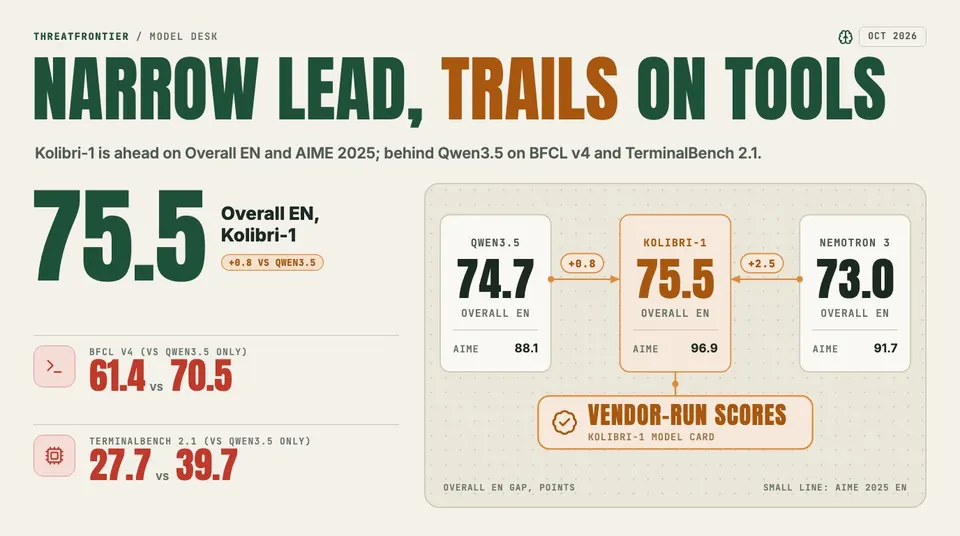
Kolibri-1 leads on maths, trails on tool calling and terminal tasks. Vendor-reported scores from the Kolibri-1 card.
Strengths are maths and reasoning: AIME 2025 96.9 in English against 91.7 for Nemotron 3 Super and 88.1 for Qwen3.5, and GPQA Diamond 84.3. Weaker areas show in the same table. MMLU-Pro is 80.0 against 84.6 for Qwen3.5. BFCL v4 overall is 61.4 against 70.5 for Qwen3.5. TerminalBench 2.1 is 27.7 against 39.7 for Qwen3.5. AA-Omniscience accuracy is 14.8, near the bottom of the field, though its non-hallucination rate of 44.0 is well above most peers, meaning it abstains more than it guesses.
Base model: Kolibri Base scores 81.1 / 81.5 Overall, but Nemotron 3 Super Base, with about 12B active parameters, scores 83.1 / 85.0.
Long context (RULER, base model): Kolibri Base scores 69.8 at 256k and 63.2 at 1M, ahead of Nemotron 3 Nano (72.1 and 58.5) and Qwen3.5 (80.1 and 57.5) only at 1M. At 256k both beat it, and at 4k it trails all but Gemma 4 (84.7). The 1M window is usable, but degrades, and the lead is a few points.
Who should self-host it
For where it sits among smaller open models, see our Ling 3.1 Flash vs GLM 5.3 Flash vs Qwen 3.8 Flash Next comparison.
- EU and German organisations needing on-premise or sovereign inference, with an Apache 2.0 license and no data leaving the premises.
- Teams with German-language workloads: Kolibri's German Overall of 70.8 is the highest of the compared MoE models, 0.6 ahead of GPT-OSS 120B and 1.0 ahead of Qwen3.5.
- Long-document and RAG users with one or two 80-141 GB GPUs. Aleph Alpha's blog claims 18 concurrent long-context requests on two H100s against 3 for a 123B model, and 28% faster decode. That is a vendor measurement.
- Maths and reasoning-heavy pipelines.
Look elsewhere if you need top agentic coding or function-calling scores, English-only deployments where Qwen3.5 is comparable, or a single GPU with large concurrent KV caches: 78 GB of weights on a 141 GB H200 leaves limited room for 1M-token contexts (our arithmetic, not a vendor figure).
Deployment notes
Aleph Alpha serves the model through vLLM using its aleph-alpha-inference package, available as a container or from GitHub. It recommends temperature 1.0, top_p 0.97 and top_k 128, and an FP8 KV cache. Because the weights are a third-party download, pin the Hugging Face revision, verify hashes, and run it in an isolated inference environment with no outbound network access, particularly when tool calling is enabled.