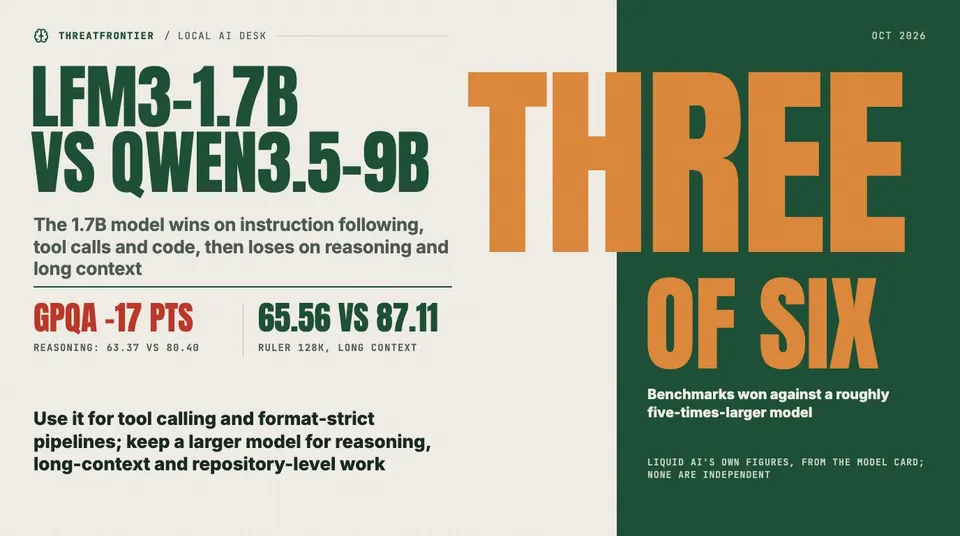
Liquid AI's own table shows LFM3-1.7B ahead on IFEval, BFCL and LiveCodeBench but 17 points behind on GPQA. Ollama 0.40.13 runs it on every desktop.
Liquid AI's LFM3-1.7B, a 1.73-billion-parameter text model, outscores Alibaba's roughly five-times-larger Qwen3.5-9B on three of six benchmarks Liquid chose to report, and trails it on the other three. Ollama 0.40.13, released on 28 October, brings the LFM3 family to Linux and Windows, so most developers can now run it locally with one command. All figures below are Liquid AI's own, from the model card; none are independent. For the previous generation, see our LFM2.5-24B-A2B vs Qwen3.6-35B-A3B comparison.
Where the small model wins
| Benchmark | LFM3-1.7B | Qwen3.5-9B |
|---|---|---|
| IFEval | 96.66 | 92.08 |
| BFCL V4 | 71.39 | 62.83 |
| LiveCodeBench v6 | 73.46 | 69.86 |
| GPQA Diamond | 63.37 | 80.40 |
| SWE-bench Verified (OpenCode) | 43.40 | 51.20 |
| RULER 128K | 65.56 | 87.11 |
LFM3 leads on instruction following (IFEval), function calling (BFCL V4) and competitive-programming problems (LiveCodeBench v6). The card also gives a headline average of 49.37 for LFM3 against 47.24 for Qwen. That figure is not the mean of the six rows above, so it covers Liquid's wider table; the narrow lead it shows hides how far apart the two models are on individual tests.
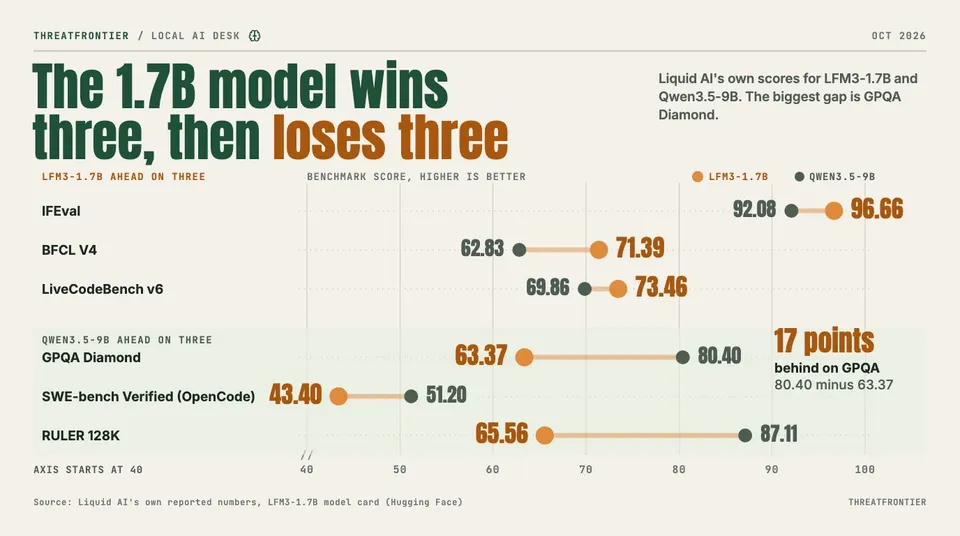
Liquid AI's own table: LFM3-1.7B leads Qwen3.5-9B on IFEval, BFCL V4 and LiveCodeBench v6, then trails on GPQA Diamond, SWE-bench Verified (OpenCode) and RULER 128K.
Where it loses
The gaps are larger on the losing side. On GPQA Diamond, graduate-level science questions, LFM3 is 17 points behind. On RULER at 128K tokens, a long-context retrieval test, it trails by about 21.5 points, even though the model advertises a 256K context window. On SWE-bench Verified with the OpenCode harness it scores 43.40 against 51.20. Liquid itself says the model is not recommended for agentic coding or complex multi-step reasoning, and that knowledge-heavy work should use retrieval or search.
Which jobs it suits
The card points to local agents, tool calling and structured outputs, plus domain fine-tuning (SFT, DPO, GRPO, continued pretraining via TRL). The architecture is mostly short convolutions: 13 gated short-convolution layers, 5 sliding-window attention layers and 6 global attention layers. At 4-bit it needs about 1 GB of memory. That fits routers, extractors, function-calling front ends and format-strict pipelines, where IFEval and BFCL scores matter more than GPQA. It is a poor fit for answering factual questions from memory, working across very long documents, or driving a coding agent through a repository.
Running it in Ollama
Ollama v0.40.12 (27 October) introduced the LFM3 family on Apple silicon only. v0.40.13 (28 October) added Linux and Windows. Update, then run:
ollama run lfm3
The lfm3:1.7b tag (also latest) is 1.1 GB to 1.7 GB, with 256K context, and Ollama lists tools and thinking capabilities. Ollama's page also lists ollama launch <app> --model lfm3 for Claude Code, OpenCode, Hermes Agent and OpenClaw. Liquid recommends temperature 0.1, top_k 50 and repetition_penalty 1.1 for chat, tools, agents and coding; for math and STEM use temperature 1.0, top_p 0.95, top_k 20. Other routes on the card are vLLM (vllm serve "LiquidAI/LFM3-1.7B") and Docker Model Runner.
What to do
Test it on your own tool-calling and format-compliance cases before swapping it in, since vendor tables pick their rows. Keep a larger model for reasoning, long-context and repository-level work.