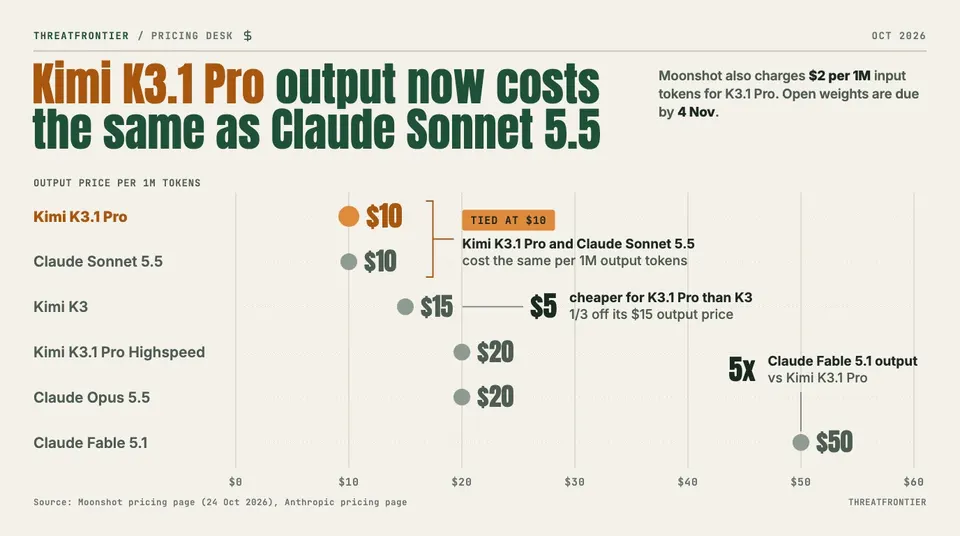
Moonshot prices Kimi K3.1 Pro at $2/$10 per million tokens, down from K3's $3/$15 and level with Claude Sonnet 5.5, with memberships from $15 to $159 a month.
Moonshot AI has released Kimi K3.1 Pro and priced it below its own predecessor. API access costs $2 per million input tokens and $10 per million output tokens, down from $3 and $15 for Kimi K3. A faster variant, K3.1 Pro Highspeed, costs $4 and $20. The weights are described as open and are due "by Nov 4, 2026", about ten days after this writing. Developers choosing a coding model, and anyone paying for a Claude, ChatGPT or open-model coding subscription, now have a new price point to compare against.
This article covers pricing and packaging only. Moonshot's own pages give benchmark figures that disagree with each other, so none are quoted here.
What Moonshot is selling
Kimi K3.1 Pro is the first model in the K3.1 series and a post-trained version of K3. Moonshot calls it its "most capable 3T-class open-weight model to date." It is available on Kimi.ai and the mobile apps, in Kimi Work and Kimi Code, and through the Kimi API under the ids kimi-k3.1-pro and kimi-k3.1-pro-highspeed. Moonshot says the Highspeed variant delivers 2-3x the speed of the base model. Zero Data Retention is available to API customers, and enterprise administrators must switch the model on, because access is off by default at launch.
The context window is 1M tokens (1,048,576 in the API documentation). Output defaults to 131,072 tokens and can be raised to 1,048,576. Thinking is always on, with reasoning_effort set to low, high or max (max is the default). Sampling parameters such as temperature and top_p are fixed.
The price list
Moonshot's pricing page, updated on 24 October 2026, lists these API rates per million tokens:
| Model | Input | Cached input | Output | Cache write (5 min / 1 h) |
|---|---|---|---|---|
| K3.1 Pro | $2.00 | $0.20 | $10.00 | $2.00 / $4.00 |
| K3.1 Pro Highspeed | $4.00 | $0.20 | $20.00 | $4.00 / $8.00 |
| K3 | $3.00 | $0.30 | $15.00 | not listed |
Each K3.1 Pro rate is 2/3 of the K3 price, a third less, on input, cached input and output alike. Highspeed doubles the input, output and cache-write rates but leaves the cached-input rate at $0.20, so a cache-heavy agent loop pays far less than 2x for the faster model. Billing is flat pay-as-you-go with no tiering by context length. API access unlocks after a top-up of at least $1, and cumulative top-ups set the account's rate limits.
The consumer memberships run from Free through Plus ($15), Pro ($31), Max ($79) and Ultra ($159) a month. Those are effective monthly prices under annual billing. The page does not show annual totals or monthly-billing prices, so the real up-front cost cannot be read from it. The extra-long chat capacity of up to 1M tokens applies only to Max and Ultra.
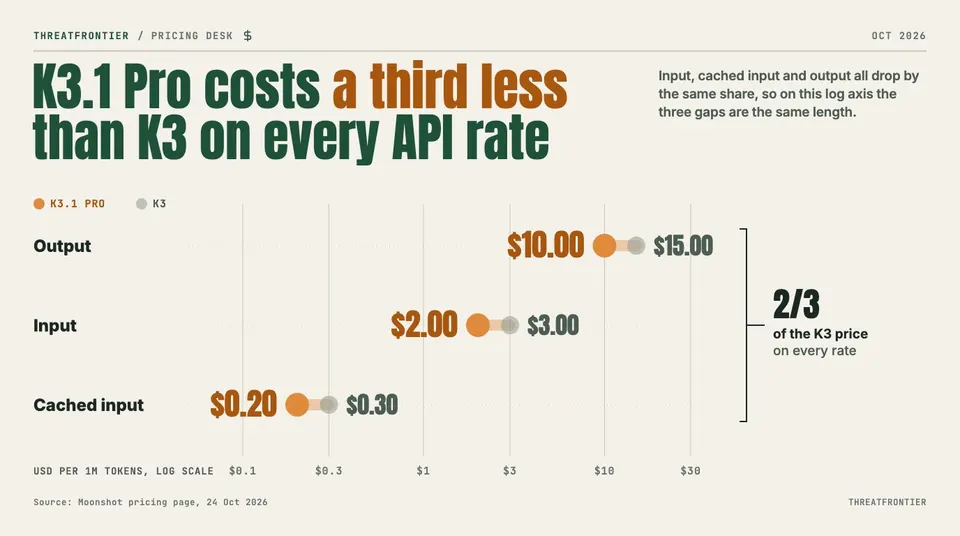
K3.1 Pro cuts every K3 API rate by a third. Prices per million tokens, from Moonshot's pricing page of 24 October 2026.
How it compares
Claude. Anthropic's pricing page lists Sonnet 5.5 at $2 input and $10 output per million tokens, the same headline rate as K3.1 Pro. Opus 5.5 is $4/$20, the same as K3.1 Pro Highspeed, and Fable 5.1 is $10/$50. On output, K3.1 Pro is $5 below K3 and Fable 5.1 costs 5x as much. A matching price does not mean matching quality or token efficiency, and this article does not rank the models. On subscriptions, Claude Pro is $17 a month with annual billing ($20 monthly) and Max starts at $100, at 5x or 20x Pro usage. Kimi's Plus at $15 and Pro at $31 bracket Claude Pro; Ultra at $159 sits above Claude's entry Max tier.
ChatGPT. OpenAI's Codex pricing page lists ChatGPT Go at $8, Plus at $20, and Pro plans at $100, $200 or $500 a month, with Codex included from Free upward. Pro plans currently have no five-hour limit. The Plus plan is described as suited to "a few focused coding sessions each week." OpenAI's plans bundle its own models, whereas Kimi's memberships and API serve Moonshot's.
The $10 open-model plans. Two $10 products now give access to open and aggregated models:
- OpenCode Go costs $10 a month and lists 30 models, including both Kimi K3.1 Pro and Kimi K3. Limits are set in dollars per model: 20% of the monthly limit per 5 hours, 50% per week and 100% per month. For K3.1 Pro the monthly limit is $15, which OpenCode estimates at about 147 requests per 5 hours, 368 per week and 735 per month. Go Plus costs $40 with a $60 monthly limit for the same model.
- Command Code GOAT costs $10 a month plus a processing fee and includes $80 of monthly credits (up to about $100 with deals) across 33-plus open models. The page text read for this article does not name K3.1 Pro, and credit value differs by model.
For a developer who mainly wants Kimi's model inside a coding agent, the $10 aggregators cap usage tightly, while Moonshot's API has no stated spend cap beyond account tier. The break-even depends on token volume, which these pages do not let us estimate.
What to do
- Re-price before you switch. Compare cost per completed task on your own workload, not list price. Always-on thinking at max effort by default can inflate output tokens, which are billed at $10 per million. Set
reasoning_effortdeliberately. - Use caching. Cached input is $0.20 per million, a tenth of the base rate. Long agent sessions with stable prefixes benefit most; note the 5-minute default TTL and the separate cache-write charge.
- Treat "open weights" as pending. The weights are only promised by 4 November, and none of the pages read state a licence. Do not plan self-hosting or redistribution until the licence is published.
- Check data handling. Zero Data Retention is available for API customers. Enterprises should confirm the model is enabled in their admin settings before assuming access.
- Mind the migration clock. Moonshot says its K2 series becomes unavailable to newly registered users from 31 October 2026 and will be retired by the end of December 2026.
Open questions
Moonshot has not published a licence for the weights, annual membership totals, or a release date for the launch itself beyond "available today." Its platform pricing page also rendered with empty tables when we read it, so the figures above come from the consumer-facing pricing page.