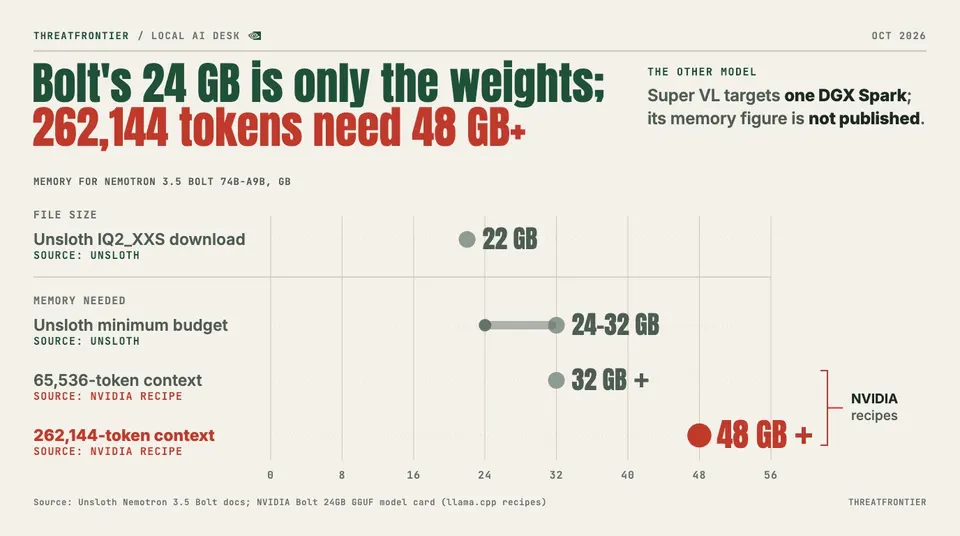
Bolt's 24 GB is its 2-bit weights; budget 32 GB+ for real context. Super VL is a DGX Spark model with no published memory figure. What each needs.
NVIDIA released two open-weight Nemotron 3.5 models on 15 October 2026, and they suit very different machines. Nemotron 3.5 Bolt 74B-A9B has a native 2-bit build whose weights take about 24 GB, but 24 GB is the weights, not the whole job: Unsloth budgets 24–32 GB of memory for its 22 GB GGUF, and NVIDIA's own llama.cpp recipes ask for a discrete GPU with 32 GB+ for a 65,536-token context and 48 GB+ for the full 262,144-token context. Nemotron 3.5 Super VL 120B-A12B ships in NVFP4 and targets a DGX Spark or datacentre GPUs; NVIDIA has not published a memory figure for it. Benchmark figures for both models below are reported by NVIDIA and have not been independently reproduced, unless a third party is named.
The short answer
- 24 GB GPU: Bolt, with a short context. The weights load, but NVIDIA's documented recipes start at 32 GB. Super VL has no documented consumer-GPU target.
- Mac: Bolt may run through llama.cpp or Unsloth's GGUF route on a Mac with 32 GB or more of unified memory, but NVIDIA does not document it. Its GGUF card lists only Ada Lovelace and Blackwell GPUs on Windows and Linux.
- DGX Spark: Super VL. NVIDIA lists one DGX Spark as a deployment target for it.
A smaller Bolt E4B (4 GB) is due on 23 October.
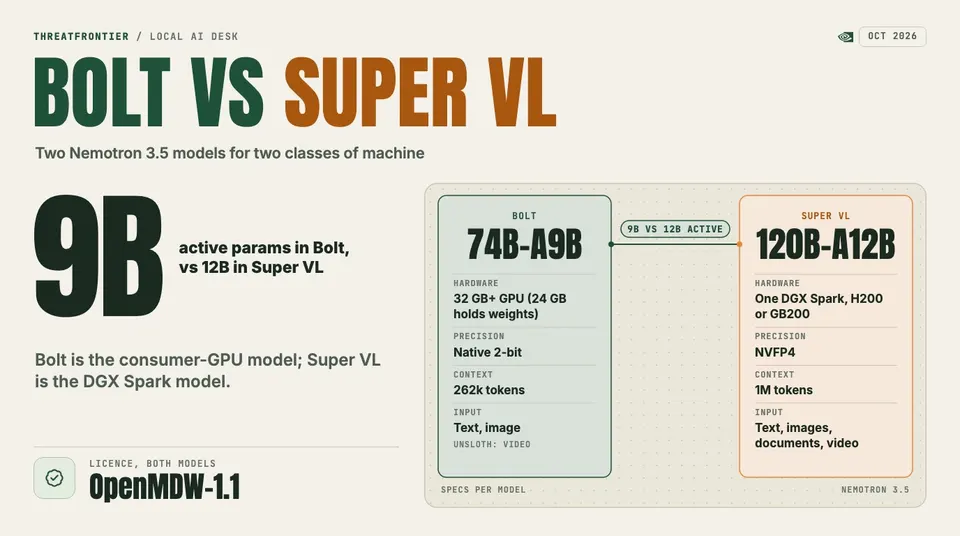
Bolt (9B of 74B active, native 2-bit, 262k tokens) against Super VL (12B of 120B active, NVFP4, 1M tokens); both use the OpenMDW-1.1 licence.
Nemotron 3.5 Bolt 74B-A9B
Bolt is a mixture-of-experts model with 74B total and 9B active parameters, a hybrid of Mamba-2, attention and MoE layers, with text and image input (Unsloth also documents video) and a reasoning mode. Its context is 262k tokens. The licence is OpenMDW-1.1, which allows commercial use.
Artificial Analysis, an independent benchmarker, scores it 21 on its Intelligence Index (v4.3.2), fourth of 67 in its class, against a median of 8 for comparable open-weights models. It is verbose: 230M output tokens on the index against a 100M median, so expect long reasoning traces, which run slowly on modest hardware.
NVIDIA's own table compares the 2-bit 24 GB build with BF16 (vendor-reported):
| Benchmark | 24 GB IQ2 | BF16 |
|---|---|---|
| GPQA Diamond | 86.43 | 88.83 |
| Terminal-Bench 2.1 | 50.98 | 53.93 |
| BrowseComp | 66.75 | 70.00 |
| PinchBench | 87.82 | 90.35 |
| HLE (no tools) | 25.30 | 28.73 |
The 2-bit build gives up between two and four points on each row. NVIDIA says the BF16 release is for customisation and post-training, not for running at home.
Memory: what "24 GB" means
The Unsloth IQ2_XXS GGUF is a 22 GB download. Unsloth estimates a minimum of 24–32 GB of memory, says to budget about 32 GB for short contexts, and 48–64 GB for headroom. Long contexts and image or video input need more for the cache and the vision projector, and the 998 MB draft model needs 1–2 GB on top.
NVIDIA's llama.cpp recipes on the GGUF card point the same way:
- 262,144-token context with speculative decoding: an RTX Spark with 128 GB, or a discrete GPU with 48 GB or more.
- 65,536-token context with a q8_0 KV cache: an RTX Spark with 64 GB, or a discrete GPU with 32 GB or more.
So a 24 GB card holds the weights, but full context is not realistic there. Unsloth advises starting at 4K tokens and growing as memory allows, up to 128K.
Nemotron 3.5 Super VL 120B-A12B
Super VL is a 120B total, 12B active MoE that takes text, images, documents and video, distilled from Nemotron 3 Ultra. Context goes to 1M tokens. The licence is also OpenMDW-1.1.
NVFP4 uses 4-bit weights and activations on Blackwell; the same checkpoint runs on other hardware with 4-bit weights and 16-bit activations. NVIDIA's card lists one DGX Spark, one H200, two H100s or one GB200 as targets. It does not publish a minimum memory figure or a file size, so check the repository before you download. The DGX Spark example sets --gpu-memory-utilization 0.75, and the TensorRT-LLM recipe for it uses a 131,072-token context.
On DGX Spark NVIDIA recommends its LiLiCorr drafter, which it says gives up to 2.3x faster token generation than decoding without speculation. That is NVIDIA's maximum, not a measured average.
All of the following results are vendor-reported. NVIDIA gives CharXiv reasoning 80.8 and Hermes Bench 63.44%, against 56.33% for Nemotron 3 Ultra. SWE-bench Verified is 71.1, and GPQA-Diamond is 89.5 in BF16 and 89.9 in NVFP4. On the rows NVIDIA published, the NVFP4 checkpoint stays within about a point of BF16.
Runtimes
| Runtime | Bolt | Super VL |
|---|---|---|
| llama.cpp | GGUF recipes from NVIDIA and Unsloth | Listed on the card |
| Ollama | ollama run hf.co/nvidia/NVIDIA-Nemotron-3.5-Bolt-74B-A9B-24GB-GGUF | Listed in NVIDIA's blog |
| LM Studio | Listed in NVIDIA's blog | Listed in NVIDIA's blog |
| vLLM | Primary runtime; needs VLLM_USE_V2_MODEL_RUNNER=1, --trust-remote-code and a reasoning parser plugin | Listed on the card |
| SGLang, TensorRT-LLM | SGLang listed | Both listed, plus NIM and Dynamo |
For the 2-bit Bolt, llama.cpp gives the most control and is the route NVIDIA's memory recipes are written for. Ollama and LM Studio are easier, but NVIDIA does not say how they handle the speculative drafter or long contexts.
What to buy
- Single 24 GB GPU: run Bolt IQ2_XXS with a short context and expect to keep the window small. A 32 GB card is the floor NVIDIA's recipes assume.
- Mac with 32 GB or more: Bolt IQ2_XXS is plausible through llama.cpp or Unsloth, though NVIDIA does not document Macs; 48–64 GB gives real context headroom. Super VL has no documented Mac route.
- DGX Spark: Super VL in NVFP4 with the LiLiCorr drafter. For other models on the box, see Best Local AI Models to Run on Your DGX Sparks.
- Smaller machines: wait for Bolt E4B on 23 October, or see our guide to the best local LLM for 16GB VRAM.
Sources
- NVIDIA: Nemotron 3.5 Bolt 74B-A9B 24GB GGUF model card
- NVIDIA: Nemotron 3.5 Bolt 74B-A9B BF16 model card
- NVIDIA: Nemotron 3.5 Super VL 120B-A12B NVFP4 model card
- NVIDIA blog: Nemotron 3.5 Super VL
- NVIDIA developer blog: Nemotron 3.5 Super VL powers specialized agents with multimodal reasoning
- Unsloth: Nemotron 3.5 Bolt docs
- Artificial Analysis: Nemotron 3.5 Bolt 74B-A9B