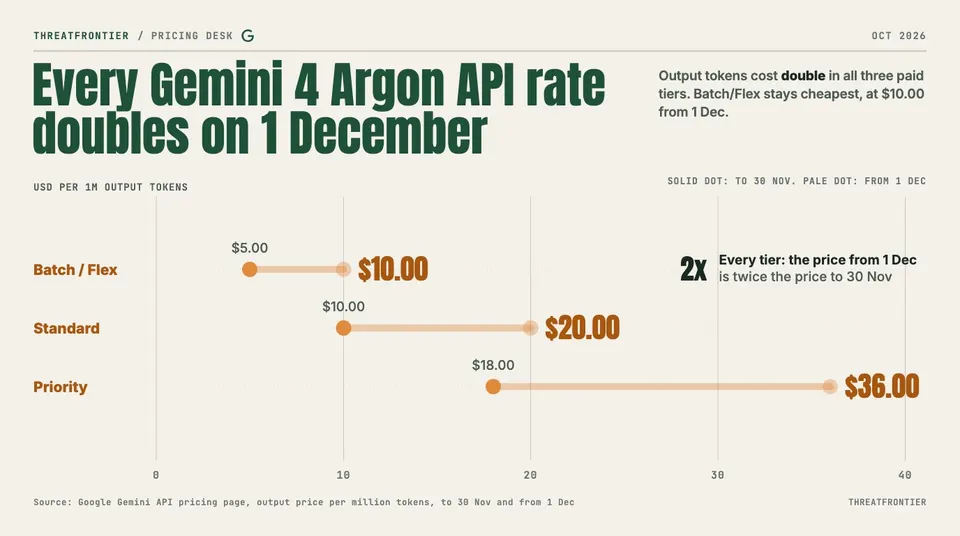
Gemini 4 Argon's introductory $2/$10 per million tokens ends 30 November. Every paid API tier doubles on 1 December; here is the cost and where to use it.
Google's $2 per million input tokens and $10 per million output tokens for Gemini 4 Argon is an introductory price. Google's pricing page shows it holding through 30 November 2026, then rising to $4 and $20 from 1 December. Every paid tier doubles with it, so a team that sized its budget on launch rates will see the API bill double within weeks. Our earlier comparison covers how the model stands against GPT-6 Astra and Claude Opus 5.5. This piece covers cost and access.
The price table
Rates are per million tokens on the paid tiers, as listed on Google's pricing page.
| Tier | Input to 30 Nov | Input from 1 Dec | Output to 30 Nov | Output from 1 Dec | Cached to 30 Nov | Cached from 1 Dec |
|---|---|---|---|---|---|---|
| Standard | $2.00 | $4.00 | $10.00 | $20.00 | $0.10 | $0.20 |
| Batch | $1.00 | $2.00 | $5.00 | $10.00 | $0.05 | $0.10 |
| Flex | $1.00 | $2.00 | $5.00 | $10.00 | $0.05 | $0.10 |
| Priority | $3.60 | $7.20 | $18.00 | $36.00 | $0.18 | $0.36 |
There is no Free tier for Argon. Caching is implicit only; explicit caching is not supported. The page lists no prompt-length price tiers for this model. Google's launch post describes the $2/$10 rate as introductory and the $4/$20 rate as the one that applies afterwards.
A worked example
ThreatFrontier's example workload is 100 million input tokens and 20 million output tokens a month. That volume is our assumption, not a Google figure; the arithmetic uses the published rates.
| Scenario | Until 30 Nov | From 1 Dec |
|---|---|---|
| Standard, no caching | $400 | $800 |
| Batch or Flex | $200 | $400 |
| Priority | $720 | $1,440 |
| Standard, 70M of the input cached | $267 | $534 |
Caching and Batch or Flex lower the bill but not the slope: the doubling applies to each. The cheapest lever after 1 December is moving latency-tolerant work to Batch or Flex, which at the new rates costs the same as Standard did during the launch window. Output weighs heavily: in the standard case, output is half of the example bill.
Who can use Argon where
Google announced Argon on 30 September 2026, with initial access through its Fairwind Program for trusted cyber defenders. Since 13 October it has been in the Gemini app and in GitHub Copilot.
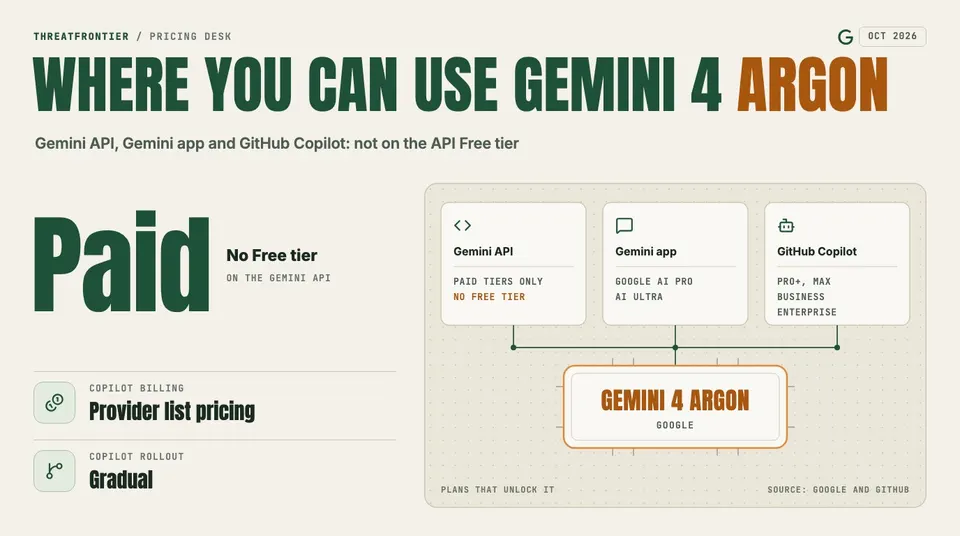
Gemini 4 Argon is on the Gemini API's paid tiers, in the Gemini app for Google AI Pro and Ultra subscribers, and in GitHub Copilot Pro+, Max, Business and Enterprise.
- Gemini API: paid tiers only.
- Gemini app: Google AI Pro and Ultra subscribers. For what the cheaper app plans now get, see our piece on the Gemini app limit cuts.
- GitHub Copilot: Pro+, Max, Business and Enterprise, in VS Code, Visual Studio, Copilot CLI, the coding agent, the Copilot app, JetBrains, Xcode and Eclipse. Rollout is gradual. GitHub says Copilot bills the model at provider list pricing under usage-based billing. Business and Enterprise admins control access through the model policy in Copilot settings.
Subscription access is a separate route from API billing. GitHub's changelog does not say whether Copilot's rate for Argon changes on 1 December, so check your plan's billing page rather than assuming either way.
What to do before 1 December
- Measure real input and output token counts per task now, while the rate is low, and rebuild the budget at $4/$20.
- Move work that can wait to Batch or Flex.
- Structure prompts so repeated prefixes can hit implicit caching.
- Copilot Business and Enterprise admins: decide under the model policy whether Argon should be on for your organisation.
- Do not plan around a Free tier; there is none.