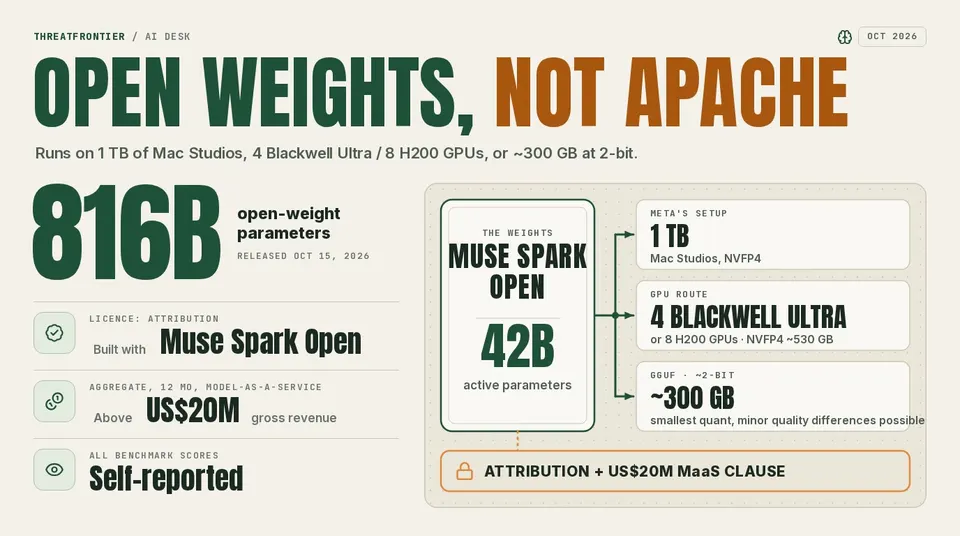
Meta's 816B Muse Spark Open runs on 1 TB of Macs, four Blackwell GPUs or ~300 GB at 2-bit. The licence is not Apache; all scores are self-reported.
Meta released Muse Spark Open on October 15: an 816B-parameter mixture-of-experts model with 42B active parameters, a 1M-token context and text, image, video and audio input. The weights are on Hugging Face under Meta's own Muse Model License, behind a manual approval gate. How much hardware you need depends on the format: 1 TB of Mac Studios for Meta's NVFP4 setup, four Blackwell Ultra GPUs for a server, or about 300 GB for the smallest GGUF. On Meta's own comparison table, it trails Qwen3.8, GLM 5.3 and Kimi K3 on most coding benchmarks and loses to Reflection's Beam on Terminal-Bench. Every score below is self-reported.
What the card says
The model card lists 62 layers, hidden size 8192, 128 query and 16 key-value heads, 256 experts with 8 active per token, and a 202,048-token vocabulary. Recommended sampling is temperature 1.0, top-p 1.0, top-k disabled, with reasoning effort set to high or xhigh. Access is gated: the repository requires manual approval, and you submit your first and last name, date of birth, country and affiliation before Meta lets you download.
Hardware: four ways to run it
Meta's developer blog gives the NVFP4 checkpoint as about 530 GB, "about a third the size of BF16" (about 1.6 TB). Our VRAM math across quantization formats explains how file size maps to memory. The routes Meta names:
- Mac Studio cluster (NVFP4, MLX). Two M5 Ultra Mac Studios with 512 GB of unified memory each, or four with 256 GB each, 1 TB in total, linked by Thunderbolt 5 with RDMA. This is the setup behind TechCrunch's "at least 1 TB of RAM" line, which cites Engadget. A single Mac Studio does not hold the NVFP4 weights.
- GPU server (NVFP4). Four Blackwell Ultra GPUs or eight H200s; TensorRT-LLM serves it on a single four-GPU Blackwell node. The card lists minimums of 700 GB of VRAM for NVFP4 and 2 TB for BF16, which exceed the file sizes; we read that as headroom for KV cache but could not confirm it.
- Other vendors' formats. AMD has FP8 and MXFP4. Intel has INT4 GPTQ for Xeon 6 and MXFP4 for the upcoming Crescent Island, which Meta says fits on four 160 GB cards.
- Unsloth GGUF down to about 2-bit. Meta says it runs locally on a 256 GB setup with llama.cpp, and the smallest version fits in about 300 GB of combined RAM and VRAM, or unified memory on Apple silicon. The card warns that quantized inference "may show minor quality differences".
So a single 512 GB Mac Studio can in principle hold the 2-bit file, at a quality cost nobody has independently measured yet. For machines in the 128 GB class, see our Apple silicon guide: Spark Open is out of reach there.
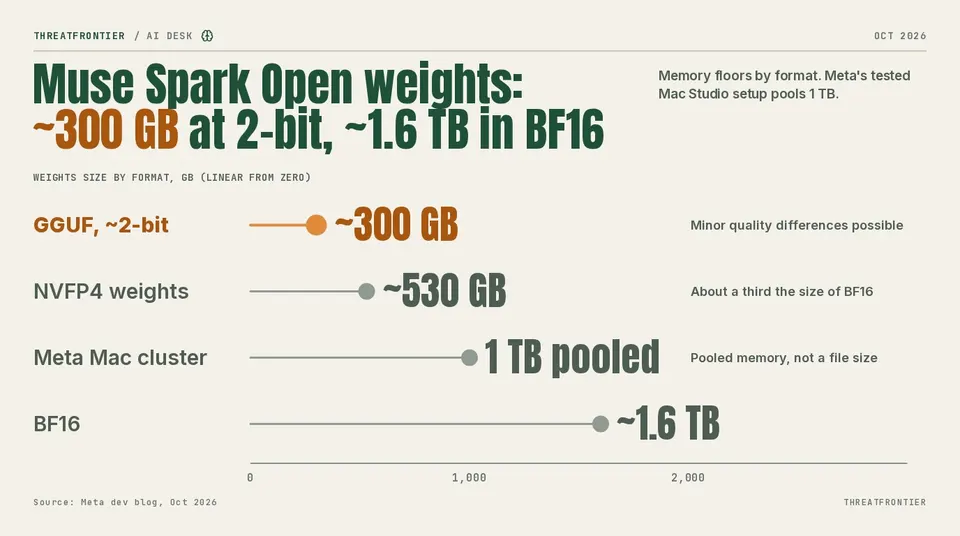
Weight sizes by format; the 1 TB Mac Studio cluster is pooled memory, not a file size.
Licence: read the conditions
We read the licence text. It grants rights to use, copy, modify (including fine-tune), distill, merge, distribute, sublicense and sell, subject to these conditions:
- Attribution. Products or services using the model or any Derivative must display "Built with Muse Spark Open" in the interface, or in documentation, website or settings menu.
- Derivatives are broad. The definition covers any AI model "created, trained, modified (including fine-tuned), distilled, or otherwise improved using the Software or any outputs or results thereof". The attribution and Usage Policy follow those models.
- Model as a Service. If you or your affiliates give third parties API-style access to models and your aggregate gross revenue exceeds US$20 million in any 12 months, you must notify Meta and sign a separate agreement before offering the model or Derivatives that way. The threshold is the licensee's and affiliates' total gross revenue, not MaaS revenue. Internal use, research, other commercial activity, and powering features of your own non-MaaS product are excluded. We found no monthly-active-user clause.
- Usage Policy. Incorporated as Exhibit A. It bars, among other things, malicious code, military, warfare, nuclear and espionage uses, operating critical infrastructure, and representing outputs as human-generated. It says the model is not intended for people under 18.
- Outputs. Meta claims no ownership.
Compare Reflection's Beam, whose card states Apache 2.0, with no attribution string or revenue trigger.
Benchmarks: Meta's own table
The model card's Benchmarks section compares Spark Open at xhigh effort with Inkling, Nemotron 3 Ultra, Beam, Mistral Large 4, Qwen3.8-2.4T-A95B, GLM 5.3 and Kimi K3. These are Meta's numbers, and its research post says a full evaluation report is "available soon". Selected rows ("not listed" means Meta's table gives no Beam figure in our reading):
| Benchmark (Meta's table) | Spark Open | Beam | Qwen3.8 | GLM 5.3 | Kimi K3 |
|---|---|---|---|---|---|
| Terminal-Bench 2.1 | 76.4 | 80.1 | 82.0 | 83.9 | 85.0 |
| DeepSWE 1.1 | 60 | 44 | 57 | 67 | 68 |
| SWE-Atlas-QnA | 58 | 35 | 62 | 59 | 66 |
| GPQA Diamond | 89.0 | 90.5 | 93.5 | 91.7 | 93.5 |
| JobBench | 61.8 | not listed | 52.7 | 61.4 | 54.3 |
| MCP-Atlas | 89.2 | 78.7 | 84.5 | 84.2 | 82.3 |
| HLE-Diamond (no tools) | 26.1 | not listed | 17.3 | 16.4 | 22.2 |
On Meta's numbers Spark Open trails Qwen3.8, GLM 5.3 and Kimi K3 on Terminal-Bench, GPQA and the Artificial Analysis Intelligence Index (39 against 40, 45 and 44), and on DeepSWE against GLM and Kimi. It leads on MCP-Atlas, HLE-Diamond and JobBench (61.8 against GLM's 61.4). It also reports BabyVision 80.2 and VideoMMEv2 61.5. Different vendors use different sampling, so small gaps mean little.
Beam's own card (BF16, temperature 0.7, top-p 0.99) agrees on direction: Terminal-Bench 2.1 80.1, DeepSWE 43.3, SWE Atlas Codebase QnA 31.8, MCP Atlas 80.8, GPQA Diamond 90.6. On both vendors' numbers Beam beats Spark Open on Terminal-Bench, while Spark Open leads clearly on DeepSWE and SWE-Atlas. Beam is the smaller model: 501.3B total and 23.4B active parameters.
Beam has now shipped
Our October 14 piece said Beam's weights had not shipped. Reflection's blog now lists "Beam is now available" on October 16, 2026, and the Beam-1.0-501B-A23B card is live under Apache 2.0 in BF16, FP8 and NVFP4. The card lists no hardware requirements. Its figures differ from the launch post (SWE-Bench Verified 81.6 against 80.9 earlier), so the card was revised.
Runtimes, hosts and price
Day-one runtimes: SGLang, vLLM, TensorRT-LLM, Hugging Face Transformers, MLX, llama.cpp and Unsloth. Meta names Baseten, Fireworks AI, Modal, Nebius, OpenRouter and Together AI as hosts, with Groq in limited preview. Amazon SageMaker AI, Google Cloud Model Garden and Microsoft Foundry Models are model catalogs, where you download the weights into your own instances. Meta published no per-token prices. On October 17, OpenRouter's API listed meta/muse-spark-open at US$1.25 per million input tokens and US$4.25 per million output tokens with a 1,048,576-token context, served by Modal, Together, Nebius (fp4), Fireworks and Baseten (fp4). Modal lists a 1,000,000-token context. See our open-model pricing comparison for other hosts.
What to do
- Pick the format before buying hardware: 1 TB of unified memory for NVFP4 on Macs, four Blackwell Ultra or eight H200 GPUs, or about 300 GB for a 2-bit GGUF if you accept the quality risk.
- Request Hugging Face access early; approval is manual.
- If you resell inference above the revenue line, talk to Meta first.
- Add the attribution string and carry the Usage Policy into fine-tunes and distills.
- Treat all scores as vendor claims until independent runs appear.