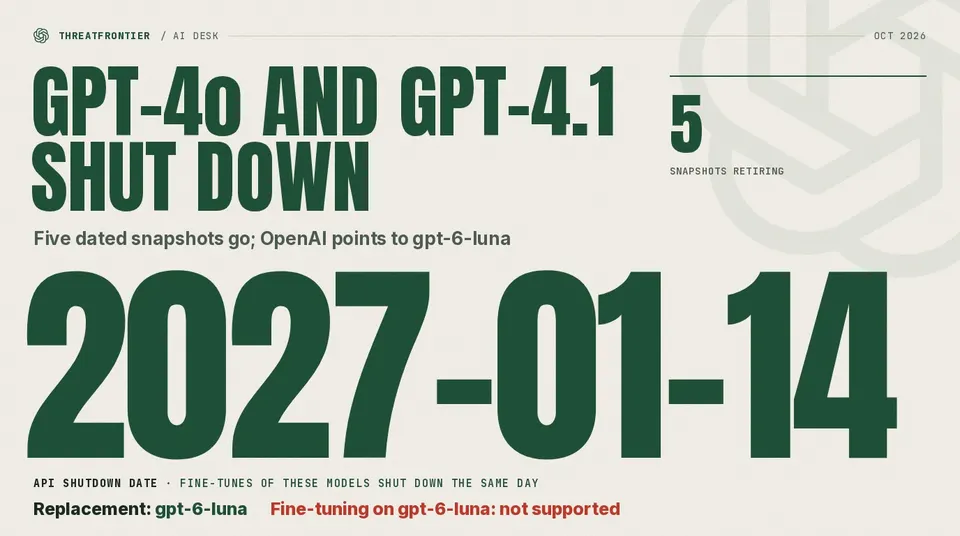
OpenAI will shut down five GPT-4o and GPT-4.1 API snapshots on 2027-01-14. Here is the gpt-6-luna price table, what breaks, and the dates to hit.
On October 14, 2026, OpenAI told API developers that five GPT-4 series snapshots will be removed on January 14, 2027: gpt-4o-2024-08-06, gpt-4o-2024-11-20, gpt-4o-mini-2024-07-18, gpt-4.1-2025-04-14 and gpt-4.1-mini-2025-04-14. OpenAI's recommended replacement for all five is gpt-6-luna (we covered the GPT-6 Sol and Luna launch). Anyone who pins these snapshot names in production, or runs fine-tunes on them, has about three months. A sixth GPT-4o snapshot, gpt-4o-2024-05-13, goes much sooner, on October 23, 2026. This is separate from the ChatGPT-side retirements covered in GPT-5.5 Retires From ChatGPT and Codex on October 14.
What is retiring and when
Per OpenAI's deprecations page, all five snapshots share the 2027-01-14 shutdown date and the same replacement. The page states that fine-tuned versions follow the same schedule as their base models. Earlier entries from OpenAI's April 22, 2026 batch of legacy-model shutdowns, announced before GPT-6, and later entries have different dates:
| Model | Shutdown | Listed replacement |
|---|---|---|
| gpt-4o-2024-05-13 | 2026-10-23 | gpt-5.6-sol |
| gpt-4.1-nano (gpt-4.1-nano-2025-04-14) | 2026-10-23 | gpt-5.6-luna |
| ft-gpt-4.1-nano-2025-04-14 (fine-tunes) | 2026-10-23 | gpt-5.6-luna |
| tts-1, tts-1-hd, gpt-4o-mini-tts snapshots | 2027-01-06 | gpt-realtime-2.1-mini |
| whisper-1, gpt-4o-transcribe | 2027-02-26 | gpt-live-transcribe or gpt-transcribe |
| gpt-5.1, gpt-5.3-codex | 2027-04-01 | gpt-6-sol |
| gpt-5.4-nano | 2027-04-01 | gpt-6-luna |
chatgpt-4o-latest is already gone: it was removed on 2026-02-17, with gpt-5.1-chat-latest as the replacement. The gpt-5.6-* substitutes belong to the April 2026 batch, where every replacement is a gpt-5.6 model (sol, terra or luna); the five snapshots in the October 14 notice point to gpt-6-luna instead.
Migration table: old model versus gpt-6-luna
Prices are Standard tier, USD per 1M tokens, from OpenAI's pricing page as read on 2026-10-15.
| Model | Input | Cached input | Output |
|---|---|---|---|
| gpt-4o | $2.50 | $1.25 | $10.00 |
| gpt-4o-mini | $0.15 | $0.075 | $0.60 |
| gpt-4.1 | $2.00 | $0.50 | $8.00 |
| gpt-4.1-mini | $0.40 | $0.10 | $1.60 |
| gpt-6-luna | $0.10 | $0.01 | $0.50 |
On list price, gpt-6-luna is cheaper than all four models it replaces in the table (gpt-4.1-nano, retiring October 23, is not one of them; its listed substitute is gpt-5.6-luna). Caveats from the model page: prompts over 272K input tokens are charged 2x the input and cache rates and 1.5x the output rate for the whole request, and regional processing adds 10% where available. Cache writes are listed at $0.125 per 1M tokens. Batch and Flex are priced at 50% of Standard.
gpt-6-luna facts
- Context window 1,050,000 tokens and maximum output 128,000 tokens. For comparison, gpt-4.1 has 1,047,576 context and 32,768 output; gpt-4o has 128,000 context and 16,384 output.
- Knowledge cutoff May 18, 2026.
- Reasoning effort levels: none, low, medium (default), high, xhigh, max. Unlike the old non-reasoning models, the default is medium, so latency and token use can change unless you set
none. That is an inference from the default; test it. - Supports streaming, structured outputs, function calling, file search, image input, web search and prompt caching. Endpoints are Chat Completions, Responses and Batch only; Assistants, Realtime, Embeddings and audio endpoints are not supported. On Chat Completions, function calling works only with
reasoning_effortset tonone; the page says to use the Responses API for built-in tools and function calling. - Fine-tuning is not supported. gpt-4o and gpt-4.1 both support it.
- The page lists no restrictions on temperature, top_p or logprobs, but it also does not confirm they work. We could not verify sampling-parameter behavior; test before cutover.
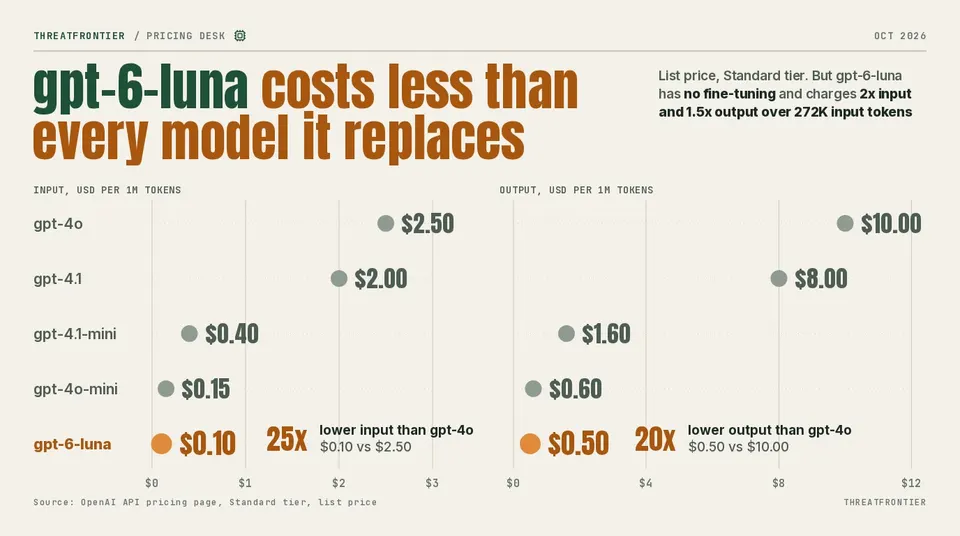
List price per 1M tokens (Standard tier): gpt-6-luna is cheaper than all four retiring models it replaces, but has no fine-tuning, and prompts over 272K input tokens cost 2x on input and 1.5x on output.
What breaks
- Pinned snapshots. Any request naming one of the five dated IDs will fail after 2027-01-14, and
gpt-4o-2024-05-13fails after 2026-10-23. - Plain model names. The gpt-4o and gpt-4.1 pages show the aliases
gpt-4oandgpt-4.1pointing atgpt-4o-2024-08-06andgpt-4.1-2025-04-14, and mark every snapshot Deprecated. The deprecations page lists only dated snapshots, and OpenAI does not say what the aliases do after 2027-01-14. Treat alias traffic as affected. - Tool calling on Chat Completions. gpt-6-luna defaults to medium reasoning effort, and function calling on Chat Completions works only at
none. Apps that call tools through Chat Completions needreasoning_effort: noneor a move to the Responses API. - Fine-tunes. Inference on a fine-tuned model is disabled when its base model is deprecated, and gpt-6-luna cannot be fine-tuned. New fine-tuning is closing too: per the deprecations page, organizations that never ran fine-tuning could not create jobs from May 7, 2026; those with no fine-tuned inference in the past 60 days lost it on July 2, 2026; and active existing customers lose it on January 6, 2027. Retraining on another base model is only possible before that date, and only if your organization is still eligible. Otherwise, plan to re-evaluate with prompting.
- Assistants API users cannot move to gpt-6-luna on that endpoint, per the model page.
- gpt-4o-2024-05-13, gpt-4.1-nano and ft-gpt-4.1-nano users have the earliest deadline: 2026-10-23.
- Cost and latency. Reasoning defaults and the 272K-token threshold (2x input, 1.5x output) can change bills even though list prices are lower.
ChatGPT side
OpenAI's help center article says GPT-4o, GPT-4.1, GPT-4.1 mini and o4-mini were retired from ChatGPT on 2026-02-13, with Business, Enterprise and Edu access to GPT-4o in Custom GPTs ending 2026-04-03. At that time it said the models stayed in the API. The October 14 notice is the API follow-up. The help center page does not mention the January 2027 date.
What to do, by when
- Now: inventory every use of the five snapshot IDs, including config files, SDK defaults and third-party tools.
- Before 2026-10-23: move any
gpt-4o-2024-05-13, gpt-4.1-nano orft-gpt-4.1-nano-2025-04-14traffic (the listed substitutes are gpt-5.6-sol and gpt-5.6-luna). - By mid-November: run your evaluation set against gpt-6-luna, testing reasoning effort (and
nonefor Chat Completions tool calls), output length, structured outputs and sampling parameters. - Before 2027-01-06: if you must create a new fine-tuning job on another base model, do it before that date, and only if your organization can still create jobs. Decide a plan for each existing fine-tune, since there is no fine-tuning on gpt-6-luna.
- Ship the switch well before 2027-01-14 to leave margin, and replace snapshot pins and plain
gpt-4o/gpt-4.1names.