GPT-6 Sol and Luna halve OpenAI's API prices yet score near rival flagships on coding, while flagship Astra is OpenAI's first Critical-rated cyber model.
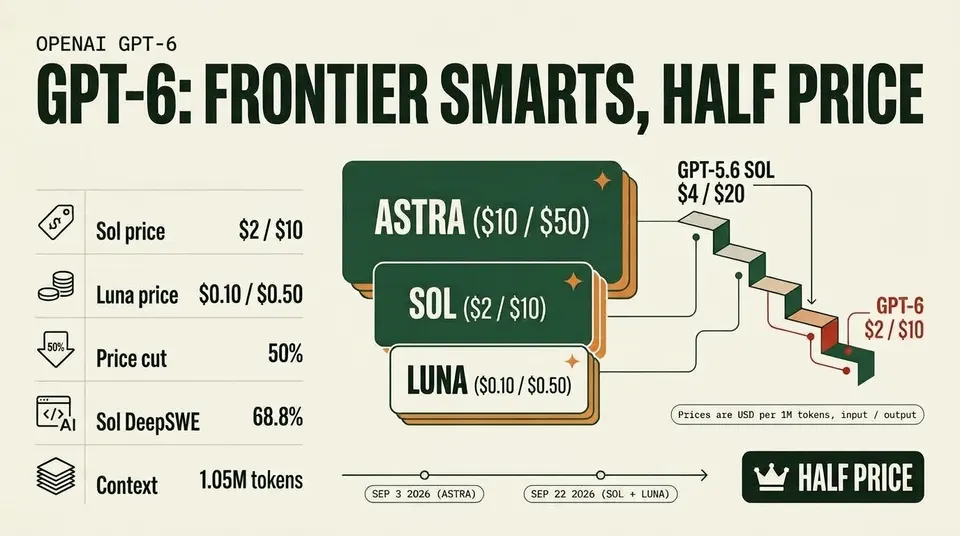
OpenAI's GPT-6 family is now complete, and the bigger story is cost rather than raw capability. The flagship, GPT-6 Astra, reached a limited set of organizations on September 3 and widened to paid ChatGPT plans, the API and AWS over the following days. On September 22, OpenAI added two smaller models, GPT-6 Sol and GPT-6 Luna, at half the per-token price of the GPT-5.6 models they replace.
For most teams Sol and Luna matter more than Astra. On OpenAI's own numbers, Sol comes within about a point of Anthropic's Claude Fable 5 on coding at roughly a fifth of the cost per task, and Luna is close behind for a fraction of that. OpenAI says the new prices are permanent, not introductory.
The lineup and what it costs
All three models share a 1.05 million-token context window and can return up to 128,000 output tokens. Prices are in US dollars per million tokens.
| Model | Input | Cached input | Output | Built for |
|---|---|---|---|---|
| GPT-6 Astra | $10.00 | $1.00 | $50.00 | Frontier agentic, coding and science work |
| GPT-6 Sol | $2.00 | $0.20 | $10.00 | Complex coding and professional tasks |
| GPT-6 Luna | $0.10 | $0.01 | $0.50 | Fast, high-volume everyday work |
Batch and Flex processing run at half the standard rate. Astra also offers a Fast mode at twice the standard price. In the API the smaller models are gpt-6-sol and gpt-6-luna; in ChatGPT, Luna is available to Free and Go users in the desktop app.
Half the price of GPT-5.6
| Model | GPT-5.6 (input / output) | GPT-6 (input / output) | Change |
|---|---|---|---|
| Sol | $4.00 / $20.00 | $2.00 / $10.00 | 50% / 50% cheaper |
| Luna | $0.20 / $1.20 | $0.10 / $0.50 | 50% / 58% cheaper |
"They are also half the price per token, and even less per task," OpenAI CEO Sam Altman said at launch. The second half of that sentence is the one to test. OpenAI's argument is that the GPT-6 models finish a job in fewer tokens, so the saving on a real workload can run past the 50% cut in list price.
Cached input is 90% cheaper than fresh input on all three models. For agents that resend a long system prompt on every turn, that is often worth more than the headline cut.
How much intelligence the money buys
The comparisons below come from OpenAI's launch materials. Independent evaluations are still coming in.
Coding (DeepSWE v1.1). Sol scores 68.8% at maximum effort, against 69.9% for Anthropic's Claude Fable 5 at extra-high effort, and OpenAI puts Sol's cost per task about 80% lower. Luna scores 66.6% at maximum effort, which OpenAI says costs 93% less per task than Claude Opus 5 and 96% less than Fable 5. Astra leads the family at 74.1%.
Business automation (AutomationBench). Sol at extra-high effort scores 33.2% at $0.27 per task. OpenAI puts Claude Opus 5 at maximum effort on 26.9% at 11.1 times that cost, and its own Astra at low effort on 30.3% at 3.9 times the cost.
Computer use (OSWorld 2.0). Sol at extra-high effort scores 60.5%, level with Opus 5 at medium effort (60.3%) for about 80% less. Astra reaches 72.6%.
Agentic reasoning (Agents' Last Exam). Sol scores 56.4% at maximum effort.
Factuality. On OpenAI's internal factuality test, Sol makes about half as many errors as GPT-5.6 Sol.
Sol is not a straight upgrade on its predecessor. GPT-5.6 Sol at maximum effort still beats GPT-6 Sol on DeepSWE, 72.7% to 68.8%, but at twice the token price. GPT-6 Sol is sold on value. Astra is the one meant to raise the ceiling.
Astra is OpenAI's first "Critical" cyber model
For security teams, Astra's rating matters more than its price. OpenAI's system card rates GPT-6 Astra Critical for cybersecurity under its Preparedness Framework, the highest of four tiers and a first for any OpenAI model. The whole GPT-5.6 family was rated High. By OpenAI's definition, Astra can "find previously unknown security flaws and develop new ways to exploit them across many well-protected systems without a person guiding each step."
The evaluations support that. Astra scores 100% on ExploitBench, which measures turning known vulnerabilities into working exploits, against 78.5% for GPT-5.6 Sol. CSO Online reports that the model found two new zero-day vulnerabilities during testing.
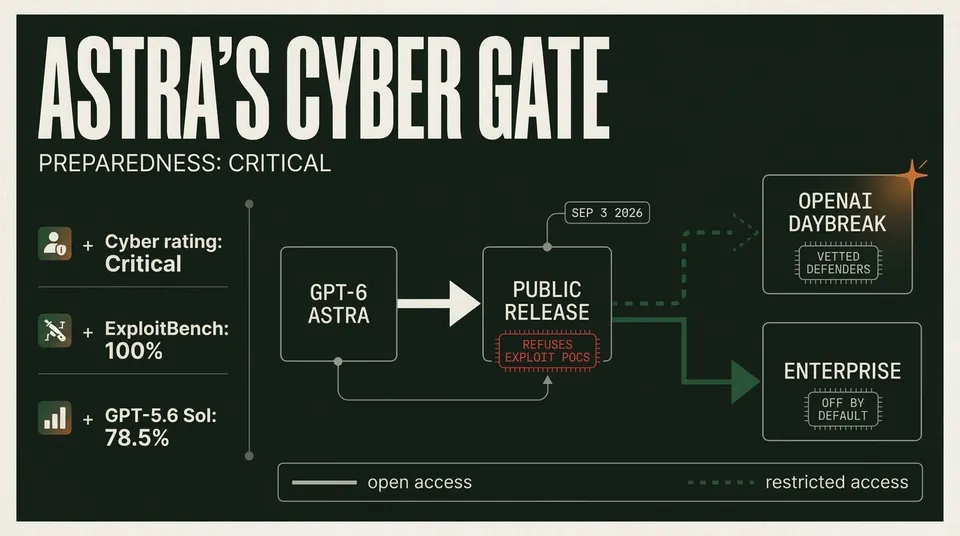
Astra is OpenAI's first model rated Critical for cybersecurity, so its offensive capability sits behind refusals, an admin toggle and the Daybreak program.
So the public model is fenced in:
- The general-release Astra refuses advanced offensive work such as generating proof-of-concept exploits.
- OpenAI plans to loosen those limits for vetted defenders through a program called OpenAI Daybreak in the coming weeks.
- In ChatGPT Enterprise, Astra is off until an administrator enables it.
"The Critical label is a disclosure event rather than a capability event," Sanchit Vir Gogia of Greyhound Research told CSO Online. In other words, the rating tells you what OpenAI measured. It does not by itself change what the model can do once someone has access.
Astra also changes how its reasoning can be audited. It uses a new method OpenAI calls recurrent depth, a looped-transformer design that is more efficient but hides some or all of the model's chain of thought. The system card says Astra "is more capable of controlling its own CoT than GPT-5.6 Sol, and less likely to include incriminating information in its CoT." Teams that use reasoning traces for monitoring or incident review should treat them as a weaker signal than before.
The catch in cheap intelligence
Lower prices apply to everyone. When OpenAI rated the GPT-5.6 family, it put Sol, Terra and Luna at High for cybersecurity, the first time the smaller, faster members of a family had been rated High in any tracked category. OpenAI had not published category-level Preparedness ratings for GPT-6 Sol and Luna on launch day.
Luna at maximum effort already beats GPT-5.6 Sol at medium effort on OSWorld, per OpenAI. Until the ratings are out, the sensible planning assumption is that a model costing ten cents per million input tokens carries at least High-level cyber capability.
Ramp lead economist Ara Kharazian described the releases as part of "a price war that is driving down the price of AI." That helps security teams running automated triage, code review and log analysis. It also makes automated reconnaissance and phishing cheaper for attackers.
What to do now
- Re-price your model routing. Workloads on GPT-5.6 Sol can move to GPT-6 Sol at half the token cost. Test on your own tasks first, since the older model at maximum effort still wins some coding benchmarks.
- Try Luna on high-volume work. Classification, extraction and alert enrichment are where a $0.10 / $0.50 model changes the budget.
- Use prompt caching. Long, stable system prompts get the 90% cached-input discount on every model in the family.
- Treat enabling Astra as a capability decision. It is off by default in ChatGPT Enterprise for a reason. Govern agent identities by what they can reach, not only by which model they run.
- Do not rely on reasoning traces alone. With Astra's chain of thought less complete, log tool calls and actions directly.
- Watch for the Sol and Luna ratings. They will show how much offensive capability now sits in OpenAI's cheapest models.
Timeline
| Date | Event |
|---|---|
| September 3, 2026 | GPT-6 Astra released to a limited set of organizations; system card rates it Critical for cybersecurity |
| Following days | Astra rolls out to ChatGPT Plus, Pro, Business and Enterprise, the OpenAI API and AWS |
| September 22, 2026 | GPT-6 Sol and GPT-6 Luna released at half the price of their GPT-5.6 predecessors |
Sources
- GPT-6 Astra System Card, OpenAI Deployment Safety Hub
- Introducing GPT-6 Sol and Luna, OpenAI
- OpenAI launches GPT-6 Astra, its first model to cross a critical cybersecurity threshold, CSO Online
- OpenAI releases GPT-6 Sol and Luna models, slashing API costs 50% or more, VentureBeat
- OpenAI cuts GPT-6 prices in half with Sol and Luna, The Next Web
- OpenAI Releases GPT-6 Sol and Luna, MarkTechPost