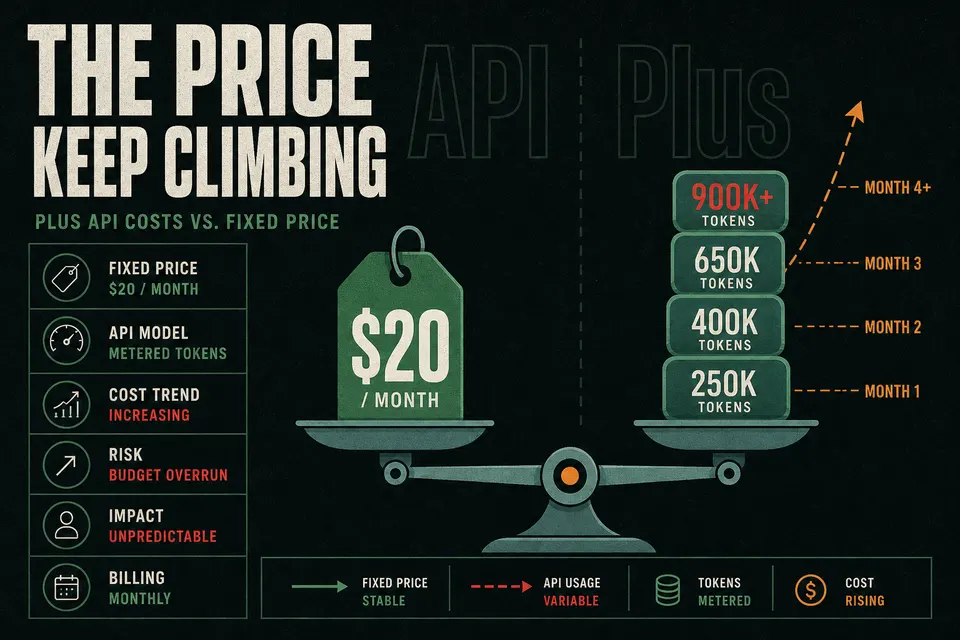
Pick wrong and you either pay for capacity you never touch or get throttled mid-task. The break-even math is simpler than either vendor's pricing page.
Every developer, freelancer, and product manager paying for AI eventually hits the same fork. On one side sits the flat-rate subscription—ChatGPT Plus, Pro, Claude Pro, Claude Max—billed at a predictable monthly rate. On the other sits the pay-as-you-go API, metered by the token and scaling directly with how hard you push it. Pick wrong, and you either overpay for capacity you never touch or get throttled mid-task at the worst possible moment.
The shortcut most people want first is the daily break-even line: a $20/month plan pays for itself at roughly $0.67/day of equivalent API spend, a $100 plan at $3.33/day, and a $200 plan at $6.67/day. Stay consistently above your line and the subscription wins; fall below it and the API is cheaper. Everything else is refining that one comparison.
The question has real budget weight now. AI use has exploded across personal productivity and product backends, token prices keep shifting, and heavy interactive use is normal rather than exceptional. Yet most coverage compares plan tiers—Plus versus Pro—rather than the underlying billing models, which is what actually determines your bill.
Two billing models, two different questions
A subscription is a flat monthly fee buying access plus a usage allowance metered against rolling time windows. ChatGPT Plus costs $20/month; ChatGPT Pro runs $200/month for far more headroom. See ChatGPT Pro $100 vs $200, 5x vs 20x usage explained. Anthropic mirrors this with Claude Pro at $20/month, Claude Max 5× at $100/month, and Claude Max 20× at $200/month. See Claude Max 100 vs 200, same features at 5x vs 20x usage. You get a polished app—mobile, memory, voice, image generation, custom GPTs and Projects—and a bill you know in advance. The ceiling is soft: cross the rate limit and you wait for the window to reset. ChatGPT Plus has historically capped GPT-4o-class use near 80 messages per three-hour window; Claude meters against a roughly five-hour rolling window, with Max tiers adding weekly caps.
The API flips every one of those properties. You pay per million input and output tokens, with no floor and no ceiling. Spend is variable and uncapped, tracking your exact consumption—but you get a raw HTTP endpoint, not an app, and supply your own client.
Two mechanical facts dominate API bills regardless of which model version ships:
- Output tokens cost roughly 3–5× input tokens on every major provider. The length of the reply, not the size of the prompt, drives the bill.
- Prompt caching cuts repeat-input cost to about 0.1× the base rate. For agentic and coding loops resending a large, stable context, caching pays for itself after a single reuse.
The break-even calculation
Let S be the flat monthly fee, and C_api what the same work would cost at API rates.
If C_api > S, the subscription is cheaper. If C_api < S, the API wins.
To compute C_api, use the token formula:
C_api = (input_tokens / 1e6 × input_rate)
 + (output_tokens / 1e6 × output_rate)
 [+ caching: cache_read × 0.1, cache_write × 1.25]
Worked examples: text chat rarely justifies a subscription
Take GPT-4o at $2.50 per million input tokens and $10.00 per million output, assuming an average exchange of 200 input plus 500 output tokens—roughly a 400-word reply. (Rates are current as of publication and change frequently.)
| User type | Msgs/month | GPT-4o API/mo | GPT-4o-mini/mo | vs $20 Plus |
|---|---|---|---|---|
| Light | 50 | ~$0.28 | ~$0.02 | API wins hugely |
| Moderate | 300 | ~$1.65 | ~$0.10 | API wins (~12×) |
| Heavy | 1,000 | ~$5.50 | ~$0.33 | API still wins (~3.6×) |
The break-even for ChatGPT Plus on pure GPT-4o text chat lands around 3,500 messages a month—more than 100 every single day, without fail. That's an atypical human pattern. For text-only use, the raw math favors the API for the vast majority of people, and even heavy users don't cross the line. On Claude, the equivalent tipping point sits near 200,000 tokens per month on Sonnet-class output ($3/$15 per million), roughly 150,000 words.
One caveat: several tools publishing these pro-API conclusions also sell "bring your own key" and billing-consolidation products, so treat their framing as directionally right for light-to-moderate text use but self-interested. The moment you leave plain text chat, the answer flips hard.
When the subscription clearly wins
Heavy, consistent, interactive use is where flat rates shine.
- Coding and agentic sessions. A daily driver running a top-tier model like Claude Opus ($5/$25 per million) inside a coding agent, resending large context every turn, blows past the $3.33/day Max-5× threshold within the month. The subscription absorbs context that would run the API meter red-hot. OpenAI's Codex faces the same math under its own plan tiers; see Codex and GPT-6 usage limits by ChatGPT plan.
- Voice. OpenAI's Realtime audio bills around $40 per million input and $80 per million output tokens; a 30-minute voice chat can run $1–3. That's the one case where daily use makes ChatGPT Plus the cheaper choice.
- Image generation, custom GPTs, and Projects, plus anyone who values a predictable bill and a single vendor relationship.
When the API clearly wins
Bursty, batch, and backend workloads favor metered pricing.
- Bursty agents. Idle six days, then fire 200 tool calls on day seven. The subscription charges the same all week; the API only charges for the burst.
- Batch jobs. Both OpenAI and Anthropic offer Batch APIs at roughly 50% off.
- Product backends that route intelligently—a cheap model like GPT-4o-mini ($0.15/$0.60) or Claude Haiku ($1/$5) for classification, reserving the top model for hard steps—cut LLM cost by 60–80% before the subscription question even arises.
- Low or unpredictable volume that never earns back the flat fee.
Hidden frictions that reverse the math
Pure cost is only half the story. Several factors can flip the decision regardless of where the numbers land:
- Rate limits cap subscription value. A flat fee is only "cheaper" until you're throttled mid-run and must wait for a window reset. If you can't afford a mid-task pause, the uncapped API is worth its premium.
- Opaque limits. Vendors increasingly decline to publish exact message counts, making capacity hard to plan.
- Multi-tool reality. A production agent needs web search, browsing, code execution, storage—each a separate API and billing relationship. That fragmentation is a real, unpriced overhead.
- Team and governance needs. Seat-based plans (OpenAI Business runs about $25/user/month with admin, SSO, and no training on your data) change the calculus versus juggling per-key API access. Developer tools run a similar seat-plus-credits model: see what $10 vs $39 buys on GitHub Copilot Pro vs Pro+.
- Data residency and privacy. No-training guarantees and regional routing can force an API or enterprise tier no matter what the raw cost says.
The decision checklist
- Pull your real usage—messages per day and rough token counts, input and output separately, since output dominates.
- Compute C_api at the model tier you actually use.
- Compare to the daily break-even: $0.67, $3.33, or $6.67.
- Interactive and consistently above the line? Subscribe.
- Bursty, batch, low-volume, or a backend product? Go API—then add routing, caching, and batch discounts.
- Check the frictions—rate limits, team seats, data residency, voice and image intensity. Any one can overturn the cost verdict.
- Right-size the model first. Routing cheap-to-expensive saves 60–80% before the sub-versus-API question even matters.
Token prices keep falling and plan structures keep shifting, so re-verify the exact rates before committing real budget. GPT-6's launch was a recent example, shipping near-frontier intelligence at half the previous price. But the framework endures: audit your pattern, run the break-even, and let the workload—not the marketing—pick your billing model.