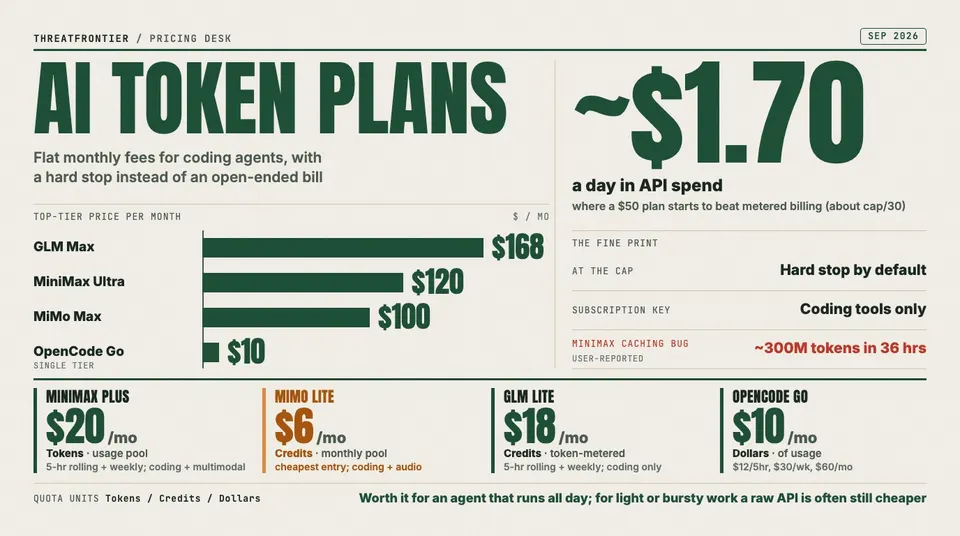
Chinese AI labs MiniMax, Xiaomi MiMo and Zhipu GLM offer flat-rate token plans for coding agents. Compare pricing, quotas and caveats to find your fit.
A new pricing model is quietly reshaping how developers pay for AI-assisted coding. As agentic workflows—where an AI runs long, tool-heavy loops largely on its own—become the default way engineers ship code, a cluster of Chinese AI labs has introduced flat-rate "token plans" that sit between two uncomfortable extremes: threadbare free tiers and the unbounded bills of pay-per-million-token APIs.
MiniMax, Xiaomi's MiMo team and Zhipu's GLM division are all now selling monthly subscriptions that grant a rolling usage quota consumed inside coding tools such as Claude Code, Cline and OpenCode. The pitch is simple: predictable cost. For developers who have watched an autonomous agent quietly burn through hundreds of dollars in an afternoon, that predictability is the entire point.
What a token plan actually is
A token plan is a flat monthly fee that buys a rolling quota of model usage—not an unlimited buffet, and not a metered tab. Three traits define the category. First, rolling quota windows: most plans meter usage across a 5-hour rolling window plus a weekly cap (MiniMax, GLM), or a monthly credit pool (Xiaomi MiMo). Second, a hard stop rather than silent overage—when quota is exhausted, service halts by default instead of billing you into oblivion. Third, a tool-restricted subscription key that works only inside approved coding agents, not for arbitrary API or production traffic; providers explicitly reserve the right to ban keys used for automated scripts or backends.
The contrast with traditional API pricing is stark:
| Token plan | Pay-per-token API | |
|---|---|---|
| Cost shape | Fixed monthly fee | Variable, unbounded |
| Cap behaviour | Hard stop on quota | No cap; bill grows |
| Best for | Heavy daily agent use | Light, bursty, or production |
| Key restriction | Coding tools only | Any use |
| Break-even | Wins above ~cap/30 daily spend | Wins for light use |
These plans are proliferating now because agentic loops consume tokens at a rate that makes per-token billing genuinely unpredictable, and buyers are hunting for a fixed ceiling. Search interest in "token plan" has climbed accordingly.
The three plans at a glance
| Feature | MiniMax | Xiaomi MiMo | GLM Coding Plan | OpenCode Go (alt.) |
|---|---|---|---|---|
| Entry price | $20/mo (Plus) | $6/mo (Lite) | $18/mo (Lite; $12.60 billed yearly) | $10/mo ($5 first month) |
| Tiers | Plus $20 / Max $50 / Ultra $120 | Lite $6 / Std $16 / Pro $50 / Max $100 | Lite $18 / Pro $80 / Max $168 | Single tier |
| Quota unit | Token-based usage pool | Monthly credits | Credits (token-metered) | Dollar value |
| Reset rule | 5-hr rolling + weekly | Monthly pool | 5-hr rolling + weekly | $12/5hr, $30/wk, $60/mo |
| Overage | Hard stop; opt-in credits/PAYG | Hard stop; no balance drain | Pure hard stop | Hard stop; opt-in balance |
| Scope | Coding + multimodal | Coding + audio (ASR/TTS) | Coding only | Coding only |
Figures are dated snapshots; promos and version numbers move fast.
MiniMax: the multimodal outlier
MiniMax is the only plan of the three that is explicitly full-spectrum multimodal—one subscription covers language, speech, video, music and image through a shared usage bar. It evolved from the lab's former "Coding Plan." Tiers run Plus ($20) for prototyping, Max ($50) for daily coding, and Ultra ($120) for heavy agent workflows, all granting every model and differing mainly by quota size and concurrent agent count. A recent upgrade shifted the meter from a fixed request count to actual token consumption. At the limit, users can cover with purchased credits, upgrade instantly, swap in a pay-as-you-go API key to continue uncapped, or wait for reset.
MiniMax also carries the category's most-cited real-world hazard. In a widely upvoted community warning, developers reported that prompt-caching on MiniMax's Anthropic-compatible endpoint is broken: standard cache instructions from IDE extensions are ignored, so the backend re-reads the full project history every turn at full price. One user reported burning roughly 300 million tokens in 36 hours of light coding.
The community-sourced fix: switch the endpoint from Anthropic to OpenAI-compatible (
https://api.minimax.io/v1), after which caching reportedly works and quota lasts far longer.
This remains user-reported and is not confirmed by MiniMax, but it is corroborated across multiple accounts—alongside complaints of a laggy first-party Mac app and unresponsive support. Full tier-by-tier pricing for Plus, Max and Ultra is in MiniMax Token Plan Plus vs Max vs Ultra.
Xiaomi MiMo: the cheapest door in
MiMo offers the lowest entry at $6/month and uses a monthly credit pool rather than rolling windows. Tiers scale from Lite (roughly 4.1 billion credits) up to Max ($100), with annual plans providing roughly twelve times the monthly volume. Its lineup spans about six models—including mimo-v2.5-pro, the base mimo-v2.5, an ASR model and several TTS voices—with TTS reportedly free for now and ASR billed by audio duration.
The pro model consumes roughly three times the credits of the base model, making model choice a serious cost lever, and off-peak overnight Beijing hours attract a consumption discount. MiMo will not drain any bonus or balance at the hard stop—but there are no refunds on unused credits, and its coding-tools-only rule is enforced explicitly: using the key for scripts or custom backends is a violation that can get it banned. The full Lite-to-Max credit tiers are covered in Xiaomi MiMo token plan pricing.
GLM Coding Plan: cheap high quota, with an asterisk
Zhipu's GLM plan is the cheapest high-quota agentic option tracked, and its coding model is a strong long-context open-source coder. It is coding-only. Tiers run Lite ($18), Pro ($80) and Max ($168), scaling quota 1×, 6× and 14×, with 20% off for quarterly and 30% off for yearly billing. Since 30 July 2026 quota is denominated in credits metered on tokens, replacing the old per-prompt count.
The catch is a multiplier system: each model burns credits at its own rate, peak hours (Monday to Friday, 14:00–18:00 UTC+8) are charged at the standard rate, and everything else is billed at 50%. The plan is a pure hard stop with no overage. Full tier math for Lite, Pro and Max is in GLM Coding Plan pricing 2026. Community sentiment is mixed: one Lite user reported a single 14-minute multi-agent review devouring half a 5-hour window, and several argue raw API remains cheaper for comparable models until GLM's quotas roughly double.
OpenCode Go: the dollar-cap wildcard
OpenCode Go takes a different tack. At $10/month ($5 first month), its limits are dollar-denominated—$12 per 5 hours, $30 weekly, $60 monthly—not counted in prompts or requests. Its headline feature is model freedom: one key unlocks 13–14 open models across GLM, Kimi, MiMo, MiniMax, Qwen and DeepSeek families, with no single-vendor lock-in. Because the cap is a dollar figure, a cheap model can yield tens of thousands of requests per window while a premium coder yields only hundreds. Hosted internationally with a zero-retention policy, it appeals to proprietary work. Our full hands-on review covers real throughput and when to upgrade: OpenCode Go $10 Plan Review. A popular pattern pairs a direct vendor subscription as the main agent with Go for sub-agents and model variety.
Which plan fits which developer
| Persona | Recommended | Why |
|---|---|---|
| Light coder / first-timer | MiMo Lite or OpenCode Go | Lowest cost; Go adds model variety |
| Heavy agent user | GLM Max or MiniMax Ultra | Highest quotas; mind the caveats |
| Multimodal experimenter | MiniMax | Only truly multimodal plan |
| Budget-constrained team | OpenCode Go / MiMo Standard | Predictable low cap stretches furthest |
| Model-flexibility seeker | OpenCode Go | No vendor lock-in |
Before you buy
Quota units are not comparable at face value—tokens, credits and dollars measure different things. Watch reset cadence: rolling windows can strand you mid-task, while monthly pools cannot. Confirm whether a plan halts or bills at the limit; only MiniMax continues silently once a pay-as-you-go key is enabled. Respect the tool restrictions, and schedule heavy runs off-peak where multipliers apply.
For light or bursty work, a raw API is often still cheaper—subscriptions only pay off once daily usage climbs past roughly a thirtieth of the monthly cap. In practice, a $50 plan starts to win once you would otherwise spend about $1.70 a day on API calls; below that, metered billing is the cheaper bet.
The token plan is not a universal upgrade. But for the developer whose agent runs all day, it converts a source of billing dread into a line item they can actually forecast—and that alone explains why the category is spreading fast.