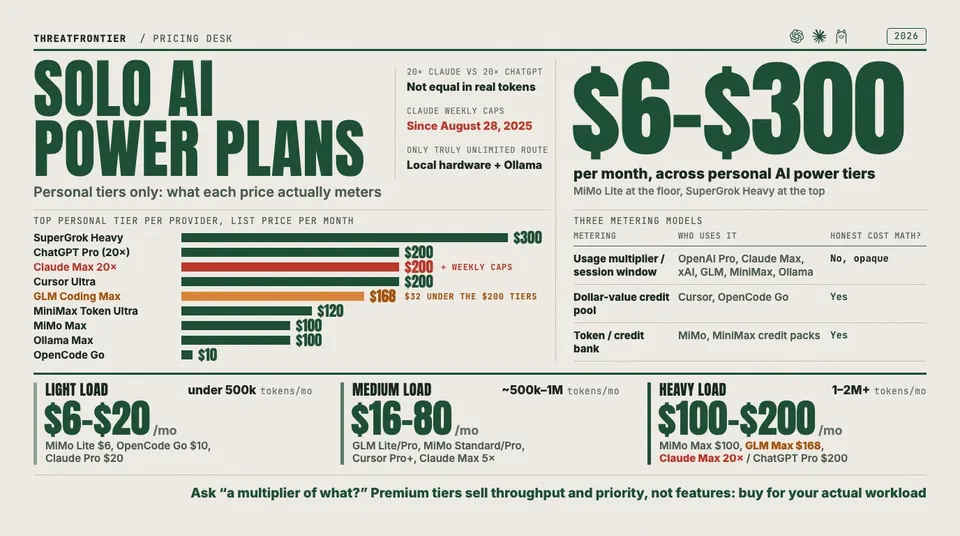
Compare 2026 individual AI subscription plans from $6 to $300 across OpenAI, Anthropic, xAI, Cursor, MiMo, GLM and more. Find the best tier for your workload.
The era of the one-size-fits-all AI subscription is over. As of early 2026, individual AI plans have splintered into a dense ladder of personal power tiers priced from $6 to $300 a month, driven by two converging pressures: providers are quietly tightening free and basic rate limits, while solo developers running coding agents, deep research and multi-model workflows demand reliable, high-volume access they can budget around.
The result is a crowded, confusing market. OpenAI, Anthropic, xAI, Cursor, MiniMax, MiMo, GLM, OpenCode and Ollama now compete head-to-head for the wallet of the individual power user — the freelancer, the indie hacker, the developer paying out of their own pocket. No two providers measure "power" the same way, and the numbers shift every quarter. This roundup isolates personal tiers only — no team seats, no enterprise.
Two facts that make naive comparison misleading
First, a "multiplier" is relative to each provider's own base tier, not an absolute quantity. OpenAI Pro and Anthropic Max both advertise "5× / 20×" language (OpenAI's $200 tier moves to 10× on 30 October 2026), but 20× of ChatGPT Plus and 20× of Claude Pro multiply different starting points — so 20× Claude does not equal 20× ChatGPT in real tokens. The single most useful question a buyer can ask is: a multiplier of what?
Second, three fundamentally different metering models are in play, and every plan below is tagged with the one it uses:
- Usage-multiplier / session-window (OpenAI Pro, Claude Max, xAI, GLM, MiniMax, Ollama) — opaque, resetting on rolling ~5-hour windows, often with additional weekly caps.
- Dollar-value credit pools (Cursor, OpenCode Go) — a transparent dollar amount of model usage you can compute against.
- Token / credit banks (MiMo, MiniMax credit packs) — explicit, published token counts.
Only the second and third categories let you do honest cost-per-token math.
The master comparison table (personal tiers only)
| Provider / Plan | Price/mo | What multiplies | Metering | Rate-limit / priority notes |
|---|---|---|---|---|
| ChatGPT Plus | $20 | base tier | session | baseline; Codex |
| ChatGPT Pro (5×) | $100 | 5× Plus usage | usage multiplier | lower per-model allowances than $200 |
| ChatGPT Pro ($200) | $200 | 20× Plus until 29 Oct, 10× from 30 Oct | usage multiplier | per-model guardrails still apply |
| ChatGPT Pro ($500) | $500 | highest Pro usage, multiple not published | usage multiplier | above this matrix's $300 ceiling; only tier with Ultrafast Codex |
| Claude Pro | ~$20 | base tier | session | ~40–45 msgs / 5h |
| Claude Max 5× | $100 | 5× Pro | usage multiplier | ~225 msgs / 5h; weekly caps apply |
| Claude Max 20× | $200 | 20× Pro (session) | usage multiplier | weekly caps are the true ceiling |
| SuperGrok | $30 | full features vs Free | session | standard queue |
| SuperGrok Heavy | $300 | Heavy multi-agent mode | session + compute | priority queue; parallel agents |
| Cursor Pro | $20 | ~$20 frontier credits | $ credit pool | Auto mode doesn't drain pool |
| Cursor Pro+ | $60 | 3× Pro | $ credit pool | more capacity |
| Cursor Ultra | $200 | 20× Pro | $ credit pool | + priority feature access |
| MiniMax Token Plus | $20 | 3–4 concurrent agents | session | 5h + weekly windows |
| MiniMax Token Max | $50 | 4–5 agents | session | same |
| MiniMax Token Ultra | $120 | 6–7 agents | session | heavy agent workflows |
| MiMo Lite | $6 | ~200 coding rounds | token bank | coding-tools only; API use banned |
| MiMo Standard | $16 | ~1,600 rounds | token bank | same |
| MiMo Pro | $50 | ~5,600 rounds | token bank | same |
| MiMo Max | $100 | ~12,800 rounds | token bank | same |
| GLM Coding Lite | $18 | 2,000 credits/5h | session | off-peak billed at 50% |
| GLM Coding Pro | $80 | 6× Lite (12,000 credits/5h) | session | + MCP calls |
| GLM Coding Max | $168 | 14× Lite (28,000 credits/5h) | session | cheapest high-quota agentic plan tracked |
| OpenCode Go | $10 | $60/mo of usage | $ value pool | $12/5h, $30/wk caps |
| Ollama Pro | $20 | 50× Free; 3 models | GPU-time | 5h + weekly reset |
| Ollama Max | $100 | 5× Pro; 10 models | GPU-time | extra-usage add-on |
Message-per-window and coding-round counts above are community-observed approximations, not vendor-guaranteed quotas, and drift with model routing. Frontier US-provider prices are the best-supported; GLM, MiMo, MiniMax, OpenCode and Ollama figures derive partly from third-party trackers and should be reconfirmed on the vendor page, since these numbers move quarterly.
Provider-by-provider notes
OpenAI's ChatGPT Pro comes in three tiers: $100 buys 5× Plus usage, and $200 buys 20× until 29 October 2026 and 10× from 30 October. A $500 tier, launched on 29 September, adds the highest allowance and Ultrafast, up to 8× faster GPT-6 Astra token generation in Codex. The $100 and $200 tiers include Codex, deep research, image generation, memory and file uploads. But even Pro carries per-model allowances that differ by tier — "unlimited" is marketing, and the $100 tier throttles harder on specific models than the $200 tier. After 30 October, $100 and $200 cost the same $20 per multiple of Plus. See ChatGPT Pro $100 vs $200 vs $500.
Anthropic's Claude Max mirrors the pricing — $100 for 5× Pro, $200 for 20× — but hides the roundup's biggest gotcha. The headline "20×" applies only to the ~5-hour session window; weekly caps, introduced August 28, 2025, are the real bottleneck. The catch, though, is workload-dependent: heavy test-driven-development and parallel multi-agent users report hitting those weekly ceilings days early, while many heavy daily users say they never brush them and attribute complaints to account-sharing or unoptimized agent loops. Interactive, hand-held use rarely triggers them.
xAI's SuperGrok at $30 and Heavy at $300 represent a tenfold gap that buys compute, not features: parallel multi-agent Heavy mode, guaranteed flagship-model access and a priority queue. A transparency gap runs through it — the consumer UI doesn't disclose which model variant actually served a query. Everyday users belong at $30; Heavy is the sole consumer tier with guaranteed flagship access plus multi-agent mode. Whether the 10× jump from $30 to Heavy is worth it is covered in depth separately.
Cursor offers the clearest credit model. Each paid tier — $20 Pro, $60 Pro+, $200 Ultra — includes a dollar pool equal to its price. The crucial nuance: Auto mode and cheaper built-in models don't drain the pool; only manually selected frontier models (Opus, GPT, Gemini) do, after which usage continues silently at pay-as-you-go API rates. Heavy users can empty a $20 pool in under a week, and context overhead can multiply a task's real cost several times over. Ultra's 20× pool and priority access buy frontier models without watching the meter. Deciding between those Cursor tiers is covered in a dedicated look at Cursor Ultra vs Pro pricing for agent coding.
MiniMax's Token Plan ($20 / $50 / $120) differentiates tiers by concurrent-agent count — 3–4, 4–5, then 6–7 — sharing one quota across text, image, speech and music. Which of Plus, Max and Ultra actually fits a given agent workload gets its own breakdown in MiniMax Token Plan: Plus vs Max vs Ultra.
MiMo, Xiaomi's entrant, runs the most transparent token bank and sets the market's true price floor: Lite $6, Standard $16, Pro $50, Max $100, with published per-token deduction rates. It is the cheapest serious entry point here — but coding-tools only, with API and script use a bannable violation. A full tier-by-tier walkthrough of Xiaomi MiMo's token plan pricing for coding agents covers exactly what each round buys.
GLM's Coding Plan (Lite $18 / Pro $80 / Max $168) has metered token-based credits instead of prompts since 30 July 2026: 2,000, 12,000 and 28,000 credits per 5-hour window, with off-peak usage billed at half the standard rate. It bills itself as the cheapest high-quota agentic IDE plan, and Max undercuts the $200 frontier tiers on raw quota — though only for GLM-quality coding, not general multimodal work. A closer look at GLM Coding Plan pricing: Lite vs Pro vs Max walks through when each tier earns its keep.
OpenCode Go at $10 is the cheapest cloud-aggregator tier: a pure dollar-value pool of $12 per 5 hours, $30 per week, $60 per month, spanning many open coding models with no lock-in. Ollama meters actual GPU-time rather than tokens, and remains the only genuinely unlimited path for those who own the hardware. How its Pro and Max tiers stack up is covered in Ollama Pro vs Max pricing, local free-forever use against paid cloud capacity that scales.
Matching the plan to the load
Only transparent-pool and token-bank plans support real math. For a light load (under 500k tokens/month), OpenCode Go at $10, MiMo Lite at $6, or Cursor Pro's Auto mode all cover it comfortably; Claude Pro at $20 works too. In India, Cursor Start at ₹649 a month is a cheaper paid entry. For a medium load (roughly 500k–1M), the $16–80 band fits best — GLM Lite/Pro, MiMo Standard/Pro, Cursor Pro+, or Claude Max 5× if Opus-grade output is required. For a heavy load (1–2M-plus), GLM Max ($168), MiMo Max ($100), Claude Max 20× ($200) and ChatGPT Pro ($200) contend — though for Claude, the weekly cap sets the true ceiling, and ChatGPT Pro $200 carries 10× Plus rather than 20× from 30 October.
The premium tiers, crucially, sell throughput, priority and exclusivity — not broader features. Below that threshold, most solo developers overpay for a multiplier they never exhaust.
The buying checklist
- Ask "a multiplier of what?" — multipliers don't compare across providers.
- Hunt for hidden weekly caps behind session multipliers; Claude is the cautionary tale, though your mileage depends on workload.
- Transparent dollar-pool plans (Cursor, OpenCode Go) are easiest to budget; token banks (MiMo) come next; session multipliers are hardest.
- Coding-only plans (GLM, MiMo, MiniMax, OpenCode) typically ban API and script use — a violation can get keys banned.
- Peak versus off-peak multipliers materially change effective cost.
- Local hardware plus Ollama is the only truly unlimited route.
The market's current generosity may not last. A growing chorus of power users argues that today's cheap high-volume plans are subsidized and will tighten quarter by quarter. OpenAI has already done it once: on 29 September it halved ChatGPT Pro $200's Codex allowance from 20× to 10× Plus, effective 30 October. That makes locking in the right tier for your actual workload, rather than the flashiest multiplier, the smartest move an individual developer can make in 2026.