I have strong, verified material. Writing the article now.
I have strong, verified material. Writing the article now.
The $0 AI Coding Stack: How Ollama and Open Models Became a Real ChatGPT Alternative in 2026
Premium AI subscriptions now routinely cost more than a mid-range smartphone every quarter. Flagship tiers from OpenAI, Anthropic and their rivals commonly run $100 to $300 per month, and even entry plans at roughly $20 draw the same three-part complaint from developers: the services log everything, forget context between sessions, and own the data you feed them. For a growing cohort of mid-level engineers, indie hackers and privacy-conscious teams, the question is no longer whether a free alternative exists — it is how far a free one can actually take you.
The answer, in 2026, is: much further than a year ago. The maturing of local runtimes such as Ollama, a wave of capable open-weight models, and free terminal agents like OpenCode have combined into a genuine $0-per-month stack for everyday coding, documentation and light research. The honest catch — the part most "you've been overpaying" marketing skips — is that free stacks hit a hard ceiling on exactly the hardest work, and that "free" and "private" are not the same thing.
Why free alternatives matter now
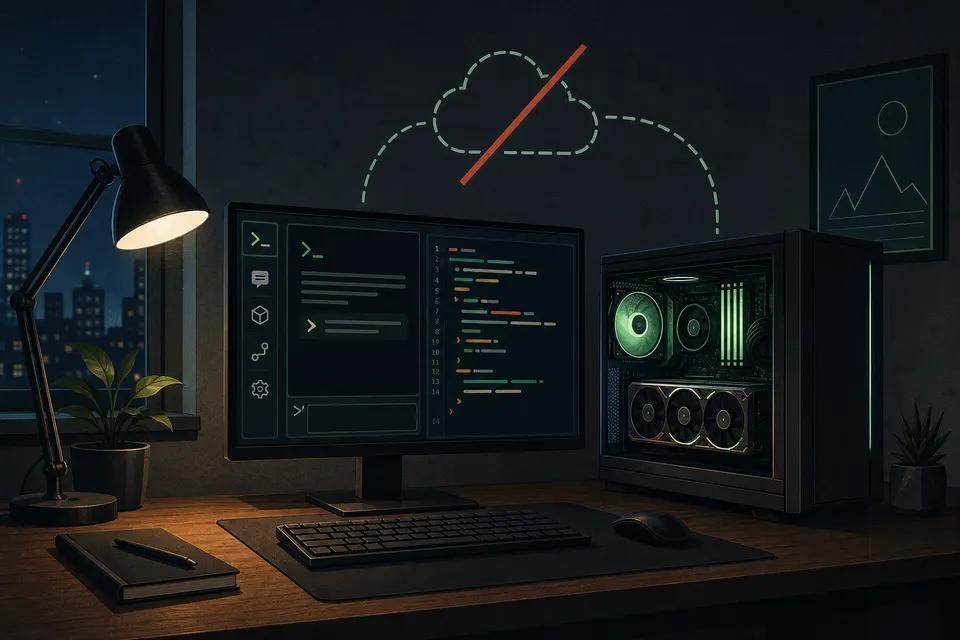
Two forces converged. The first is cost fatigue. As subscription tiers climbed, the recurring gripe on developer forums crystallized into a simple pitch: Ollama (free) + an open-weight model + a free client = $0/mo, with the bonus that your code never leaves your machine.
The second is supply. Open-weight releases have narrowed the gap with closed frontier models, and the ecosystem has diversified fast. On OpenRouter, a platform that routes requests across providers, the combined usage share of Google, Anthropic and OpenAI fell from 55% to 33% between January and June 2026, according to platform data cited by AI analysts — with open models from Chinese labs taking much of the difference. The trend accelerated after U.S. government access restrictions on top closed models rattled developers who had built on a single provider.
"You want to be as flexible as you can be," said Oren Michels, co-founder and CEO of Barndoor AI. "Maybe a year and a half ago some large company might say we bought Anthropic or we bought OpenAI, and now no one, no one buys only one."
What actually runs locally — and how well
For coding, the community's default local pick is the Qwen coder family, consistently the strongest open performer on agentic benchmarks. For general and creative chat, the Gemma family is favored, with newer releases adding native multimodal and tool-calling support. GLM (4.5/4.6) is repeatedly cited as a top open-weights coder, while heavier options like Llama 3.3 70B, DeepSeek, Kimi K2 and Mistral's Codestral round out the field.
The honest performance picture comes from benchmarks. On SWE-rebench, which tests models against fresh GitHub bug-fix pull requests in an agentic, SWE-bench-style loop, a frontier paid model (Claude Sonnet class) posted the highest scores and uniquely solved several instances no other model could. Among open models, Qwen3-Coder was the best open-source performer, with GLM close behind. Notably, a paid model — Gemini 2.5 Pro — underperformed on multi-turn, long-context agentic tasks, proving that paid does not automatically mean better; scaffolding and the agent loop matter as much as brand.
Human-rated testing sharpens the line. On the 16x Eval suite, Qwen3-Coder matched premium models on routine tasks such as cleaning markdown, tying with top paid systems. But it fell behind on complex UI and visual work and on strict instruction-following — asked to "output the diff only," open coders tend to over-produce. On one uncommon-logic task involving TypeScript type narrowing, every tested open model scored around 1 out of 10; only the frontier paid model solved it.
On routine code, open is roughly equal to frontier. On novel reasoning, uncommon patterns and clean multi-file agentic refactors, paid frontier still clearly leads.
One caveat for skeptics: SWE-rebench runs on a single inference provider, and some observers have questioned that provider's reliability. Treat exact percentages as directional.
The concrete free stack you can build today
The local core is Ollama (alternatives: LM Studio, llama.cpp, or MLX on Apple Silicon). The client is OpenCode, an open-source terminal agent that reads your project, edits files, runs commands and handles vision. A minimal Ollama configuration looks like this:
{
 "$schema": "https://opencode.ai/config.json",
 "provider": {
 "ollama": {
 "npm": "@ai-sdk/openai-compatible",
 "name": "Ollama",
 "options": { "baseURL": "http://localhost:11434/v1" },
 "models": { "qwen-coder": { "name": "qwen-coder" } }
 }
 }
}
Install with curl -fsSL https://opencode.ai/install | bash or npm i -g opencode-ai. One critical constraint trips up newcomers: OpenCode expects a large context window of roughly 64k tokens or more, and Ollama defaults far lower. You must raise it explicitly on local models or the agent misbehaves and truncates prompts. GUI alternatives include OpenWebUI, Cline and Continue.dev.
For work beyond local capacity, free cloud tiers can be blended in — with an important asterisk on data handling.
| Provider | Free models | Rough limit | Best for | Trains on your data? |
|---|---|---|---|---|
| OpenRouter | 20+ (multi) | ~20 RPM / 50 RPD | Variety, one key, failover | No |
| Groq | Llama 3.3 70B etc. | ~30 RPM / 1,000 RPD | Speed (very high tok/s) | No |
| Google AI Studio | Gemini/Gemma | 5–15 RPM | Long context, multimodal | Yes (outside EU/UK/EEA) |
| GitHub Models | GPT-4o, Claude, Llama, Phi | ~15 RPM / 150–1,000 RPD | Free frontier access | No |
| Mistral | Codestral, Small | High monthly tokens | Coding volume | Yes (Experiment tier) |
The single most important honesty point for privacy-minded readers: free is not private. Free cloud tiers from Google and Mistral's experiment plan may train on your prompts — a compliance risk that undercuts the whole pitch unless you stay fully local.
Hardware floors and the privacy payoff
A useful rule of thumb: budget roughly 2 GB of VRAM per billion parameters at full precision, halved at Q8 quantization and quartered at Q4, plus 10–20% for the key-value cache.
| Model size | VRAM (Q4) | Runs on |
|---|---|---|
| 3–4B | 2–4 GB | Integrated GPU, base M1, CPU + 16 GB RAM |
| 7–14B | 5–8 GB | RTX 3060 12GB / 4060 Ti 16GB / M-Pro — the sweet spot |
| 27–32B | ~18 GB | RTX 3090/4090 24GB |
| 70B | ~40 GB | 2× 3090, or 64 GB M-Max |
Practical minimums are 16 GB of system RAM (32 GB recommended), a modern multi-core CPU and an NVMe SSD, since model files can exceed 100–200 GB. Apple Silicon's unified memory is the standout value: a 64 GB M-Max can run 70B models that would otherwise demand data-center hardware.
The reward for going fully local is the one thing no cloud tier, free or paid, can match: code never leaves the device, nothing is logged, there are no rate limits, and it works offline.
When free is enough — and when to pay
Free and local is sufficient for the bulk of real work: boilerplate, single-file edits, standard functions, documentation, and any privacy-mandatory or regulated code — provided you have at least 12–24 GB of VRAM or an Apple Silicon Mac with 32 GB or more.
Upgrading becomes rational when reliability compounds: large multi-file agentic refactors, novel reasoning and tricky type systems, long-context multi-turn tool-calling at scale, serious multimodal work, or simply when your time is worth more than the subscription.
The most pragmatic setup is a blend. Run a local model for privacy and routine tasks; reach for free cloud tiers — Groq for speed, Google AI Studio for long context, GitHub Models for occasional frontier access — and pay only for the hard 10%.
Quick-start resources worth bookmarking: the Ollama–OpenCode integration docs, the OpenCode installer, and the community-maintained cheahjs/free-llm-api-resources tracker, which is updated monthly and remains the best single source for live free-tier limits. Verify current model versions and quotas before committing — in this corner of software, the specifics change by the week.