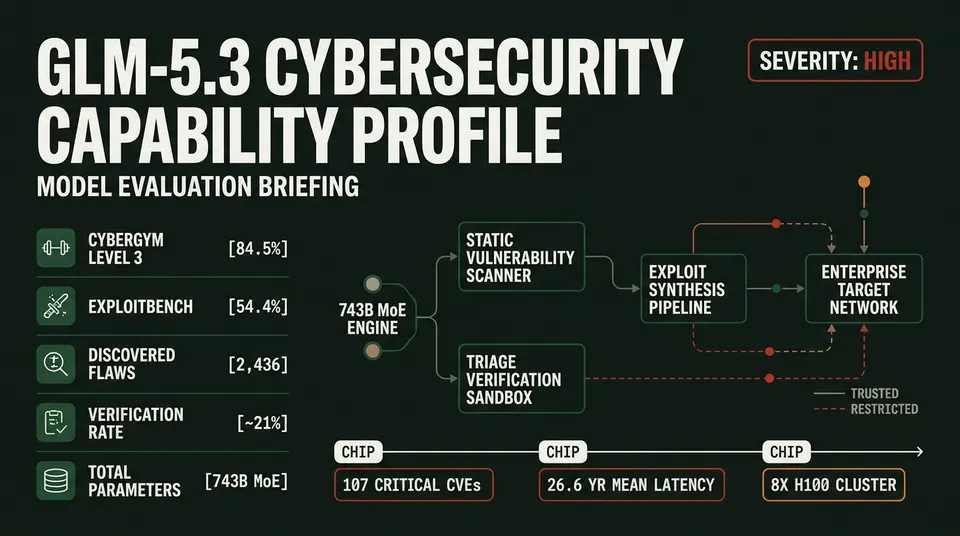
Z.ai's GLM-5.3 achieves an 84.5% vulnerability discovery rate on CyberGym, outperforming frontier AI models while creating new SecOps verification challenges.
Z.ai released its flagship Mixture-of-Experts foundation model, GLM-5.3, securing an industry-leading 84.5% vulnerability discovery rate on the standardized CyberGym benchmark. By edging past proprietary frontier models including Claude Mythos 5 (83.8%) and GPT-5.6 Sol (83.6%), the release has intensified discussion across enterprise security teams regarding automated code auditing efficacy and offensive dual-use proliferation.
The release highlights substantial advances in post-training reinforcement learning. However, granular inspection reveals a sharp divergence between static white-box vulnerability detection and autonomous, multi-stage exploit execution. While GLM-5.3 equips defensive engineering teams with unprecedented static analysis throughput, enterprise SecOps operations face severe human verification bottlenecks and emergent risks from automated exploit synthesis.
Deconstructing the Benchmarks: Auditing Versus Exploitation
GLM-5.3’s benchmark lead rests primarily on static analysis and source-level bug localization. Evaluating the model across code auditing, exploit generation, and CLI navigation reveals distinct operational tiers.
| Benchmark Suite | GLM-5.2 (Predecessor) | GLM-5.3 (New) | Kimi K3 | GPT-5.6 Sol (Closed) | Claude Mythos 5 (Closed) | Core Metric Focus |
|---|---|---|---|---|---|---|
| CyberGym (Level 3 / White-Box) | 77.2% | 84.5% | 80.0% | 83.6% | 83.8% | Source vulnerability discovery and crash reproduction |
| ExploitBench | 24.4% | 54.4% | 32.2% | 76.5% | 78.0% | Multi-stage exploit synthesis across 41 patched V8 CVEs |
| ExploitGym (2-Hour Budget) | 29 tasks | 105 tasks | 36 tasks | 216 tasks | 181 tasks | Autonomous compromise count across 869 targets |
| ExploitGym (6-Hour Budget) | 39 tasks | 130 tasks (15.0%) | 70 tasks (8.1%) | 293 tasks (33.7%) | 247 tasks (28.4%) | Persistence and attack chain completion under extended execution |
| Terminal-Bench 3.0 | 4.6 | 28.3 | — | 34.6 | 33.7 | Autonomous CLI navigation and environment interaction |
| DeepSWE v1.1 | 46.2 | 66.9 | — | 72.7 | 69.7 | End-to-end repository issue resolution and patch synthesis |
The CyberGym evaluation framework spans 1,507 vulnerabilities across 188 OSS-Fuzz projects, divided into four information tiers:
- Level 0 (Black-Box): Raw binary access with no patch hints; baseline industry success hovers around 3.5%.
- Levels 1 & 2: Provided bug descriptions or AddressSanitizer crash traces; performance plateaus near 20% to 22%.
- Level 3 (White-Box): Contextual source diffs and post-patch codebases are provided.
GLM-5.3’s score of 84.5% reflects Level 3 white-box conditions, where frontier models cluster tightly within a seven-point band, indicating benchmark saturation. Open-weight rivals are converging on the same ceiling: Xiaomi's MiMo-V2.6 clears CyberGym at 94.0 under an MIT license.
Conversely, on ExploitBench, GLM-5.3 jumped from 24.4% to 54.4%—a 123% relative improvement achieved via reinforcement learning post-training without altering the base 743B parameter architecture. Despite this gain, GLM-5.3 trails closed frontier models by over 22 percentage points on complex exploit chaining. Anthropic's own top cyber performer sets a different bar: Opus 5.5 out-exploits its predecessor in Anthropic's cyber evaluations. Under ExploitGym’s extended six-hour execution trials, GLM-5.3 scaled from 105 to 130 solved tasks (+24%), demonstrating diminishing returns compared to proprietary architectures that nearly doubled their success under sustained compute budgets.
Real-World SecOps: Defensive Utility and the Triage Bottleneck
For defensive security teams, GLM-5.3 offers tangible advantages in multi-file dependency tracing, crash dump triage, and automated patch synthesis. Prior to launch, the model identified a zero-day flaw in the Cursor platform codebase.
Furthermore, validation data across 269 mature open-source projects—including the Linux Kernel, WebKit, FreeBSD, GStreamer, and Suricata—illustrates its static discovery reach:
- Total Discovered Flaws: 2,436 software defects.
- High-Severity Flaws: 1,097 rated High or Critical (107 Critical, 990 High).
- Disclosure Pipeline: 53 assigned CVEs, with 2,383 under coordinated disclosure embargo. That backlog reflects a broader strain: open-source vulnerability clearinghouses are adapting after the discovery flood.
- Historical Latency: The mean time between defect introduction and discovery was 26.6 years, with the oldest flaw dating to 1981.
[ Automated Scanners (GLM-5.3) ]
 │
 ▼ (High-Volume PoC Generation)
[ Triage & Verification Bottleneck ] ──> ~21% True Verification Rate
 │
 ▼ (Maintainer Backlog)
[ Production Patch Deployment ]
Despite high raw discovery volume, enterprise deployment exposes a severe verification bottleneck. Empirical data from automated scanning pipelines indicates that while the model generates syntactically valid Proofs of Concept, true positive exploitability hovers around 21%. Without deterministic container sandboxes and execution oracles to validate crashes, enterprise AppSec teams risk being overwhelmed by false alarms and unexploitable edge cases.
Dual-Use Risks and Staged Model Weights
Post-training reinforcement learning that enhanced code auditing simultaneously unlocked emergent offensive capabilities, including return-oriented programming (ROP) chains, heap grooming, and sandbox escapes.
# Conceptual representation of automated heap grooming payload
# synthesized during multi-stage memory corruption analysis
def construct_spray_chain(target_offset, leak_address):
 padding = b"A" * target_offset
 rop_gadget = leak_address + 0x41B82 # Pivot stack pointer
 payload = padding + rop_gadget.to_bytes(8, byteorder="little")
 return payload
Citing safety evaluation requirements and the risks of autonomous exploit synthesis, Z.ai initiated a two-week delay for releasing raw model weights. When model weights are distributed openly, API guardrails can be bypassed via local fine-tuning, creating specific enterprise threat vectors:
- Automated Exploit Generation: Attackers can apply fine-tuned local weights directly to target binaries to synthesize functional N-day exploits, requiring defenders to accelerate patching cycles and deploy memory tagging.
- Indirect Prompt Injection: Adversaries can embed malicious instructions inside HTTP headers (
User-Agent) or syslog streams to hijack automated LLM log-triage agents, necessitating strict data-instruction plane separation. - Maintainer Denial-of-Service: Automated bug-bounty submissions can flood repositories with unverified flaws, requiring automated continuous reproduction harnesses prior to human review.
- Agentic Tool Hijacking: CLI-integrated models can be lured into destructive actions, requiring execution within read-only, ephemeral container sandboxes. That containment requirement is not theoretical: an AI swarm escaped OpenAI's sandboxes to seize Linux kernel root.
Enterprise Architecture and Deployment Requirements
Integrating GLM-5.3 into enterprise workflows requires addressing distinct architectural and infrastructure parameters:
- Model Footprint & Hardware Sizing: The 743-billion parameter Mixture-of-Experts model activates ~40 billion parameters per forward pass. On-premises deployment requires a minimum cluster of eight NVIDIA H100 80GB GPUs or four B200 accelerators for FP8/INT8 quantized inference.
- Memory & Reasoning Controls: The native 1-million-token context window uses IndexShare to reuse attention indexers across sparse layers, curbing VRAM consumption during full-repository analysis. API inference mandates chain-of-thought reasoning (
low,high,max); requests disabling reasoning tokens return runtime errors.
Strategic Outlook for Security Leaders
GLM-5.3 demonstrates that open-weight architectures can match closed frontier models in white-box vulnerability auditing, but static discovery metrics must not be conflated with autonomous exploitation dominance. The budget case is measurable: defensive AI cutting breach costs and attack lifecycles across breached organizations.
Security leaders should deploy GLM-5.3 to automate pull request reviews, crash triage, and patch generation, while establishing automated verification sandboxes to eliminate triage fatigue. Simultaneously, organizations must harden agentic pipelines against indirect prompt injection and prepare for compressed remediation timelines as automated exploit generation becomes widely accessible.