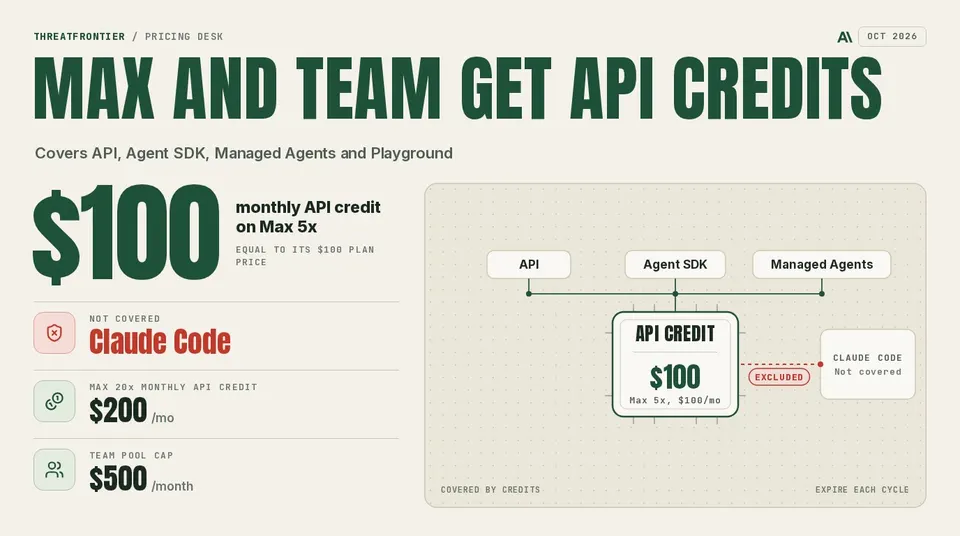
Claude Max and Team now include monthly API credits: $100 on Max 5x, $200 on Max 20x, up to $500 for Team. Claude Code is excluded and credits expire monthly.
Anthropic announced on 7 October 2026 that Claude Max and Team plans include monthly credits for the Claude Platform API. The credits equal the Max price and, on annual Team billing, the seat price. They expire each cycle and cannot be used for interactive Claude Code.
What happened
Anthropic's release notes dated 7 October say Max and Team plans "now include monthly API credits for running your own apps and agents on the Claude Platform", rolling out over several days. Per the API credits doc, Max 5x gets $100 a month and Max 20x gets $200. Team gets $20 per Standard seat and $100 per Premium seat, pooled into one balance capped at $500. Discounted Team plans (Nonprofit, Scientists) get the same amounts. Free, Pro and Enterprise are not eligible.
Why it matters: credits versus plan price
Prices below come from Anthropic's Max and Team support pages (US, excluding tax).
| Plan | Price | Monthly API credit |
|---|---|---|
| Max 5x | $100 | $100 |
| Max 20x | $200 | $200 |
| Team Standard seat | $25 monthly, $20 annual | $20 |
| Team Premium seat | $125 monthly, $100 annual | $100 |
On Max and on annually billed Team seats, the credit equals the price paid. On monthly Team billing it is 80 percent of the seat price. This is our arithmetic from the published figures. The credits are only worth that much if you use them: they do not roll over. Anthropic's example is a team of three Standard and two Premium seats, which receives $260 a month; one more Premium seat raises the next month to $360. The $500 cap is reached at five Premium seats by our arithmetic, so large teams gain nothing more from extra seats.
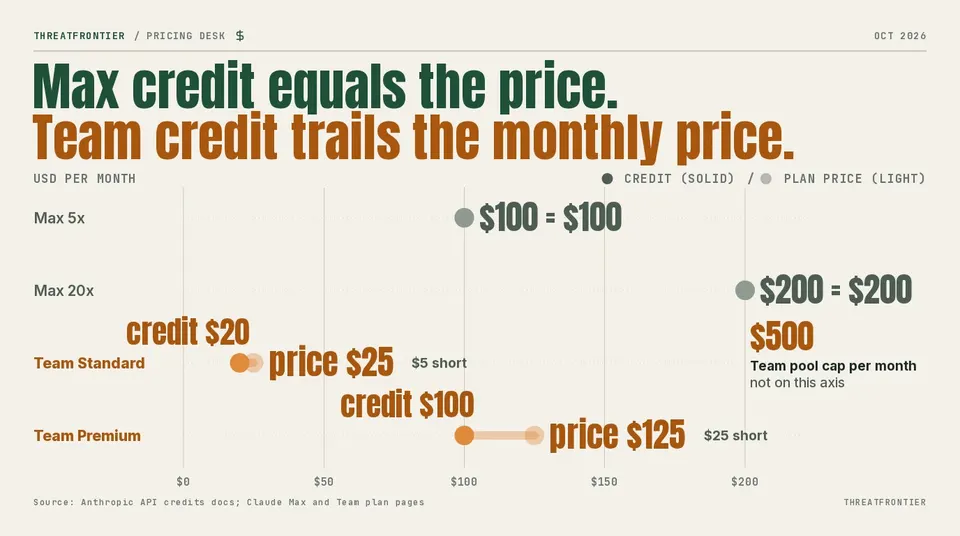
Monthly API credit vs plan price (US). Team credit equals the annual seat price.
Who benefits: people who already pay for Max and build against the API (apps, agents, evaluations) and currently buy prepaid credits (we covered whether Max is worth it with Fable 5). Teams that run internal agents get a shared pool. People who only use Claude chat and interactive Claude Code get nothing from this, though anyone who scripts headless claude -p jobs with an API key can draw on the credits (see below).
What is not covered
The doc lists the credits as usable on the Claude API, Claude Managed Agents, the Claude Agent SDK and the Playground. They do not cover interactive Claude Code in the terminal, IDE, desktop or web, extra usage in the Claude apps, or Claude Platform on AWS, Amazon Bedrock, Google Cloud or Microsoft Foundry. The doc also says credits "don't change your usage limits in Claude or Claude Code".
There is one nuance, from the Help Center FAQ on claude -p. Run with an API key from the linked Console organization, claude -p and the Agent SDK are billed as Agent SDK usage, so the credits do cover them. Signed in with your Claude plan, the same runs draw on plan limits and do not touch the credits. Runs started by the Claude Code GitHub Action, an IDE extension or the desktop app count as Claude Code and are not covered, even with -p. The program is also not the June "Agent SDK credit", which the FAQ says is not available. If an organization holds only these credits and runs a Claude Code session, Claude Code shows "Credit balance too low". Developers weighing Max for Claude Code should read our Max 5x versus 20x explainer and our Claude Code pricing coverage for Pro versus Max; the credits do not change that calculation.
How to claim, and the gotchas
- Link a Console organization under Settings > Billing (Max) or Organization settings > Billing (Team) and accept the program terms. You need to be the Max subscriber or a Team Primary Owner/Owner, plus Owner, Admin or Billing in the Console organization. No Claude Platform payment method is required.
- The link is one-to-one: each plan links one Console organization, each organization can take credits from one plan. You cannot change it yourself; only support can. Pick the organization you will build in.
- New subscribers can claim after 7 days.
- Credits expire at the end of each billing cycle (monthly on annual plans), with no rollover. Included credits are spent before purchased ones, and auto-reload watches only the purchased balance.
- Every API key and workspace in the organization shares one balance. To cap a project, give it its own workspace with a spend limit.
- Tiers: linked organizations move to at least the Start tier, and to at least Build if monthly credits exceed $200. Credits do not count toward later tier upgrades. They also count toward the monthly spend cap, which resets on the first of the calendar month, not on the billing cycle.
- Plan changes: cancelling or downgrading stops new credits but existing ones last until expiry. Max 5x to 20x brings prorated credits immediately (on Google Play, the extra $200 can arrive later, by the next renewal at the latest). Moving from Max to Team ends the Max link; a Team owner can claim after the Team plan has been active 7 days. Seats added count from the next billing month.
When credits run out
With no other credits, API requests fail with "Your credit balance is too low to access the Anthropic API" until the next monthly credits arrive. Usage is never charged to the Claude plan. Buy credits or turn on auto-reload to continue. Organizations invoiced through Anthropic sales are billed as usual beyond the credits.
What admins should do
- Every key shares one balance, so one leaked key can drain the month's credits (our inference from the sharing rule). Use separate workspaces with spend limits and rotate keys.
- Decide which Console organization is linked before an owner clicks through, since it is hard to undo.
- Restrict who holds Team Owner and Console Admin/Billing roles, as they can link and spend.
What is still unclear
Prices above are US figures from the support pages; regional prices and taxes vary. Anthropic has not said how long the offer runs, and the Help Center says the credits work with any available Claude model on the Claude Platform, including the Messages API and Message Batches API. The doc notes the Batches API costs 50 percent less, which stretches a fixed credit further.