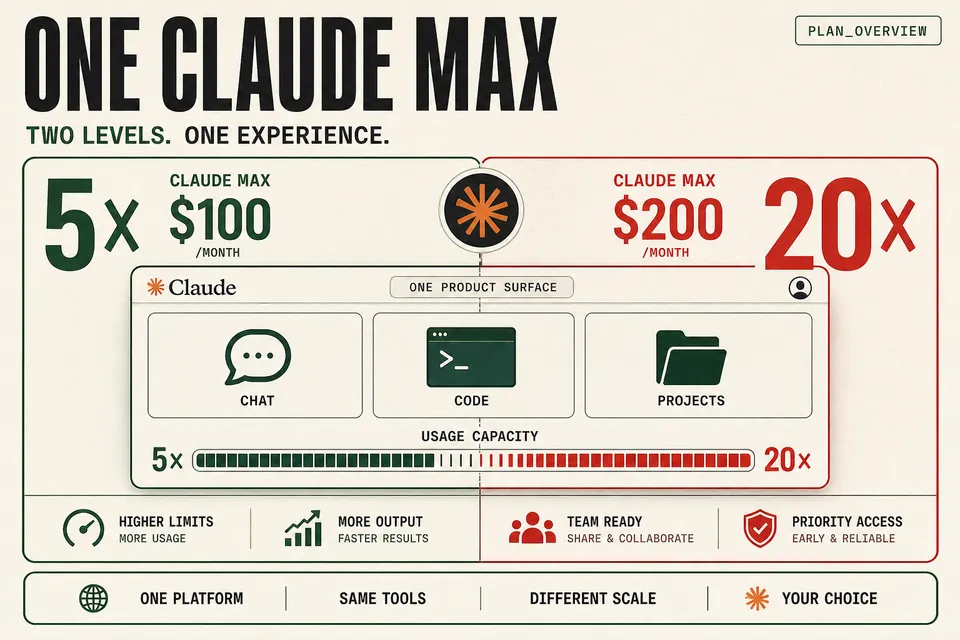
Claude Max 100 vs 200 compared: both plans share the same features—only 5× vs 20× Pro usage differs. Choose the right tier for heavy coding without overpaying.
Heavy Claude users who slam into Pro limits mid-session face a simple-looking choice that is easy to misread: pay $100 a month for Max 5× or $200 a month for Max 20×. There is no separate “Claude 200” product, no exclusive Code SKU, and no second feature catalog at the higher price. Max is one plan with two usage multipliers relative to Claude Pro—and that is the entire official difference that matters for most individual buyers.
Demand for that choice has risen as developers lean on Claude for long coding sessions, multi-project work, research, and agent-style desktop tasks. We cover the same decision from a Claude Code angle in Claude Max $100 vs $200 for Claude Code usage. Pro remains the everyday baseline. Max exists for people who need more room in the same product family. Understanding how capacity expands—and when it still runs out—keeps buyers from overpaying for headroom they will not consume.
The Free → Pro → Max ladder
Anthropic’s individual web ladder is straightforward. Free is limited. Pro costs $20 a month, or $17 a month when billed annually ($200 up front). Max 5× is $100 a month for 5× Pro usage per session. Max 20× is $200 a month for 20× Pro usage per session. Max is monthly only on the web; mobile store prices can differ; taxes are extra; and Team/Enterprise seats are a separate product line, not personal Max tiers. For how Max stacks up against rivals at the same price points, see Google AI Ultra vs Claude Max vs ChatGPT Pro.
| Plan | Price (web, individual) | Billing | Usage framing | Positioned for |
|---|---|---|---|---|
| Free | $0 | — | Limited | Occasional use |
| Pro | $20/mo, or $17/mo annually | Monthly or annual | Standard Pro capacity | Everyday productivity |
| Max 5× | $100/mo | Monthly only | 5× Pro usage per session | Frequent users, variety of tasks |
| Max 20× | $200/mo | Monthly only | 20× Pro usage per session | Daily users for most tasks |
Pro already includes more usage than Free, plus Claude Code, Claude Cowork, projects, Research, broader model access, and related tools. Max is officially everything in Pro plus more usage, with higher output limits, early access framing, and priority at high traffic described for Max as a whole—not as 20×-only perks. The $100 and $200 Max tiers share that same feature set; the only official differentiator is the 5× versus 20× capacity multiple.
How capacity works—and why Code shares the pool
Anthropic does not publish a fixed public table of messages per plan. Capacity is usage-weighted: longer conversations, heavier tools, larger context, higher-effort or thinking modes, and stronger models burn the budget faster than short Sonnet chats.
Official framing is clear. Max 5× delivers five times more usage per session than Pro. Max 20× delivers twenty times more—also described as 20× Pro usage per 5-hour session. Max plans carry two weekly usage limits: one across all models and one for Sonnet only. Weekly limits reset on a fixed account-assigned day and time under Settings → Usage. Session-style included limits are framed around about five hours; when that capacity is exhausted, it resets on that cadence. Usage credits do not change the reset clock. Max is not unlimited; Anthropic still applies limits and may add further weekly, monthly, model, or feature caps.
Claude Code is not a separate paid SKU. Session and weekly caps for that shared pool are broken down in Claude Code Max plan limits: 5x vs 20x shared caps. On Pro and Max, Code in the terminal and supported IDEs is part of the same individual subscription used for claude.ai, desktop, and mobile. All of that activity draws from one shared pool. A long agentic Code session can block chat; heavy chat or Research can leave less room for Code.
When included limits run out, the practical options are wait for reset, step up a tier (Pro → Max 5× → Max 20×), enable usage credits, or use Console/API for a short sprint. Watch for an ANTHROPIC_API_KEY environment variable; if set, Claude Code can bill API usage instead of the subscription. Credits are optional overflow on Pro and both Max tiers, billed at standard API rates, with optional monthly caps, auto-reload, and alerts. They apply to both chat and Code—variable spend, not a third Max product.
Keep usage limits separate from length (context) limits. Usage is the time-period budget across products. Length is how much a single chat can hold. Paid models can offer large context windows—up to about 1M tokens on the newest paid models—but long threads and automatic summarization still consume usage. New chats and projects with retrieval often stretch both hygiene and the budget farther than endless resume of mega-threads.
Third-party writeups sometimes quote approximate prompt ranges for Pro, 5×, and 20×; treat those as rough community orientation only. The reliable signal is what Settings → Usage shows on your account during a normal workweek. A practical way to track that across tools is monitoring AI rate limits across ChatGPT, Claude and Cursor.
Who needs 5× versus 20×
Anthropic positions Max 5× for frequent users across a variety of tasks and Max 20× for daily users who run most of their work through Claude. Capacity burns fastest with:
- Heavy Claude Code on large repositories—tool loops, multi-file context, multi-step agents
- Long resumed chats where history re-enters context every turn
- Opus / high effort / extended thinking relative to lighter Sonnet defaults
- Research, web tools, and MCP connectors, which are token-intensive
Lighter chat plus occasional Code, short prompts, and moderate context often fit Pro or Max 5×.
Community reports balance two patterns. Many power users find 5× enough after leaving Pro, and some who tried $200 later downgraded to $100 once they cleaned up context habits. Others—especially full-day agentic coding with large context—report that even Max 20× can feel tight, with session or weekly walls under extreme load. Peak-hour congestion complaints also appear in user discussion. Those are pattern reports, not guarantees: 5× is the default step-up; 20× is for measured, repeated exhaustion of 5× under normal daily intensity.
Decision guide and cost math
Max 5× is usually enough if you hit Pro limits a few times a week rather than all day every day; you lean on Sonnet or moderate context; you start new chats instead of endlessly resuming mega-threads; and you can shift heavy work across five-hour windows without real business cost.
Max 20× becomes rational when Settings → Usage on 5× regularly shows the session near 100% within the first one to three hours of a normal workday, and weekly usage climbs toward the ceiling before reset; when multi-hour agentic Code plus large context and Opus is the job; when waiting for a five-hour reset is expensive; and when optimization has already been tried—new chats, projects, less Opus, lower effort, fewer tools. If 20× still blocks the real workday, next levers are usage credits or API for sprints, or Team/Enterprise for organizational scale—not an imaginary third Max feature tier.
| Plan | Monthly $ | Price vs Pro monthly | Stated capacity vs Pro |
|---|---|---|---|
| Pro | 20 (17 annualized) | 1× | Baseline |
| Max 5× | 100 | 5× price | 5× usage / session |
| Max 20× | 200 | 10× price | 20× usage / session |
Max 5× charges 5× Pro’s monthly price for 5× session capacity. Max 20× charges 10× Pro’s monthly price for 20× session capacity. If a user truly consumes near the top of 20×, dollars per multiple improve versus 5×. If they only need roughly two to four times Pro, $200 is pure overspend.
A practical estimate without a public token table:
- Log one to two weeks on Pro (or current Max): session hits, weekly percentage, model mix, chat versus Code share.
- Map intensity: occasional Pro walls → try Max 5× first; multiple full-day Pro walls → still start at 5×, then step to 20× only if the same pattern reappears.
- Budget overflow as API-rate credits with a hard monthly cap.
- Optimize before upgrading: new chats, projects, Sonnet default, lower effort, fewer connectors.
Heuristic: rare Pro hits → stay on Pro; Pro session/weekly walls in peak weeks → Max 5×; daily multi-hour Code/Opus with 5× maxed → Max 20×; 20× still maxed under normal load → credits, API, or an org plan.
Bottom line
Claude Max 100 vs 200 is not a feature fork. It is Max 5× versus Max 20×: $100 for five times Pro session usage and $200 for twenty times, both monthly on the web, both sharing the same Max product surface, both pulling chat, desktop, and Claude Code from one pool under roughly five-hour and weekly controls. Overflow is optional credits at API rates, not a secret third SKU.
Choose the lowest Max tier that stops routine session and weekly blocks under your measured Pro—or 5×—pattern. Pay $200 only for sustained 20×-class consumption. The official ladder already resolves the confusion.