Anthropic launches Claude Opus 5 with 1M context alongside a permanent price freeze on Sonnet, cutting enterprise AI costs and setting new SWE-bench records.
Anthropic has unveiled its frontier flagship model, Claude Opus 5, pairing substantial leaps in autonomous reasoning and whole-repository software engineering with an unprecedented permanent price freeze on its enterprise workhorse tier, Claude Sonnet.
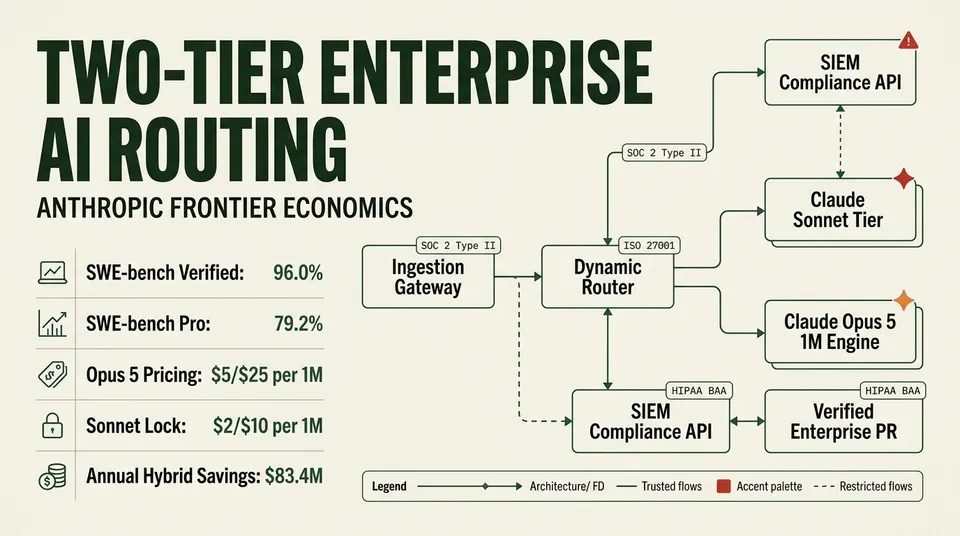
The dual announcement attacks the two primary roadblocks stalling enterprise artificial intelligence adoption: capability ceilings on mission-critical technical tasks and the financial volatility of scaling production workloads. DeepSeek takes a different approach to the same volatility, reshaping enterprise costs through asymmetric routing in its V4.1 Flash update. Opus 5 enters the market priced at $5.00 per million input tokens and $25.00 per million output tokens—slashing the operating cost of frontier-grade intelligence by 50% compared to prior legacy industry baselines. Simultaneously, Sonnet's enterprise rates have been permanently locked at $2.00 per million input tokens and $10.00 per million output tokens, formally canceling a scheduled price increase that would have raised rates to $3.00 and $15.00.
Architectural Leaps: 1M Context and Benchmark Breakthroughs
Opus 5 introduces an adaptive thinking engine supported by a native 1,000,000-token context window, allowing engineering teams to load entire multi-repository architectures into active memory simultaneously. Unlike rigid chain-of-thought implementations that enforce uniform processing delays across all prompts, Opus 5 dynamically provisions its reasoning token budget based on query complexity, mitigating latency bottlenecks on deterministic operations while expanding compute allocation during multi-step logic synthesis.
The architectural advancements translate to commanding margins across standardized engineering evaluations:
- SWE-bench Verified: Opus 5 resolves 96.0% of multi-file software engineering problems end-to-end, executing terminal commands, modifying dependent modules, and verifying test suites autonomously.
- SWE-bench Pro: Achieving 79.2%, the model demonstrates sustained coherence across enterprise-scale commercial codebases featuring complex dependency graphs and undocumented internal APIs.
- ARC-AGI-3 & Frontier Logic: Across novel inductive reasoning and symbolic constraint satisfaction benchmarks, Opus 5 establishes clear separation from existing frontier competitors.
Advanced Vulnerability Auditing and Automated Remediation
For chief information security officers (CISOs), the defining capability of Opus 5 lies in automated application security testing and red-teaming workflows. Rather than analyzing functions in isolation, the model conducts full Abstract Syntax Tree (AST) analysis across distributed microservice architectures, tracing untrusted input paths across network boundaries to surface deep-seated logic flaws, race conditions, and cryptographic misconfigurations. A later Opus 5.5 update pushed most hands-on cybersecurity work to the cheaper Opus 4.8 tier instead.
# Automated AST taint-analysis flow executed by Claude Opus 5
import ast

class SecurityTaintVisitor(ast.NodeVisitor):
 """Traces untrusted data sources to critical execution sinks across microservices."""
 def __init__(self, taint_sources, dangerous_sinks):
 self.sources = set(taint_sources)
 self.sinks = set(dangerous_sinks)
 self.tainted_vars = set()
 self.findings = []

 def visit_Assign(self, node):
 # Identify source assignments
 if isinstance(node.value, ast.Call) and getattr(node.value.func, 'id', '') in self.sources:
 for target in node.targets:
 if isinstance(target, ast.Name):
 self.tainted_vars.add(target.id)
 self.generic_visit(node)

 def visit_Call(self, node):
 # Flag tainted sinks without sanitization
 if getattr(node.func, 'id', '') in self.sinks:
 for arg in node.args:
 if isinstance(arg, ast.Name) and arg.id in self.tainted_vars:
 self.findings.append({"sink": node.func.id, "variable": arg.id, "line": node.lineno})
 self.generic_visit(node)
Upon discovering an exploitable condition, Opus 5 synthesizes verifiable remediation patches alongside accompanying unit tests and negative regression assertions. This end-to-end verification ensures that security patches do not disrupt existing business logic while strictly adhering to built-in Responsible Scaling Policy guardrails.
The Sonnet Rate Freeze and Enterprise TCO Recalibration
While Opus 5 redefines frontier capabilities, the permanent pricing lock on Claude Sonnet alters the economics of high-throughput generative AI deployments. Anthropic had previously slated Sonnet for a post-introductory enterprise rate hike to $3.00 input and $15.00 output per million tokens. Locking rates indefinitely at $2.00 / $10.00 eliminates supplier-side price volatility for software vendors building AI-native products.
Furthermore, Anthropic's integrated prompt caching architecture offers up to a 90% discount on cache reads, reducing input token costs to $0.20 per million tokens for repeated prompts and persistent codebase contexts.
| Model Tier | Input Price / 1M Tokens | Cache Read / 1M Tokens | Output Price / 1M Tokens | Context Window |
|---|---|---|---|---|
| Claude Opus 5 | $5.00 | $0.50 | $25.00 | 1,000,000 tokens |
| Claude Sonnet (Locked) | $2.00 | $0.20 | $10.00 | 200K – 1,000,000 tokens |
| Legacy Frontier Baseline | $10.00 | N/A | $30.00 | 128,000 – 200,000 tokens |
For an enterprise processing 1 billion tokens monthly (75% input, 25% output, with a 60% cache hit rate on recurring system prompts), deploying a pure legacy frontier model results in approximately $10.50 million in monthly inference expenditure, or a $126.0 million annual run-rate.
 MONTHLY ENTERPRISE COST (1B TOKENS)

 Legacy Frontier Baseline │ $$$$$$$$$$$$$$$$$$$$$ $10.50M ($126.0M/yr)
 All-Opus 5 Frontier │ $$$$$$$$$$$$$ $7.25M ($87.0M/yr)
 Tiered Hybrid Pipeline │ $$$$$$ $3.55M ($42.6M/yr)
 All-Sonnet Production │ $$$$ $2.90M ($34.8M/yr)
 └──────────────────────────────────────────►
By architecting a Tiered Hybrid Pipeline—routing 85% of standard production traffic to the price-locked Sonnet tier and escalating the top 15% of complex reasoning tasks to Opus 5—enterprises reduce monthly operational costs to ~$3.55 million ($42.6 million annually). Compared to the unoptimized legacy baseline of $126.0 million, this hybrid approach delivers $83.4 million in net annual savings, providing chief financial officers with clear unit gross margin predictability.
Enterprise Governance, Compliance, and Data Isolation
To accommodate highly regulated sectors such as financial services, healthcare, and defense, Anthropic has integrated enterprise-grade governance controls across both model tiers:
- Zero Data Retention (ZDR): Customer prompts, reasoning traces, and output completions are never stored on disk for model evaluation or training purposes.
- Regulatory Attestations: Comprehensive compliance coverage including SOC 2 Type II, HIPAA BAA, ISO 27001/27701, and full adherence to GDPR/CCPA data processor mandates.
- Enterprise Compliance API: Real-time telemetry endpoints allow security teams to stream conversation logs, token metrics, and safety flags directly into enterprise SIEM platforms, including Splunk, Datadog, and Palo Alto Networks.
- Customer-Managed Encryption Keys (CMEK): Enterprise deployments hosted via AWS Bedrock (KMS) and Google Cloud Vertex AI (Cloud KMS) support hardware-level key isolation alongside PrivateLink and VPC peering to ensure data never traverses public networks.
Strategic Blueprint: Two-Tier Sovereign Architecture
For Chief Technology Officers and engineering leads, the simultaneous availability of Opus 5 and price-stabilized Sonnet dictates a clear architectural blueprint. Monolithic AI pipelines relying on a single model tier are rapidly being replaced by dynamic routing fabrics.
| Workload Domain | Deployment Recommendation | Architectural Justification |
|---|---|---|
| Monolith Decomposition & Legacy Migrations | Claude Opus 5 | Demands 1M context to parse cross-repo dependency structures. |
| Static & Dynamic Code Auditing (SAST/DAST) | Claude Opus 5 | Deep multi-step reasoning minimizes false-positive security alerts. |
| CI/CD Code Reviews & Automated Unit Tests | Claude Sonnet | Sub-second Time-to-First-Token at a guaranteed, predictable unit cost. |
| High-Concurrency Customer Support Copilots | Claude Sonnet | Low latency protects user experience; locked rates safeguard gross margins. |
| Edge-Case Exception Escalation | Dynamic Router (Sonnet → Opus 5) | Real-time classification escalates failed Sonnet executions to Opus 5. |
By cementing Sonnet as a deflationary baseline and deploying Opus 5 as a high-order reasoning engine, Anthropic delivers a predictable, enterprise-ready infrastructure model that shifts the competitive frontier from benchmark posturing to sustainable production execution.