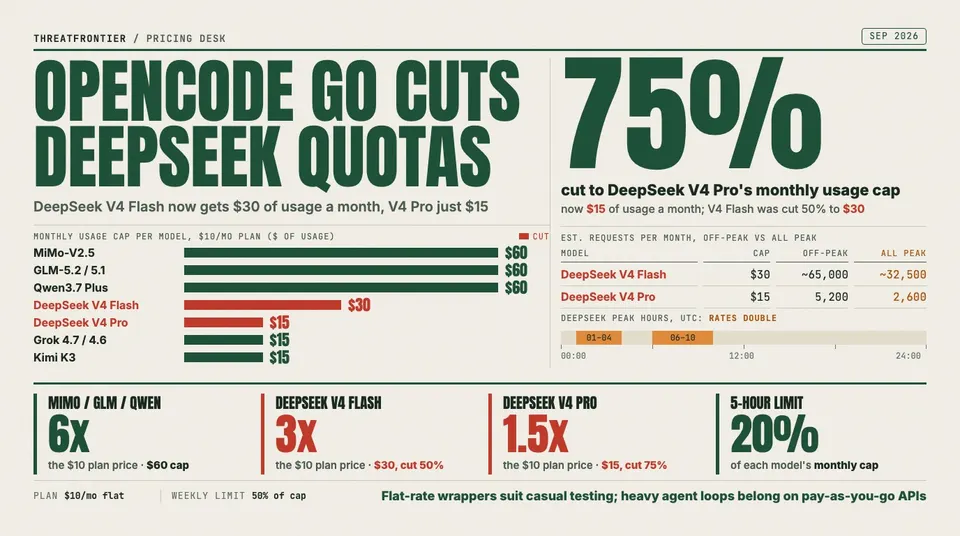
OpenCode Go cuts DeepSeek V4 quotas by up to 75% as peak API pricing and heavy token burn squeeze the margins of fixed-rate AI subscription aggregators.
Fixed-rate AI subscription gateway OpenCode Go has slashed developer usage allowances for its most popular coding models, cutting the monthly credit cap for DeepSeek V4 Flash by 50 percent and DeepSeek V4 Pro by 75 percent. The reductions—enforced alongside strict per-model rolling limits (on a $60 model, $12 every five hours and $30 per week)—expose the severe margin compression confronting AI aggregation services as upstream model providers institute dual-tier peak pricing and aggressive baseline token rates.
Under the restructured policy, subscribers paying $10 per month—a tier originally marketed as providing up to $60 in aggregate model usage, or a 6x nominal multiplier—find DeepSeek V4 Flash capped at $30 per month (a 3x multiplier) and DeepSeek V4 Pro restricted to $15 per month (a 1.5x multiplier). In contrast, partner models hosted on reserved capacity, such as MiMo-V2.5 and GLM-5.2, retain their full $60 monthly ceilings. The divergence highlights a growing rift in the developer tooling ecosystem between subsidized, margin-negative frontier models and sustainable private infrastructure.
Tiered Caps and Throttling Mechanics
OpenCode Go functions as a unified gateway compatible with OpenAI and Anthropic API specifications, allowing developers to route IDE completions, terminal commands, and agentic workflows through a single authenticated endpoint. The platform costs a flat $10 a month (the $5 first-month discount it launched with was removed on 24 August 2026), and multi-layered usage barriers now prevent power users from exhausting broker allocations. Current tiers and caps are covered in our OpenCode Go $10 plan review.
Beyond the monthly allowances, every model carries two rolling burst thresholds derived from its own monthly cap: a 5-hour limit worth 20 percent of it and a weekly limit worth 50 percent. On a $60 model that is $12 per five hours and $30 per week; on a $15 model such as DeepSeek V4 Pro it is just $3 and $7.50. When running automated tasks—such as codebase indexing, unit test generation, or autonomous debugging—developers frequently trigger the 5-hour ceiling during single coding sessions, while monthly allowances on reduced models expire within days.
| Model Tier | Monthly Usage Cap | Nominal Multiplier | Est. Requests (5h Window) | Est. Requests (Monthly) |
|---|---|---|---|---|
| MiMo-V2.5 | $60.00 | 6.0x | 30,100 | 150,400 |
| GLM-5.2 / 5.1 | $60.00 | 6.0x | 880 | 4,300 |
| Qwen3.7 Plus | $60.00 | 6.0x | 4,300 | 21,600 |
| DeepSeek V4 Flash | $30.00 | 3.0x | 13,000 | 65,000 |
| DeepSeek V4 Pro | $15.00 | 1.5x | 1,050 | 5,200 |
| GLM-5.3 | $15.00 | 1.5x | 220 | 1,080 |
| Grok 4.7 / 4.6 | $15.00 | 1.5x | 169 | 845 |
| Kimi K3 | $15.00 | 1.5x | 110 | 490 |
One roster change to plan for: Xiaomi is retiring MiMo-V2.5 and MiMo-V2.5-Pro on its own API on 21 October 2026, with the MiMo-V2.6 series as the replacement. OpenCode Go already lists MiMo-V2.6-Flash at the same $60 cap and request estimates as MiMo-V2.5, and MiMo-V2.6-Pro at $15.
Upstream Peak Surcharges Accelerate Token Burn
The immediate catalyst for the quota reduction is DeepSeek's upstream pricing structure, which imposes a 100 percent rate doubling during peak traffic windows. DeepSeek designates two daily peak intervals—01:00–04:00 UTC and 06:00–10:00 UTC—coinciding with core business and development hours across Asian and European software hubs. DeepSeek introduced that pricing alongside its V4 Pro launch and peak-hour API surcharges.
DeepSeek retired the original V4 Flash on 10 September 2026; the legacy deepseek-v4-flash name is now served by DeepSeek V4.1 Flash at the Flash price. During off-peak windows that is $0.15 per million input tokens, $0.60 per million output tokens, and $0.003 per million cached prompt tokens. During peak hours, these rates climb to $0.30 input, $1.20 output, and $0.006 cached read.
Based on empirical developer profiles consuming 410 input tokens, 71,300 cached context tokens, and 310 output tokens per request, the nominal cost per invocation doubles from about $0.00046 off-peak to about $0.00092 during peak windows. Because OpenCode meters its allowance in gross dollar consumption rather than fixed request counts, a developer working entirely during peak hours sees their effective monthly Flash capacity drop from about 65,000 requests down to about 32,500 requests. On DeepSeek V4 Pro, peak execution cuts total throughput from 5,200 requests to just 2,600. Cached context dominates that request profile; see how prompt caching cuts agent costs.
The Subscription Squeeze: Broken Aggregator Economics
The restructuring exposes the structural limits of fixed-rate AI broker models. Aggregators typically rely on two pillars: negotiating volume discounts with model providers, and banking on user "breakage," where casual subscribers subsidize heavy users.
Both mechanisms fail when applied to modern coding agents. DeepSeek prices its public endpoints near raw operational compute costs, leaving third-party proxies unable to secure enterprise discounts below published rates. Furthermore, coding subscriptions suffer from adverse selection: power engineers run long-context, automated loops that consume the full nominal allowance. A subscriber who burns $60 of pass-through API credits under a $10 plan incurs a net $50 monthly deficit for the platform.
"For most models, we make this work through bulk discounts and reserved GPU capacity," OpenCode stated in its technical documentation. "For some models, we haven’t had the opportunity to negotiate a discount or host them at a lower cost, either because the model is new or because their public pricing is already discounted."
When hosting open models on dedicated GPU clusters, inference costs decrease as tenant density scales. But when acting as a pass-through proxy to third-party APIs, brokers absorb 100 percent of upstream price volatility and peak surcharges. The same session priced across Ollama Cloud, OpenRouter and OpenCode Go shows where each wins.
Security Governance and Data Retention Risks
Routing proprietary software architectures through intermediary proxy layers also introduces enterprise compliance liabilities. While direct vendor agreements offer standardized Zero Data Retention (ZDR) guarantees, aggregator governance terms often rely on short-term bilateral contracts.
| Model Platform | Model Training Allowed? | Stated Data Retention | Governance Compliance Footnote |
|---|---|---|---|
| DeepSeek V4 Flash / Pro | No | 0 days* | Monthly Renewal Risk: ZDR agreement renews monthly (current one valid through September 30, 2026); reverts to standard retention if unrenewed. |
| MiMo-V2.5 / GLM-5.2 | No | 0 days | Fixed 0-day retention under dedicated broker infrastructure SLA. |
| GPT 6 Luna / GPT 5.6 Luna | No | 30 days | Upstream abuse monitoring logs retained up to 30 days. |
| Grok 4.7 / 4.6 | No | 30 days | Enforcing ZDR disables stateful responses and batch processing. |
For engineering teams operating under SOC 2, HIPAA, or ISO 27001 mandates, rolling monthly ZDR contracts present significant vendor risk. If a broker fails to renew its monthly ZDR agreement, source code forwarded through the proxy could automatically become subject to standard upstream logging.
Architectural Trade-Offs for Engineering Teams
As subscription wrappers restrict access to high-demand reasoning models, software organizations are evaluating alternative operational patterns.
| Architectural Dimension | OpenCode Go ($10/mo) | Direct Provider API (BYOK) | Local Inference (vLLM / Ollama) |
|---|---|---|---|
| Pricing Model | $10 flat subscription | Pay-as-you-go per token | $0 variable (Hardware CapEx) |
| DeepSeek Quota | Capped at $30 (Flash) / $15 (Pro) | Unlimited (subject to tier TPM) | Unlimited (hardware bounded) |
| Burst Throttling | Per-model 5-hour limit ($12 on $60 models, $3 on $15 models) | None (standard concurrency limits) | Compute throughput limits |
| Prompt Caching | Opaque dollar aggregation | 100% transparent cache billing | Granular KV-cache management |
| Data Governance | Rolling monthly ZDR agreements | Direct enterprise SLA | Fully air-gapped / 100% private |
| Target Workload | Multi-model exploratory testing | CI/CD pipelines & agentic loops | Proprietary source codebases |
For automated continuous integration, repository-wide refactoring, and enterprise workloads, direct pay-as-you-go API keys provide predictable caching discounts and remove arbitrary burst caps. While flat-rate subscriptions like OpenCode Go remain viable for casual multi-model experimentation, the era of unlimited, heavily subsidized access to cutting-edge coding engines through budget wrappers has effectively closed. Flat-rate token plans from Chinese AI labs are another alternative.