Honest OpenCode Go $10 plan review: flat $10/mo, per-model $15/$30/$60 caps, 32 models. See real throughput, who should buy, and when to upgrade to Zen.
Premium AI coding has gotten expensive. Claude Max and ChatGPT Pro-class tiers sit well into the triple-digit monthly range for heavy users, while provider Token Plans and pure pay-as-you-go APIs can still punish bursty agent sessions. Against that backdrop, this OpenCode Go $10 plan review centers on a deliberately simple pitch: $10 a month, cancel anytime, for a curated coding stack behind one key—with hard dollar caps instead of unlimited tokens. The reduced first month that shipped with the launch is gone—OpenCode removed it on 24 August 2026 (changelog v1.18.22)—so the plan is flat $10 from day one, with no trial rate.
Updated 12 October 2026: OpenCode's docs and pricing page, checked today, sell two plans: Go at $10/month and Go Plus at $40/month with higher per-model limits on the same lineup. The per-model $15 / $30 / $60 structure below still holds for the $10 plan, but the lineup moved again since 3 October: Claude Haiku 5.5 has joined, Step 5 Preview Free is a new free model, and Space Bunny is no longer free. Go's own docs now list 32 models, and its pricing page says "View all 31 models"; the tables below follow the docs.
Go is not a frontier clone. It is a capped multi-model bucket for developers who want volume, routing flexibility, and predictable spend. Whether it is enough depends on how you work, which models you choose, and whether you treat it as a primary brain or as the workhorse beside a stronger planner.
What OpenCode Go Is
OpenCode itself is a free, MIT-licensed terminal coding agent that can connect to any provider you hold a key for. It is compared with rival agents in Claude Code vs Codex CLI vs Antigravity CLI vs OpenCode. Go is the optional paid layer: Anomaly/OpenCode’s curated gateway of models tested for agentic coding, billed as one flat subscription instead of a stack of separate provider accounts.
Subscribe, grab an API key, and connect it in OpenCode—or any agent that speaks standard OpenAI- or Anthropic-compatible endpoints under the Go gateway. When you exhaust a limit, the official docs are explicit that you can keep working on the free models; free companion models such as Big Pickle remain available on Zen with their own separate beta limits.
Privacy is no longer one blanket claim, and the article you are reading is the place to say so plainly. Most of the Go lineup—the Zhipu, Kimi, DeepSeek, MiniMax and Qwen families—runs zero data retention with no training on user data. Four named exceptions matter as of October 2026: Grok 4.7 / 4.6, GPT 6 Luna / GPT 5.6 Luna and Claude Haiku 5.5 retain data for up to 30 days (abuse-monitoring logs for the GPT models, Anthropic's data policy for Haiku), and the Muse Spark Contributor models trade heavily discounted token pricing for permission to use your prompts and completions to train future Meta models (availability is region-limited under Meta’s geographic policy). The docs also date the DeepSeek arrangement: the ZDR agreement is renewed monthly, and the docs now say the current one is valid through 31 October 2026, so check the privacy section for the next renewal.
Pricing, Caps, and How Token Burn Works
Sticker price is simple: $10/month for Go, or $40/month for Go Plus (same models, same per-token prices, higher limits), cancel anytime, with optional top-up credit and optional Zen balance fallback so work can continue on pay-as-you-go credits after Go limits instead of hard-stopping. For a per-session cost comparison, see Ollama Cloud vs OpenRouter vs OpenCode Go pricing.
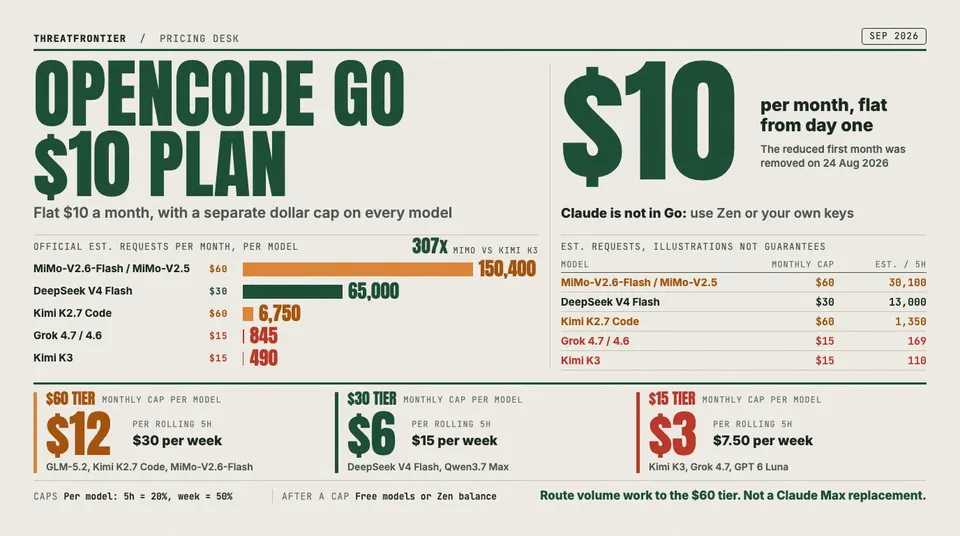
The central mechanic has changed since launch, and it is the single most important thing to understand before subscribing. Usage is not one shared envelope across the account. Every model carries its own monthly dollar limit, and the shorter windows are derived from that model’s limit: 5-hour is 20%, weekly is 50%, monthly is 100%. Burning through one model’s five-hour window does not touch any other model’s.
Three tiers are in use on the $10 plan (tiers as listed in OpenCode's docs on 12 October 2026):
| Monthly limit | Rolling 5-hour (20%) | Weekly (50%) | Typical members |
|---|---|---|---|
| $60 | $12 | $30 | GLM-5.3-Flash, GLM-5.2, Kimi K2.7 Code, Kimi K2.6, LongCat-2.0, MiMo-V2.6-Flash, MiMo-V2.5, MiniMax M3, MiniMax M2.7, Muse Spark 1.3 / 1.2 Contributor, Qwen3.7 Plus, DeepSeek V4.1 Flash, Hy3 |
| $30 | $6 | $15 | DeepSeek V4 Flash, Qwen3.8 Flash, Hy4 preview, Space Bunny |
| $15 | $3 | $7.50 | Kimi K3, GLM-5.3, Qwen3.8 Max, MiMo-V2.6-Pro, MiMo-V2.5-Pro, DeepSeek V4 Pro, DeepSeek V4 Flash Vision Exp, Grok 4.7 / 4.6, GPT 6 Luna / GPT 5.6 Luna, Claude Haiku 5.5 |
That cuts both ways. The good news: a heavy afternoon on MiMo-V2.5 leaves your Kimi K2.7 Code budget untouched, so genuine multi-model routing now buys you more total work than the old shared-envelope reading suggested. The bad news: the flagship-class models are ring-fenced at $15/month, which is $3 per rolling five hours—about 110 requests on Kimi K3, 160 on Qwen3.8 Max, 169 on Grok 4.7 or 4.6. Those are sampling budgets, not working budgets.
Recompute the old burn arithmetic per tier. On a $60 model, two full $12 five-hour burns in a day put you near $24 against a $30 weekly wall—the classic Go squeeze, still real. On a $30 model, two full five-hour burns is $12 against a $15 weekly wall, so you hit the weekly ceiling inside two heavy days. On a $15 model, a single $3 window is a fifth of the month’s entire allowance for that model. Go Plus lifts each model's monthly limit, not uniformly: Kimi K3 goes from $15 to $60, Kimi K2.7 Code from $60 to $180, and DeepSeek V4.1 Flash from $60 to $120, for example. Console tracking shows where you stand on each, and official docs note that limits may change as the team learns from early usage and feedback. Marketing’s “~6× value” story holds only for the $60 tier, and only if you can usefully consume that envelope for a $10 subscription—true with intelligent routing, false if you default to the most expensive option.
Official estimated throughput (typical agent token mixes; illustrations, not guarantees) makes the variance concrete. Representative rows, with each model’s monthly tier:
| Model | Tier | Est. / 5h | Est. / week | Est. / month |
|---|---|---|---|---|
| Kimi K3 | $15 | 110 | 250 | 490 |
| Grok 4.7 / 4.6 | $15 | 169 | 423 | 845 |
| Qwen3.8 Max | $15 | 160 | 400 | 810 |
| GLM-5.2 | $60 | 880 | 2,150 | 4,300 |
| DeepSeek V4 Pro | $15 | 1,050 | 2,600 | 5,200 |
| Kimi K2.7 Code | $60 | 1,350 | 3,380 | 6,750 |
| GPT 5.6 Luna | $15 | 2,050 | 5,100 | 10,250 |
| Claude Haiku 5.5 | $15 | 3,850 | 9,620 | 19,230 |
| GPT 6 Luna | $15 | 4,230 | 10,560 | 21,130 |
| MiniMax M2.7 | $60 | 3,400 | 8,500 | 17,000 |
| Qwen3.7 Plus | $60 | 4,300 | 10,800 | 21,600 |
| GLM-5.3-Flash | $60 | 6,320 | 15,790 | 31,580 |
| DeepSeek V4 Flash Vision Exp | $15 | 6,500 | 16,250 | 32,500 |
| DeepSeek V4.1 Flash | $60 | 26,000 | 65,000 | 130,000 |
| LongCat-2.0 | $60 | 11,400 | 28,600 | 57,200 |
| DeepSeek V4 Flash | $30 | 13,000 | 32,500 | 65,000 |
| MiMo-V2.6-Flash / MiMo-V2.5 | $60 | 30,100 | 75,200 | 150,400 |
| Muse Spark 1.3 Contributor | $60 | 45,300 | 113,300 | 226,600 |
Additional models and full estimates live in the current Go docs. Per-1M rates explain the spread. The genuinely cheap end is MiMo-V2.6-Flash and MiMo-V2.5 at $0.14 / $0.28 and Muse Spark at $0.10 / $0.20—Muse Spark being the one you pay for in training rights rather than dollars. DeepSeek V4 Flash and V4.1 Flash are not in that bracket: they bill $0.15–$0.30 in / $0.60–$1.20 out, because DeepSeek moved to peak and off-peak pricing on 16 August 2026 and rates double during its two weekday peak windows (01:00–04:00 and 06:00–10:00 UTC, Monday to Friday, per OpenCode's docs). (DeepSeek itself retired the original V4 Flash on 10 September 2026 and now serves that model name with V4.1 Flash at the same Flash price.) Higher up, GLM-5.2 is $1.40 / $4.40, Qwen3.8 Max is $2.00 / $6.00, Grok 4.7 and 4.6 are $2.00–$4.00 / $6.00–$12.00, Claude Haiku 5.5 is $0.10 / $0.50 (prompts up to 100K tokens, $0.50 / $2.50 beyond) and Kimi K3 is $3.00 / $15.00. Background on that switch is in DeepSeek's V4 Pro launch and peak-hour API surcharges.
One change since the last revision: DeepSeek V4.1 Flash had been running a 4× usage promotion that was due to end on 27 September 2026. OpenCode's docs and pricing page still list it at a $60 cap with about 26,000 requests per 5 hours and 130,000 per month, and carry no promotion note as of 12 October. We could not confirm from a primary source whether that is the new permanent limit, so check the console before planning around it. Quotas can also shrink: OpenCode Go cut DeepSeek V4 quotas by up to 75%, and the docs still put DeepSeek V4 Flash at $30 and DeepSeek V4 Pro at $15.
A second dated caveat applies to the cheapest workhorse. Xiaomi is retiring MiMo-V2.5 and MiMo-V2.5-Pro on its API on 21 October 2026 and moving users to the MiMo-V2.6 series. Go already lists MiMo-V2.6-Flash with the same $0.14 / $0.28 rates, $60 cap and 30,100 / 5h estimate as MiMo-V2.5, and MiMo-V2.6-Pro on the $15 shelf (as is MiMo-V2.5-Pro), so switch any config that hard-codes opencode-go/mimo-v2.5 to opencode-go/mimo-v2.6-flash before then.
Models and How Often the List Changes
OpenCode's docs list 32 models on 12 October 2026, two of them free for a limited time (LongCat 2.5 Preview Free and Step 5 Preview Free, with no usage cap), and its pricing page says "View all 31 models". Space Bunny, free on 3 October, is now a paid model on the $30 tier ($0.15 / $0.60 per 1M, 3,130 requests per 5 hours). The roster turns over fast enough that enumerating it ages the article, so read it by tier, as above: a deep $60 bench of open-weight coders and flash models for volume, a $30 middle (DeepSeek V4 Flash, Qwen3.8 Flash, Hy4 preview, Space Bunny), and a ring-fenced $15 flagship shelf. Models that appeared in earlier revisions of this review, such as Qwen3.7 Max, Qwen3.6 Plus, GLM-5.1 and MiniMax M2.5, are no longer in the docs list.
The one structural change worth stating outright: Go is no longer open-weights-only. GPT 6 Luna, GPT 5.6 Luna, Grok 4.7, Grok 4.6 and, new since 3 October, Claude Haiku 5.5 are all inside the subscription, each capped at $15/month. Claude is no longer absent, but only the small Haiku model is there: Anthropic's larger models live on Zen’s broader pay-as-you-go gateway or via your own keys on the free client. So Go now gets you a small, metered taste of three proprietary families, not none.
Official language is explicit: the list of models may change as the team tests and adds new ones. Early “three models only” coverage is stale, and so is any fixed enumeration—this page has now watched the roster turn over twice. Re-check the live docs and the machine-readable Go models endpoint before renewing or hard-coding IDs. Config-style IDs follow opencode-go/<model-id>. Endpoints support OpenAI-compatible chat completions, Anthropic-compatible messages, and a responses endpoint; official positioning is use with any agent, not OpenCode-only—despite some third-party lock-in claims.
Go vs Free OpenCode vs Zen
| Dimension | Free OpenCode client | OpenCode Go | OpenCode Zen |
|---|---|---|---|
| What | OSS agent; BYO providers | Flat sub for a curated model set | PAYG curated gateway |
| Cost | Free software; you pay providers | $10/mo (or $40/mo Go Plus) + hard $ caps | Credits / per-token; auto-reload options |
| Models | Any provider via your own keys | 32 listed in the docs; mostly open, plus GPT Luna, Grok and Claude Haiku 5.5 | GPT*, Claude*, Gemini*, Grok*, plus open models |
| Caps | Provider-dependent | Per model: $15 / $30 / $60 per month (higher on Go Plus), 20% per 5h, 50% per week | Spend = balance; optional workspace limits |
| Fallback | N/A | Free models; optional Zen balance | Auto-reload when balance is low |
Free client is the tool; Go is the cheap capped bucket with per-model budgets; Zen is metered access to the full frontier lineup.
Go competes hardest with multi-vendor open-model coding plans—not with Claude Max on peak reasoning. Direct provider Token Plans can offer deeper single-vendor quotas at $3–$40-class pricing but multi-key friction; OpenRouter and raw APIs maximize flexibility without a $10 “bucket” discipline; Zen is the natural spillover when caps hit and you need Claude or a bigger GPT without rewiring providers.
On everyday structured coding—boilerplate, CRUD, tests, scaffolding, routine refactors—the open models on Go are competitive enough for many workflows. Proprietary flagships still win on deep multi-file architecture, creative debugging, and highest-stakes production reasoning, and the $15 caps on the Grok, GPT Luna and Haiku models are too thin to change that. Treat the $60-tier flash models as volume workers, spend the $15 shelf on the two or three decisions a week that actually deserve it, and stack Claude or Codex-class tools for planning when architecture quality matters more than request count.
Who Should Buy—and When to Switch
Ideal for the $10 plan: budget-conscious indies, freelancers, and side-project builders; developers who want a multi-model stack without juggling many keys; light-to-moderate daily AI coding, or a secondary worker beside Claude/Cursor/Codex; anyone willing to route models instead of defaulting to the most expensive option every time—which the per-model caps now reward directly. For the full price ladder, see the $6 to $300 AI subscription decision matrix.
Poor fit as a sole plan: full-time, all-day AI-native coding on expensive models; primary need for frontier Claude quality; burst workflows that repeatedly drain a model’s five-hour window and then its weekly wall; anyone who needs strict zero-retention across every model they touch, given the Grok, GPT Luna, Claude Haiku and Muse Spark exceptions.
Decision list
- Need frontier reasoning as primary → Claude Max, ChatGPT Pro, or Zen frontier models. Compare Claude Max $100 vs $200 tiers first.
- Want a multi-model bench under roughly $15/month and can route volume work to the $60 tier → Go at $10/month is the cheapest way in, if the per-model caps fit.
- Caps interrupt only on the $15 flagship shelf → keep Go and enable Zen balance for spillover.
- Caps exhaust even on the $60 tier, or quality gaps on architecture persist → provider Token Plan, higher PAYG, or stack a stronger planner for hard work and Go for execution; pure experimenters can stay on free OpenCode plus Big Pickle.
Bottom Line
For the search intent behind OpenCode Go $10 plan review, the honest answer is narrow and useful: Go is an excellent capped multi-model budget tool—best as a smart-routed secondary (or light primary), not a Claude Max replacement. The value is real when you treat each model’s $15 / $30 / $60 monthly budget as a separate design constraint rather than one shared pot, and route volume work to the $60 tier. The failure mode is equally clear: expensive-model defaults and full-time frontier expectations will drain the $15 shelf in an afternoon and sour the experience.
Check the live model list and docs before you depend on any specific ID, tier or promotional multiplier—the DeepSeek V4.1 Flash cap (a 4× promotion until 27 September, $60 in the docs still), the DeepSeek ZDR renewal (valid through 31 October 2026), Xiaomi's MiMo-V2.5 retirement on 21 October 2026, and the roster has already turned over twice since launch. If you hit the $15 shelf often, Go Plus at $40 raises those limits to $60 on most of the $15 shelf ($120 for GLM-5.3), at least fourfold. Otherwise buy a month at $10 if the workflow fits—and keep a clear upgrade path for the days it does not.
Related reading
- Best AI Coding Stack 2026: Jobs, Tools, and Three Budget Builds That Actually Work
- GLM Coding Plan Pricing 2026: Z.ai Lite vs Pro vs Max Explained
- Xiaomi MiMo Token Plan Pricing: 2026 Tier Guide for Coding Agents
Sources
- OpenCode Go docs (plans, models, per-model limits, estimated requests, privacy; read 12 October 2026)
- OpenCode Go pricing page (Go and Go Plus prices, model count; read 12 October 2026)
- OpenCode changelog