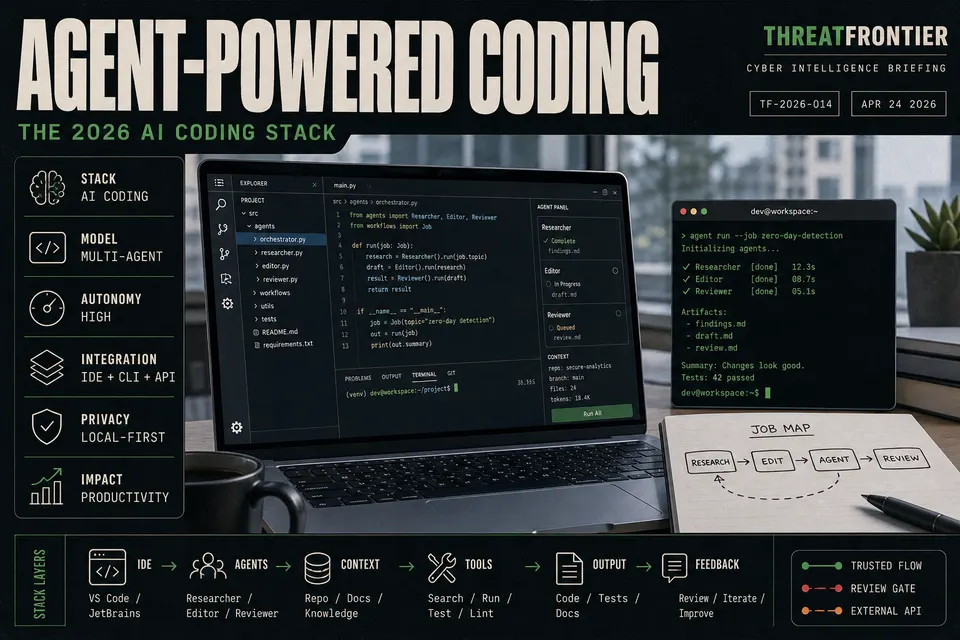
Entry plans still cluster near $20 a month while daily agent use climbs to $60-$200 or more. The winning move is composition by job, not collecting brands.
Developers do not need another “best AI coding tool” crown. They need a stack that maps to real work without burning three subscriptions on the same job. By mid-2026 the market has settled into complementary layers—in-editor agents, terminal and cloud agents, chat for research, and optional local models—while entry plans still cluster around $20 a month and daily agent use quietly climbs to $60–$200 or more. Surveys put AI coding use near the mid-80s among developers, and many teams now run multi-tool stacks (often two to four tools) rather than a single winner. The winning move is composition by job, not brand collection.
The job map that replaces brand loyalty
| Job | What “done” looks like | Best-fit category | Primary 2026 picks |
|---|---|---|---|
| In-editor iteration | Fast Tab, multi-file diffs, stay in the IDE | AI-native editor | Cursor (Composer, Tab, Bugbot) |
| Deep agentic execution | Issue → repo → edit → test → PR | Terminal agent | Claude Code, OpenCode (BYOK) |
| Async / batch work | Queue tasks, review PRs later | Cloud sandbox agent | OpenAI Codex |
| Research & planning | Specs, architecture, tradeoffs | Frontier chat | Claude, ChatGPT, Grok |
| Review / adversarial QA | Catch what the author model misses | Cross-provider review | Second model, Bugbot, review plugins |
| Local / private / free tokens | Offline, regulated code, cheap Tab | Local inference | Ollama + Continue or agent backends |
Orchestration, execution, and review form a three-layer pattern. Full-app “vibe” generators sit outside this SE-focused map. Their security record is covered in vulnerabilities in AI-generated code from vibe coding.
Agents compared: IDE, terminal, cloud, open-source
| Tool | Role | Price band (mid-2026) | Best fit | Weak fit |
|---|---|---|---|---|
| Cursor | VS Code–fork IDE; Tab, Composer, visual diffs; model-agnostic | Hobby free; Pro $20; Pro+ about $60; Ultra $200. Daily Agent often $60–$100 | All-day in-editor iteration, multi-model switching | Pure terminal purists; over-agenting burns credits |
| Claude Code | Terminal-first agentic loops; whole-codebase search | Bundled in Claude Pro $20; daily pro use usually Max $100–$200 | Large refactors, issue→PR, deep multi-file reasoning | Users who only want visual IDE-native UX |
| OpenAI Codex | Async sandboxed cloud agents; queue and review later | Via ChatGPT Free/Plus/Pro; serious use often ~$100–$200/dev/mo (token variance) | Parallel backlog, well-scoped batch work | Mid-flight exploratory steering |
| OpenCode | OSS terminal agent; BYOK + free models | $0 or Go ~$10/mo + API spend | Cost control, same frontier model cheaper via API | Less Anthropic-native Skills/hooks polish |
Head-to-head: Cursor owns interactive IDE loops; Claude Code owns deep local agentic execution; Codex owns batch cloud parallelism; OpenCode owns freedom and price. For a fuller side-by-side, see our Claude Code, Codex CLI, Antigravity CLI and OpenCode comparison. Many productive stacks run Cursor + Claude Code (or OpenCode). Benchmarks are not interchangeable across harnesses—use them as color, not ranking tables. Agentic tools with broad filesystem and shell access can destroy work; sandboxes, least privilege, backups, and human PR review are non-negotiable.
Chat for research without double-paying
| Need | Prefer | Why | Rough price |
|---|---|---|---|
| Specs, long docs, same bill as Claude Code | Claude Pro/Max | One seat covers chat + Code | Pro $20; Max $100 / $200 |
| Ecosystem + Codex in the loop | ChatGPT Plus/Pro | Planning feeds async agents | Plus $20; Pro $100+ |
| Live X/news signal | Grok SuperGrok | Real-time social search | ~$30 SuperGrok |
If Claude Max already funds Claude Code, default research chat to Claude. If ChatGPT + Codex is primary, plan there. Add Grok only when real-time signal is worth the extra seat. Cursor multi-model can replace short planning threads; long research still feels better in dedicated chat UIs.
When Ollama is worth it
Ollama (often via Continue or agent backends) wins on privacy, offline work, zero token cost after hardware, and autocomplete latency. It is strong for explain-this-file, small functions, tests, and configs.
It is a poor sole agent for long multi-tool loops, strict tool-calling under heavy quantization, and hard novel multi-file debugging. Practical floor: ~24–32GB VRAM or unified memory; 16GB handles smaller edits only. Prefer higher quants when agents must emit reliable tool calls.
Default pattern: hybrid—local for Tab and private boilerplate; escalate hard work to Claude Code, Cursor Agent, Codex, or OpenCode→API. Model names churn; pick the current best coding model that fits your VRAM. If you outgrow local hardware, our Ollama Pro vs Max pricing breakdown covers when cloud capacity is worth paying for.
Three starter stacks
Costs are individual USD/month mid-2026, excluding hardware.
Tier A — $0–30 (“coherent free/cheap”)
Cursor Hobby or VS Code + free agents; OpenCode free models or Go $10; free chat tiers; Ollama + Continue if hardware allows; optional Copilot Free/Pro $10. Who: learners and side projects. Tradeoff: rate limits and DIY plumbing.
Tier B — $50–120 (“working pro default”)
- Cursor Pro+ (~$60) + Claude Pro ($20) ≈ $80 — IDE + Claude agent (watch Pro caps).
- Cursor Pro ($20) + Claude Max 5× ($100) ≈ $120 — stronger Claude Code headroom. Our Claude Max $100 vs $200 usage breakdown for developers covers when the jump to 20x pays off.
- ChatGPT Plus ($20) + Cursor Pro ($20) + OpenCode Go ($10) ≈ $50 — Codex path + IDE + cheap terminal agent.
Who: full-time engineers who ship daily without Ultra/Max everywhere. Heavy agent days still push toward Tier C.
Tier C — $150–400+ (“power / multi-agent”)
Cursor Pro+ or Ultra ($60–$200), Claude Max ($100–$200) and/or heavy Codex via ChatGPT Pro, optional SuperGrok (~$30) for real-time needs, cross-provider review on critical paths, high-end local for private offline. Lean power: Claude Max $100 + Cursor Pro+ $60 + ChatGPT Plus $20 ≈ $180. Stack past $300 only when limits truly block merges—and avoid duplicate model families. See our Google AI Ultra vs Claude Max vs ChatGPT Pro comparison for developers for how the three $200 tiers actually differ. If you add Grok, SuperGrok vs SuperGrok Heavy at $300 explains what the 10x price buys.
Implementation and anti-overpay rules
Week one: install Cursor; add Claude Code or OpenCode; pick one chat home; write project memory (CLAUDE.md / AGENTS.md); define review policy (human + optional second model on auth, payments, data paths); enable local Tab only if hardware qualifies.
Prevent overpaying:
- Map spend to jobs, not logos—one strong tool per job.
- Assume $20 ≠ unlimited agent; budget $60–100+ for daily agents.
- Prefer fixed Max for a predictable ceiling; prefer BYOK/OpenCode when you can meter tokens.
- Do not double-pay the same frontier family for chat and agent without a reason.
- Free/local for Tab and boilerplate; frontier agents for ambiguous multi-file work.
- Async Codex for scoped backlog; interactive Cursor/Claude Code for exploration.
- Cross-model review only on critical paths; re-audit monthly which tool actually opened PRs.
Bottom line
There is no universal best AI coding tool in 2026. There is a job map, a hybrid local layer when hardware justifies it, and three budget stacks that cover the full loop. For the fuller price ladder across vendors, see our individual AI subscription decision matrix from $6 to $300. Start with Tier B if you ship daily; drop to Tier A to learn; climb to Tier C only when limits block merges. Re-check official pricing the week you buy—credit systems and default models still move. Pay once per job, cancel the tool that only repeats 80% of another, and keep a human in the review path.