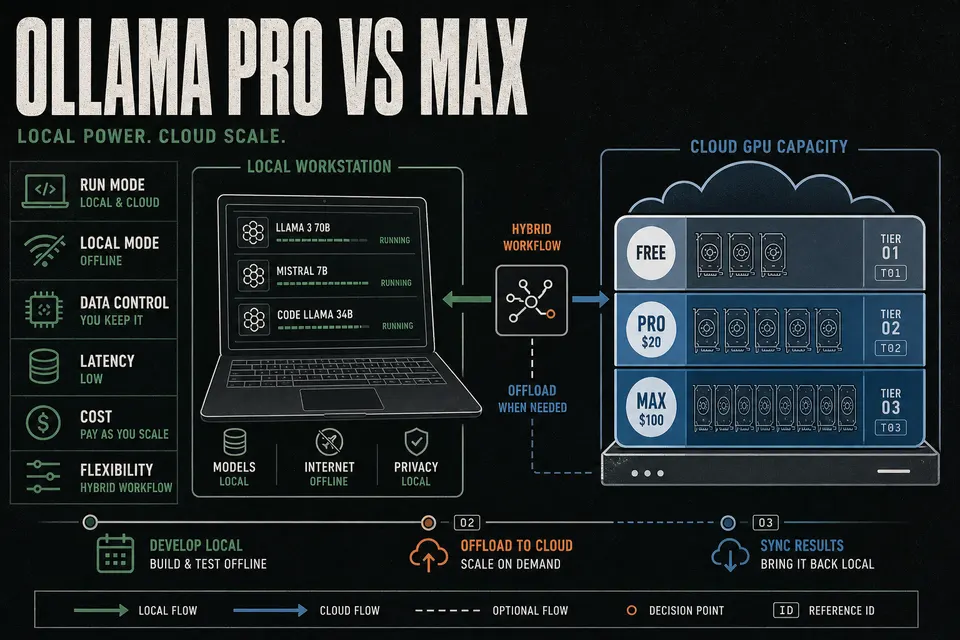
Local and cloud Ollama share a CLI and an API but not a cost model. Knowing where that boundary sits decides whether you ever need to pay anything at all.
Running models on your own hardware stays free and unlimited. Ollama's paid Pro and Max tiers buy remote cloud capacity, now sold as a monthly pool of token credits, not a replacement for the local runtime.
Ollama remains one of the simplest ways for developers to run open models on a laptop or workstation. The Ollama Pro vs Max pricing question is practical for anyone who wants larger models without buying GPUs: who needs $20 a month of cloud headroom, and when is $100 a month justified?
The answer starts with a split most comparisons blur. Local Ollama and cloud Ollama share the same CLI and API. They do not share a cost model. And the cloud cost model itself changed at the end of August, so many guides written before September describe limits that no longer apply to new subscribers.
This guide was last checked against ollama.com/pricing and Ollama's model pages on September 24, 2026.
What changed on August 31
Ollama moved its Pro, Max and Team plans to per-token pricing with a monthly pool of usage credits. Chinese labs have converged on a similar model: see how MiniMax, Xiaomi MiMo and Zhipu GLM price coding-agent token plans. Every cloud model now has a published price per million tokens for input, cached input and output, and each plan includes a fixed dollar amount of credit that refreshes every month.
What that replaced: the old plans metered GPU time against a 5-hour session limit and a 7-day weekly limit, with each model given a "usage level" from light to extra heavy. Those windows are gone for anyone on the new pricing.
Two details matter if you already pay:
- Existing Pro, Max and Team subscribers keep their current plan as-is unless they choose to switch. The upgrade is optional and lives in account settings, so a legacy subscriber may still be on the old 5-hour and weekly windows.
- Included credits reset monthly, on the day your subscription started, and do not roll over. Unused credit is replaced at each reset, not carried forward.
Local forever free, cloud Free is something else
On your own hardware, Ollama does not meter you. Download models, run them offline, keep prompts and weights on your machine, and run as many local processes as your VRAM and CPU allow. That path is free forever.
Cloud Free is a separate layer. It costs $0, includes starter usage credits and access to starter models, and allows one concurrent request. Ollama does not publish the dollar value of the starter credits. Sign in with ollama signin, pull a cloud model (usually with a -cloud suffix), and requests leave your machine for Ollama's infrastructure. That is useful for trying large open models you cannot fit locally. It is not unlimited Ollama in the cloud.
Hybrid workflows are first-class: a small private model locally and a large open model in the cloud, from the same tools. Cloud model retirements do not touch your local copies.
Pro: $20 a month buys $60 of credit
Pro costs $20 per month, or $200 per year billed annually (about $16.67 a month). It includes:
- $60 of usage credits per month, spent at each model's per-token price
- Access to larger "pro" models
- 3 concurrent requests (versus 1 on Free)
- The option to buy additional credits once the included pool runs out
The headline number is the ratio: $20 buys $60 of list-price usage, three times the subscription price. For an individual developer running coding agents or long research sessions against cloud models, that is the reason Pro exists.
Max: $100 a month buys $300 of credit
Max costs $100 per month and includes:
- $300 of usage credits per month
- 10 concurrent requests (versus 3 on Pro)
- Early access to the newest models
Notice what did not change between tiers: Max also returns 3× its price in credit, exactly like Pro. Max is not a better per-token rate. You pay for three things: a bigger pool, more parallel requests, and earlier model access.
That makes the Pro-or-Max decision simple arithmetic. If extra credits cost face value on top of Pro (our assumption; Ollama sells them at the same per-token list prices):
- Up to $60 of monthly usage: Pro alone covers it for $20.
- $60 to $140 of usage: Pro plus extra credit costs $20 to $100, still no more than Max.
- Above $140 of usage: Max's $300 pool is cheaper, up to $300 of usage.
So Max pays off at roughly $140 a month of list-price usage, or sooner if you need more than three requests in flight at once. Concurrency is the other trigger: several agents, multi-model pipelines or parallel long sessions will queue behind Pro's three slots long before they exhaust $60 of credit.
Team and Enterprise are real now
The team features that were "coming soon" in July have shipped in early access:
- Team: $500 a month, unlimited users, $1,000 of usage credits shared across the team, 10 concurrent requests, centralized billing and administration.
- Enterprise: custom pricing, adding model access controls and cost budgets.
For a small team, Team's shared $1,000 pool (2× its price) is a worse credit ratio than individual Pro seats (3×), but it removes per-seat billing and pools unused capacity. Other vendors size team plans around the same tradeoff; MiniMax's Plus, Max and Ultra token plans weigh rolling windows the same way. Five developers on Pro would pay $100 for $300 of combined credit, but it would be split into five separate $60 pools.
How metering works now: tokens, at each model's price
Usage is measured in tokens, priced per million at each model's input, cached input and output rates, and deducted from your credit pool. Some models also have peak pricing: off-peak rates apply outside 12:00 to 18:00 UTC on weekdays and all day on weekends, and during that weekday window selected models cost more.
Examples from Ollama's model pages and pricing list, per million tokens:
| Model | Input | Cached input | Output | Peak window |
|---|---|---|---|---|
| DeepSeek V4.1 Flash | $0.15 | $0.003 | $0.60 | doubles to $0.30 / $0.006 / $1.20 |
| DeepSeek V4 Pro | $0.66 | $0.022 | $1.98 | doubles to $1.32 / $0.044 / $3.96 |
| GLM-5.3 | $1.40 | $0.26 | $4.40 | no peak surcharge |
| GLM-5.3-Flash | $0.15 | $0.03 | $0.50 | no peak surcharge |
| Gemma 4 | $0.14 | $0.05 | $0.40 | no peak surcharge |
Prices change with the catalogue, so check the model page before planning a budget around one number. GLM sells a separate flat-rate coding subscription too; see Z.ai's GLM coding plan tiers, Lite versus Pro versus Max.
Cached input is where coding agents save money. An agent re-sends a large, mostly unchanged context on every turn, and the cached rate is a small fraction of the fresh-input rate. A typical coding session we modelled in our Ollama Cloud vs OpenRouter vs OpenCode Go comparison (about 9M cached input, 0.23M fresh input and 0.06M output tokens) costs roughly:
- $2.92 on GLM-5.3, so Pro's $60 covers about 20 sessions a month
- $0.10 on DeepSeek V4.1 Flash off-peak, or $0.19 in the peak window, so the same $60 covers 300 to 600 sessions
Concurrency still applies on top of credits: Free allows 1 request at a time, Pro 3, Max and Team 10.
| Plan | Price | Included credit | Credit per $1 | Concurrent requests |
|---|---|---|---|---|
| Free (cloud) | $0 | Starter credits (amount unpublished) | n/a | 1 |
| Pro | $20/mo or $200/yr | $60 / month | 3× | 3 |
| Max | $100/mo | $300 / month | 3× | 10 |
| Team (early access) | $500/mo | $1,000 / month, shared | 2× | 10 |
| Enterprise | Custom | Custom, with cost budgets | n/a | Custom |
Who should stay local, Free, Pro, or Max
- Local only. Best when privacy, offline use and models that fit your hardware matter; unlimited local concurrency. Weak when you need large open models without the VRAM.
- Cloud Free. Good for evaluation and occasional larger trials, one request at a time. Not enough for daily agent loops.
- Pro. The default paid step. $60 of credit covers daily coding against mid-priced models or hundreds of sessions on cheap ones, with three parallel requests. That default-tier logic mirrors Claude Max's own 5x entry tier for Claude Code, sized for solo developers rather than parallel agent fleets.
- Max. Worth it past roughly $140 a month of usage, or when three parallel requests are the bottleneck. Not a better per-token price, and not needed for local work.
- Team. For groups that want one bill and a shared pool more than the best credit ratio.
Two habits stretch any tier: run DeepSeek-family models off-peak when you can, since their weekday afternoon (UTC) price is double, and keep agent context stable so more of it bills at the cached rate. If you are weighing Ollama against a flat coding subscription, our OpenCode Go $10 plan review covers the per-model cap alternative, and the $0 AI coding stack covers what local-only can do.
Privacy and ops in brief
Ollama states that prompt and response data is never logged or trained on. Models are hosted primarily in the United States, with traffic sometimes routed to Europe and Singapore for extra capacity. There is no commercial SLA on the pricing page, so teams that need contractual uptime should evaluate that separately from the capacity math. Cloud performance has been uneven at busy times before; see our report on the Ollama Cloud slowdown.
Bottom line
Local Ollama remains free forever on your own hardware. Cloud Free is a light trial with starter credits and one request at a time. Pro at $20 a month ($200 a year) includes $60 of token credit and three parallel requests, enough for daily coding against most open models. Max at $100 a month includes $300 of credit and ten parallel requests. It has the same 3× credit ratio as Pro, so it pays off only past about $140 a month of usage or when you need more concurrency. Team at $500 adds a $1,000 shared pool for unlimited users.
Since August 31, metering is per token at each model's published rate, with peak pricing on some models and credits that reset monthly without rollover. It is no longer a GPU-time allowance in 5-hour and weekly windows, unless you are still on a legacy plan. Confirm figures on ollama.com/pricing before you upgrade; the catalogue and per-model prices change often.