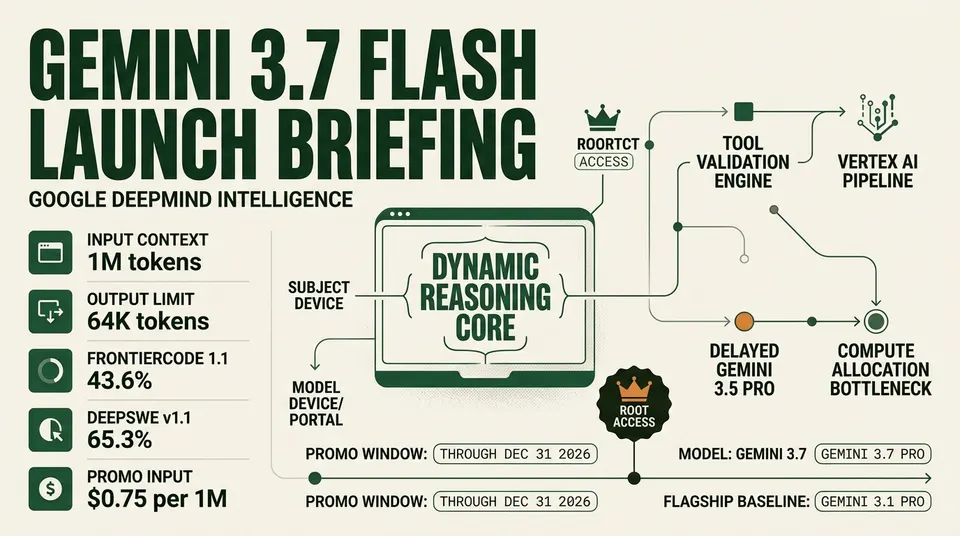
Google launches Gemini 3.7 Flash with hybrid reasoning for advanced agentic workflows and fast coding, while its flagship Gemini 3.5 Pro model faces delays.
Google has officially released Gemini 3.7 Flash, introducing an adaptive hybrid reasoning engine designed to accelerate agentic workflows, production code generation, and complex document analysis. Arriving just three weeks after its predecessor, the rapid deployment underscores a decisive operational strategy: Google is concentrating compute and algorithmic planning into its lightweight tier, even as its flagship frontier model, Gemini 3.5 Pro, remains delayed in partner testing. That predecessor, our review of Gemini 3.6 Flash, called it incremental, not a frontier leap.
The release offers enterprise technology leaders a cost-efficient deployment engine for production software systems. However, the expanding operational gap between Google's high-velocity Flash releases and its stalled flagship tier highlights mounting compute allocation trade-offs and structural realignments within Google DeepMind.
Inside the Hybrid Architecture: Dynamic Thinking and Agentic Planning
Gemini 3.7 Flash moves away from the rigid separation between high-speed generative models and compute-heavy reasoning engines. Rather than routing queries across disparate model checkpoints, the architecture integrates a dynamic thinking engine directly into the core Flash model. The system programmatically modulates its deliberate reasoning budget based on query complexity and latency constraints.
Where earlier iterations minimized reasoning steps to avoid infinite loops, Gemini 3.7 Flash intentionally allocates thinking compute to upfront task decomposition, schema validation, and tool-calling verification. This upfront diligence resolves persistent agent failure modes, enabling automated self-correction when external APIs fail or return malformed data.
The model maintains a 1,048,576-token (1M) input context window alongside support for up to 64,000 output tokens per request, supported by native context caching across Google Cloud infrastructure. Google has also optimized the model's multimodal orchestration pipeline to coordinate lightweight sub-agents, including Gemini Omni and Nano variants, across interface synthesis, code refactoring, and robotic control loops.
# Configuration for dynamic thinking budget in Gemini 3.7 Flash
import google.genai as genai

client = genai.Client()
response = client.models.generate_content(
 model="gemini-3.7-flash",
 contents="Refactor distributed transaction orchestration with failure recovery.",
 config={
 "thinking_config": {
 "thinking_budget": 8192,
 "enable_dynamic_routing": True
 },
 "temperature": 0.2,
 "max_output_tokens": 16384,
 }
)
Benchmark Performance: Outpacing Flagships in Production Coding
On standardized evaluations measuring software engineering and autonomous workflow execution, Gemini 3.7 Flash demonstrates significant generational gains over Gemini 3.6 Flash, frequently outperforming heavier competitor flagships on deterministic tasks.
| Evaluation Metric | Gemini 3.7 Flash | Gemini 3.6 Flash | Claude Sonnet 5 | GPT-5.6 Terra | Target Domain Tested |
|---|---|---|---|---|---|
| FrontierCode 1.1 Main | 43.6% | 34.4% | 42.7% | 41.3% | Production code synthesis & first-pass accuracy |
| DeepSWE v1.1 | 65.3% | 49.0% | — | 69.6% | Long-horizon repository repair & issue resolution |
| WebDev Arena (Elo) | 1588 | 1538 | 1541 | 1523 | Frontend generation, design parity, UI fidelity |
| AutomationBench | 30.4% | 17.0% | 10.7% | 23.6% | Multi-application enterprise tool orchestration |
| GDP.pdf | 34.0% | 22.0% | 28.0% | 24.7% | Dense document & unstructured visual reasoning |
| Terminal-bench 2.1 | 85.8% | — | — | 87.4% | Command-line execution & bash script automation |
| Agent's Last Exam (OS) | 26.3% | — | 33.3% | — | Desktop operating system navigation & control |
The model achieves a 43.6% score on FrontierCode 1.1, surpassing Claude Sonnet 5 (42.7%) and GPT-5.6 Terra (41.3%), while registering a substantial leap on DeepSWE v1.1 to 65.3%. Its performance on AutomationBench reaches 30.4%, nearly doubling the previous generation. However, in multimodal desktop control environments, Gemini 3.7 Flash scored 26.3% on Agent's Last Exam, trailing Anthropic's flagship capabilities. Anthropic's own flagship launch is covered in Claude Opus 5's launch and frozen Sonnet pricing.
The Pro Conundrum: Flagship Delays and Compute Allocation Bottlenecks
While the Flash tier advances rapidly, Google's top-tier frontier pipeline faces noticeable headwinds. Efficiency-focused rivals are pushing the low-latency tier too; see Ling 3.0 Flash's radical efficiency architecture. Gemini 3.5 Pro—initially slated for a mid-year release following internal previews—slipped past targeted deployment windows after falling short of internal performance targets in complex algorithmic reasoning and multi-repository code refactoring.
Consequently, Google's generally available flagship offering remains Gemini 3.1 Pro, creating an unusually prolonged gap between Flash-tier iterations and flagship upgrades. This delay unfolds against a backdrop of significant organizational transformation inside Google DeepMind. Demis Hassabis transitioned operational leadership to assume the role of Chair of DeepMind and Alphabet Chief Scientist, with Koray Kavukcuoglu promoted to Senior Vice President overseeing end-to-end Gemini research, development, and commercialization.
Internal tensions over compute scheduling have contributed to the timeline slippage. Google engineering teams face resource allocation choices between large-scale pre-training runs for next-generation frontier foundations and fine-tuning iterative Pro checkpoints. Concurrently, Google Cloud Platform has directed high-capacity Tensor Processing Unit (TPU) and GPU clusters toward hosting third-party enterprise and commercial AI client workloads rather than exclusively subsidizing internal pre-training runs.
Enterprise Economics and Gemini 3.7 Flash Pricing
To drive enterprise adoption across Vertex AI and Google AI Studio, Google has introduced aggressive promotional pricing through December 31, 2026, cutting token costs by 50%.
| Gemini 3.7 Flash Pricing Tier | Promotional Rate (Through Dec 2026) | Standard Rate (From Jan 2027) | Claude Sonnet 5 | GPT-5.6 Terra |
|---|---|---|---|---|
| Input Tokens (per 1M) | $0.75 | $1.50 | $2.00 | $2.00 |
| Output Tokens (per 1M) | $3.75 | $7.50 | $10.00 | $12.00 |
| Context Caching (per 1M) | $0.075 | $0.15 | Variable | Variable |
For engineering teams building multi-step agentic systems, total cost of ownership depends more on task-level completion rates than raw token prices. Context caching is a related lever; see how prompt caching cuts agent costs without touching the model. Because Gemini 3.7 Flash achieves higher first-pass accuracy on FrontierCode and AutomationBench, it sharply reduces expensive retry loops in 10-to-30-step workflows. Deployed across Vertex AI, Google AI Studio, Android Studio, and consumer-facing Gemini Spark across 160 countries, the model provides high-throughput utility across enterprise pipelines and Google's 950 million monthly active users.
Frontier Safety and Extended Reasoning Guardrails
Extended reasoning architectures introduce distinct safety considerations, particularly regarding autonomous tool invocation and hazardous material synthesis. Gemini 3.7 Flash incorporates safety constraints defined under Google's Frontier Safety Framework:
- CBRN Risk Mitigation: Strict filtering layers intercept queries attempting to generate actionable synthesis protocols for Chemical, Biological, Radiological, or Nuclear vectors during prolonged thinking states.
- Bioresilience Alignment: Post-training protocols limit dual-use pathogen engineering assistance while preserving capabilities for legitimate biomedical research.
- Defensive Cyber Protections: Incorporating threat parameters developed during specialized security testing, the system restricts automated exploit weaponization while maintaining support for defensive vulnerability analysis, patch validation, and threat modeling.
Automated reasoning pipelines must maintain deterministic boundaries between exploratory problem solving and actionable dual-use execution.
Strategic Outlook
The launch of Gemini 3.7 Flash demonstrates Google's pragmatic pivot toward dominating the commercial application layer through aggressive pricing, distribution, and low-latency agent orchestration. By embedding hybrid reasoning into its high-volume tier, Google delivers immediate utility across enterprise cloud ecosystems and consumer products. However, the continued absence of a breakthrough flagship Pro release leaves a competitive opening at the frontier boundary. Rivals are already probing it: see xAI's Grok 4.6 launch with a 500k context window challenging frontier pricing. Google's broader market position will ultimately depend on whether its infrastructure advantages can resolve internal compute constraints and deliver its next-generation frontier architecture.