Ant Group’s inclusionAI launches Ling 3.0 Flash, a 124B sparse MoE model featuring sub-100ms latency, dynamic reasoning, and ultra-cheap enterprise pricing.
Enterprise engineering teams accelerating the transition toward sub-second large language model inference for autonomous agents have a formidable new contender to evaluate. Ant Group’s AGI division, inclusionAI, has officially deployed Ling 3.0 Flash, a 124-billion-parameter sparse Mixture-of-Experts model engineered specifically for high-concurrency production environments and long-horizon tool-calling workflows. By pairing dynamic reasoning capabilities with an aggressive pricing structure, the release directly targets the low-latency enterprise inference market previously dominated by lightweight models such as Claude Haiku and Gemini Flash. Nvidia is chasing the same market with Nemotron 3.5 Lightning, a sparse 30B MoE.
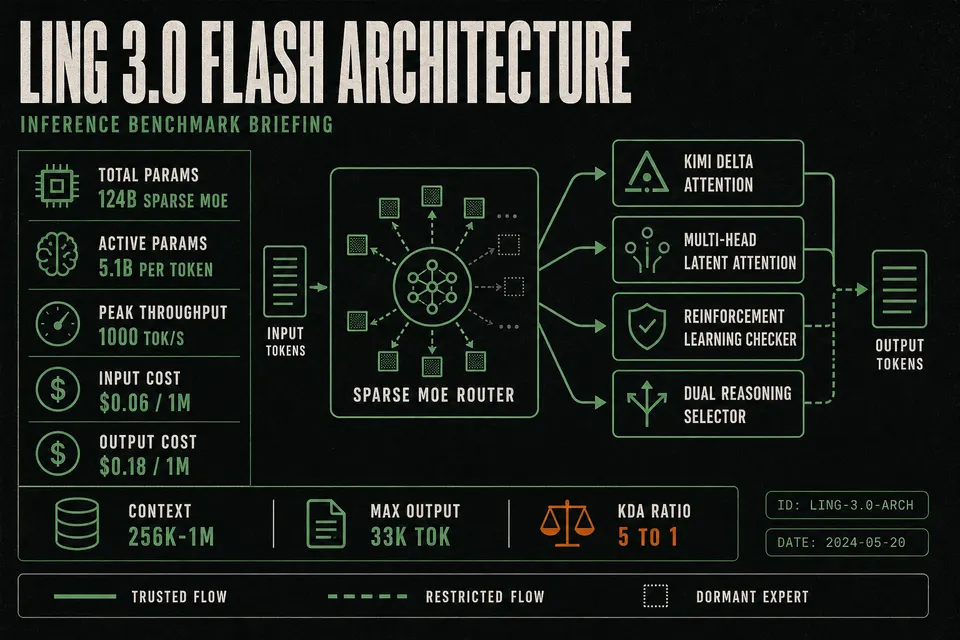
The release comes at a critical juncture for artificial intelligence infrastructure. As organizations scale autonomous coding assistants, live streaming translation, and complex agentic loops, traditional dense models present unsustainable compute costs and operational bottlenecks. Ling 3.0 Flash addresses these infrastructure constraints through structural compression, activating just 5.1 billion parameters per token to deliver ultra-low-latency processing under optimal serving conditions.
Performance and Latency: Vendor Claims vs. Production Realities
In benchmark evaluations published by inclusionAI, Ling 3.0 Flash achieves peak generation speeds reaching up to 1,000 tokens per second alongside time-to-first-token latency under 100 milliseconds. The model features a native 256,000-token context window that can be extended up to 1 million tokens, supporting single-response outputs of up to approximately 33,000 tokens.
However, enterprise solution architects must distinguish peak synthetic benchmark claims from production realities. Independent testing across commercial gateway providers shows that real-world network overhead, token routing, and concurrency load push average operational time-to-first-token latencies higher than raw hardware benchmarks suggest. Furthermore, early evaluation indicates that while Ling 3.0 Flash demonstrates strong performance on standard code generation and tool-calling evaluations, synthetic benchmark scores reflect heavily optimized evaluation paths.
| Model Variant | Active / Total Params | Context Window | Claimed Peak Speed | Output Token Price (/1M) |
|---|---|---|---|---|
| Ling 3.0 Flash | ~5.1B / 124B | 256K – 1M | Up to 1,000 tok/s | $0.18 |
| DeepSeek V4 Flash | ~2.4B / 100B+ | 1M | ~120 tok/s | $0.28 |
| Kimi K2.5 | Sparse MoE | 256K | ~45 tok/s | $3.00 |
| Claude Haiku 4.5 | Dense Lightweight | 200K | ~100 tok/s | $5.00 |
| Gemini 3.5 Flash | Multi-Query MoE | 1M | ~150 tok/s | $9.00 |
While competitive models like Gemini 3.5 Flash offer mature multimodal capabilities across native video and audio feeds, Ling 3.0 Flash focuses strictly on text and structured data processing, optimizing compute throughput specifically for logic execution and text generation. Google's newer Gemini 3.7 Flash hybrid-reasoning update pursues a similar low-latency approach.
Technical Architecture: Sparse MoE and Hybrid Attention Stacks
The speed and efficiency of Ling 3.0 Flash stem from a fundamental architectural shift away from pure dense transformers toward a native hybrid attention mechanism integrated with sparse Mixture-of-Experts routing.
To maintain high retrieval quality across expanded context windows without incurring massive Key-Value cache overhead, the architecture implements a five-to-one hybrid ratio: five Kimi Delta Attention layers stacked against every single Multi-Head Latent Attention layer.
- Kimi Delta Attention (KDA): Acts as an ultra-low-footprint linear memory mechanism that handles continuous sequence state updates, dramatically reducing dynamic memory bandwidth requirements during long-context processing.
- Multi-Head Latent Attention (MLA): Provides high-precision contextual retrieval and cross-token dependencies, resolving the historical "lost-in-the-middle" retrieval decay common in linear attention models.
- Reinforcement Learning Strong-Check Mechanism: Integrates a specialized verification layer fine-tuned via reinforcement learning to prevent parameter drift and hallucinated function signatures during long-horizon tool execution.
- Switchable Dual-Reasoning Modes: Allows developers to programmatically toggle between a "thinking" state—which allocates dynamic inner-monologue reasoning tokens for complex debugging—and a "non-thinking" state designed for maximum throughput in routing and summarization tasks.
Token Economics and Enterprise API Pricing
The primary commercial disruption introduced by Ling 3.0 Flash lies in its radical output token pricing model. In production environments utilizing autonomous agents, output token volume typically dominates operational expenditures due to repetitive code generation, tool calls, and step-by-step reasoning logs.
# Strategic model routing implementation for cost optimization
def select_inference_tier(task_type: str, payload_size: int) -> dict:
 if task_type == "agent_routing" or task_type == "high_volume_summarization":
 return {
 "model": "inclusionai/ling-3.0-flash",
 "reasoning_mode": "non-thinking",
 "input_cost_per_m": 0.06,
 "output_cost_per_m": 0.18
 }
 elif task_type == "complex_architecture_design":
 return {
 "model": "frontier/reasoning-flagship",
 "reasoning_mode": "deep_thought",
 "input_cost_per_m": 1.25,
 "output_cost_per_m": 10.00
 }
Priced standardly at $0.06 per million input tokens and $0.18 per million output tokens on public API aggregators, Ling 3.0 Flash significantly undercuts legacy enterprise alternatives. Prompt caching further reduces input costs by up to 80 percent down to $0.012 per million cached tokens, enabling high-frequency agent loops at a fraction of traditional infrastructure spend.
Enterprise Readiness, Compliance, and Security Risk Factors
Despite its compelling speed and cost profile, enterprise deployment of Ling 3.0 Flash introduces strategic compliance and operational considerations that CTOs must evaluate.
Direct integration with the developer's native API console currently presents procurement barriers for international enterprises, as account billing remains restricted to personal Alipay accounts, with enterprise invoicing and corporate account management still under active development.
Organizations operating within strict regulatory frameworks must account for several operational factors:
- Data Sovereignty and Governance: Operating under a Chinese provider, workloads subject to SOC 2 Type II, ISO 27001, HIPAA, or EU GDPR requirements necessitate zero-data-retention agreements through third-party gateway aggregators.
- Absence of Air-Gapped Deployment: Model weights are not open at launch, meaning enterprises requiring self-hosted or air-gapped security boundaries must await scheduled open-weight releases. Enterprises needing open weights today can instead evaluate Alibaba's already-open Qwen3.8-27B hybrid model.
- Gateway Infrastructure Redundancy: To prevent single-point routing failures or cross-border latency spikes, engineering teams must implement multi-provider fallback gateways with automated traffic failover.
Strategic Deployment Roadmap: When to Deploy Ling 3.0 Flash
Ling 3.0 Flash represents a highly specialized inference engine optimized for high-volume, text-heavy computational pipelines.
Recommended Deployment Scenarios
- Agentic Routing and Intent Classification: Serving as a rapid, low-cost outer router that parses user intent and dispatches tasks to downstream systems.
- Autonomous Coding Workflows: Driving iterative code completion, file edits, and syntax validation inside developer environments where execution speed is paramount.
- High-Concurrency Document Processing: Extracting structured JSON schema from large repositories, resume screening, and processing enterprise Knowledge Base updates.
Unfavorable Deployment Scenarios
- Native Multimodal Analytics: Processing raw video streams, complex architectural PDF drawings, or native audio files, where multimodal models remain essential.
- Strict Regulated On-Premise Workloads: Environments demanding immediate localized execution on internal GPU clusters prior to official open-weight distribution.
For principal AI engineers and enterprise tech leaders, Ling 3.0 Flash delivers an exceptionally powerful building block for high-speed agentic architectures, establishing a new price-to-performance benchmark for ultra-low-latency language model inference.
Related reading
- Opus 5 Enterprise AI Pricing Reshapes Security Compute: High-Reasoning LLM Economics and the Cybersecurity Routing Catch
- Qwen 3.8 Flash Next vs DeepSeek V4 Flash Benchmarks: Inside Alibaba’s 6B-Active Architecture and the Shift in Open-Weight Economics
- GLM 5.3 Flash vs DeepSeek V4 Flash: Benchmarks, Architecture, and Pricing Compared