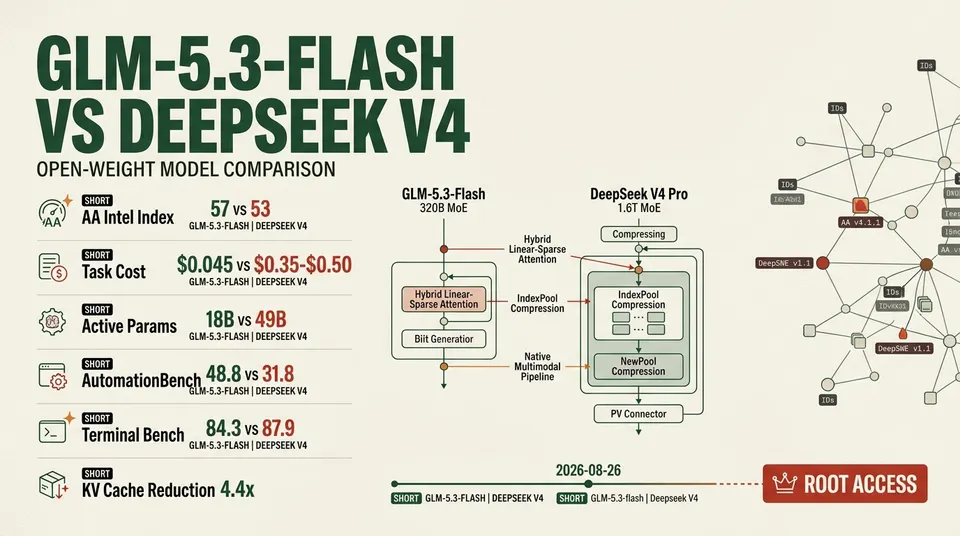
Compare GLM 5.3 Flash vs DeepSeek V4 Flash across benchmarks, architecture, and API pricing. Explore agent performance, KV cache gains, and cost savings.
On August 26, 2026, artificial intelligence laboratory Z.ai officially launched GLM-5.3-Flash, fundamentally shifting the cost-performance Pareto frontier across open-weight foundation models. Previewed anonymously on OpenCode and OpenRouter under the codename ox-alpha—where it ranked as the most-used model of the week—the release establishes an aggressive technical comparison: GLM 5.3 Flash vs DeepSeek V4 Flash benchmarks and pricing.
Trained on a 30-trillion-token multimodal corpus as the first natively multimodal architecture in the GLM-5 family, GLM-5.3-Flash registered a composite score of 57 on the Artificial Analysis Intelligence Index v4.1.1 at an effective task cost of $0.045. DeepSeek V4 Pro scored 53 under maximum reasoning effort. GLM-5.3-Flash achieves this four-point lead while activating just 18 billion parameters per token from a 320-billion total parameter base, compared to DeepSeek V4 Pro’s ~49 billion active parameters drawn from a ~1.6-trillion footprint.
API Pricing Disruption and Economic Breakdown
Autonomous software engineering agents execute iterative feedback loops—ingesting context, calling external tools, rendering browser screenshots, and debugging compiler traces—rapidly compounding token volume. GLM-5.3-Flash’s flat rate structure fundamentally undercuts DeepSeek’s dynamic peak-tiered pricing. Google competes on the same axis; our Gemini 3.6 Flash review found it cheaper and faster but not a coding leader.
| Pricing Dimension | GLM-5.3-Flash | DeepSeek V4 Flash 0731 | DeepSeek V4 Pro 0813 |
|---|---|---|---|
| Pricing Model | Flat / Predictable | Dynamic Peak / Off-Peak | Dynamic Peak / Off-Peak |
| Peak Window (UTC) | None | 01:00–04:00 & 06:00–10:00 (M–F) | 01:00–04:00 & 06:00–10:00 (M–F) |
| Uncached Input / 1M | $0.075 | $0.22 (Off-Peak) / $0.44 (Peak) | $0.66 (Off-Peak) / $1.32 (Peak) |
| Output Tokens / 1M | $0.250 | $0.66 (Off-Peak) / $1.32 (Peak) | $1.98 (Off-Peak) / $3.96 (Peak) |
| AA Cost per Task | $0.045 | ~$0.08–$0.15 | ~$0.35–$0.50 |
For autonomous developer pipelines, the economic disparity is substantial. DeepSeek applies surge rates during peak developer hours, driving output costs to $1.32 per million tokens on V4 Flash and $3.96 per million on V4 Pro. Those surcharges were controversial when DeepSeek first introduced them — see DeepSeek's V4 Pro launch and peak-hour API surcharges. In high-frequency, recursive agent loops, GLM-5.3-Flash delivers up to a 15.8-fold cost reduction over peak DeepSeek V4 Pro execution.
Architectural Teardown: Hybrid Attention and IndexPool
GLM-5.3-Flash mitigates the quadratic scaling bottlenecks of 1-million-token context windows by pairing layer pruning with a hybrid linear-sparse attention topology. Alibaba shipped a near-identical hybrid design the same month, compared directly in Qwen3.8 Flash vs GLM 5.3 Flash. The network routes compute across 45 layers—down from 92 in GLM-4.5—while activating 18 billion parameters per forward pass.
The hybrid attention layer divides processing into complementary paths:
- Linear Attention: Models dense local token sequences using recurrent state-space transitions with linear $O(N)$ computational complexity.
- Sparse Attention: Deploys a lightweight global indexer to selectively retrieve historical token activations across the 1M window without computing full attention matrices.
- IndexPool Compression: Compresses four separate indexer key vectors into a single representative vector through weighted pooling. This 4:1 compression ratio achieves a 4.4× reduction in per-layer key-value (KV) cache memory in BF16 format and a 3.0× reduction in attention compute per head.
- Manifold-Constrained Hyper-Connections (mHC): Bounded residual stream topologies stabilize inter-layer gradient propagation across deep expert routing decisions.
Benchmark Breakdown: Head-to-Head Performance
Standardized frontier evaluations demonstrate distinct specializations between GLM-5.3-Flash and DeepSeek’s flagship architectures. Closed frontier models are fought over on the same coding benchmarks in GPT-6 Astra vs Claude Fable 5.1 vs Opus 5.5 for coding.
| Benchmark Suite | GLM-5.3-Flash (18B/320B) | DeepSeek V4 Pro 0813 (~49B/1.6T) | DeepSeek V4 Flash / Vision Exp | Claude Opus 4.8 | GPT-5.6 Terra |
|---|---|---|---|---|---|
| AA Intelligence Index | 57 | 53 | — | — | — |
| DeepSWE v1.1 | 63.4 | 62.7 | 59.3 | 58.0 | 69.6 |
| AutomationBench v1.0.6 | 48.8 | 31.8 | 38.8 | 41.0 | 37.2 |
| Toolathlon Verified | 78.4 | 74.1 | 75.9 | 76.2 | 74.9 |
| Terminal Bench 2.1 | 84.3 | 87.9 | 83.9 | 85.0 | 87.4 |
| NL2Repo | 56.3 | 61.5 | 57.7 | 69.7 | — |
| LiveCodeBench-Base | 37.6 | — | 29.9 | — | — |
| GDPval-AA v2 | 1773 | — | 1675 | 1582 | 1571 |
GLM-5.3-Flash dominates multi-step agentic workflows and tool-calling environments, scoring 48.8 on AutomationBench v1.0.6 against DeepSeek V4 Pro’s 31.8, and 78.4 on Toolathlon Verified against 74.1. On DeepSWE v1.1, GLM-5.3-Flash scored 63.4 versus DeepSeek V4 Pro’s 62.7; accounting for scaffold variations across Claude Code 2.1.207 and mini-swe-agent harnesses, this margin represents functional parity in automated software patch generation.
DeepSeek retains an edge in pure POSIX terminal execution and large repository navigation. DeepSeek V4 Pro outpaces GLM-5.3-Flash on Terminal Bench 2.1 (87.9 vs. 84.3) and NL2Repo (61.5 vs. 56.3), demonstrating superior handling of bash environments, compiler diagnostics, and multi-file dependency trees.
Visual Coding Loops vs. High-Throughput Terminal Execution
Developer workflow mechanics highlight the core philosophical split between the two model suites. GLM-5.3-Flash integrates text, code, image, and video modalities natively within a single context. DeepSeek bifurcates text reasoning and visual understanding, routing visual assets through a separate deepseek-v4-flash-vision-exp endpoint.
In frontend workflows, GLM-5.3-Flash natively inspects rendered UI screenshots, identifies styling and layout defects that pass standard linters, and outputs code corrections without context handoffs. This advantage is reflected in multimodal benchmarks: GLM-5.3-Flash scored 62.4 on OfficeQA Pro and 89.4 on CharXiv Reasoning w/ Tools, exceeding DeepSeek V4 Vision Exp (57.9 and 80.4, respectively).
DeepSeek maintains a structural advantage in raw generation throughput. Powered by its DSpark speculative decoding engine, DeepSeek V4 Pro sustains ~68 tokens per second, compared to ~49 tokens per second for GLM-5.3-Flash. Additionally, DeepSeek V4 Pro supports an expansive maximum output ceiling of 384,000 tokens under high reasoning effort, enabling the synthesis of entire monolithic codebases in a single API pass.
Deployment Economics and Domestic Silicon Infrastructure
Both model suites are distributed under permissive MIT licenses, but self-hosting logistics differ sharply. GLM-5.3-Flash’s 320-billion parameter footprint fits entirely on a standard single 8-GPU node (H100/H200 or domestic equivalents) using FP8/W8A8 precision and hybrid INT8/FP8/BF16 KV caches. For a smaller local footprint, see the best local AI models to run on a DGX Spark. By contrast, DeepSeek V4 Pro’s ~1.6-trillion parameter structure mandates multi-node clusters across 4 to 8 interconnected 8-GPU nodes.
Z.ai hosts GLM-5.3-Flash on domestic Chinese AI accelerator clusters via an Encode-Prefill-Decode (EPD) disaggregated serving architecture. DeepSeek's own flash-tier model has its own agent-benchmark and security profile, covered in DeepSeek V4 Flash 0731's engineering architecture. The system decouples visual token encoding, linear/sparse prompt prefilling, and autoregressive token decoding into independently scaled physical node pools. Combined with intra-node tensor parallelism, ReplaySSM memory handling, and SGLang engine extensions authored by internal autonomous infrastructure agents, the setup yields a 3× end-to-end throughput gain over baseline serving stacks.
Technical Workload Selection Matrix
| Production Workload | Recommended Model | Primary Justification |
|---|---|---|
| Autonomous Browser & Desktop Agents | GLM-5.3-Flash | Native multimodal context, AutomationBench lead (48.8), and $0.045/task execution cost. |
| Frontend & UI Component Synthesis | GLM-5.3-Flash | Single-model visual feedback loop inspects screenshots directly without context handoffs. |
| High-Volume Tool-Calling Pipelines | GLM-5.3-Flash | 78.4 Toolathlon score; flat pricing prevents bill shock during recursive tool retries. |
| CLI Automation & Backend Systems | DeepSeek V4 Pro 0813 | Dominates Terminal Bench 2.1 (87.9); superior bash and multi-file dependency resolution. |
| Monolithic Codebase Synthesis | DeepSeek V4 Pro 0813 | 384K output token window with 68 tok/s sustained speculative generation speed. |
| On-Premises Single-Node Deployment | GLM-5.3-Flash | 320B parameter weight footprint runs on a single 8-GPU node under an MIT license. |
GLM-5.3-Flash establishes that hybrid linear-sparse attention and index compression can match massive trillion-parameter models while slashing serving costs. While DeepSeek retains a moat in raw terminal compilation and massive output horizons, GLM-5.3-Flash resets expectations for multimodal agent economics and efficiency.