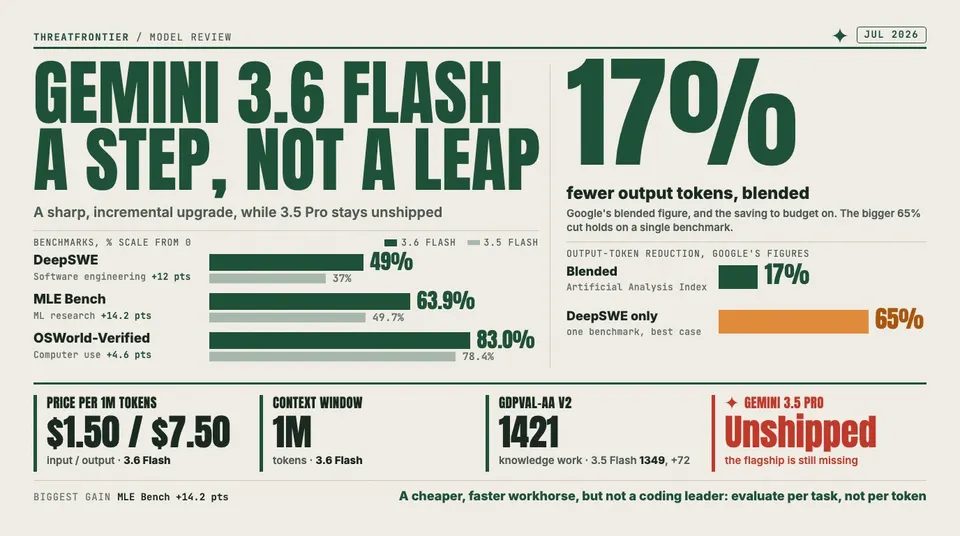
Gemini 3.6 Flash review: a real but incremental upgrade. Cheaper, faster, 1M context—but not a coding leader, and Google's 3.5 Pro flagship remains unshipped.
Google shipped its newest lightweight AI on July 21, 2026, and the marketing arrived louder than the model. Gemini 3.6 Flash — often mis-searched as "Gemini Flash 3.6" — is a genuine, measurable improvement over the Flash tier it replaces. But hands-on impressions and Google's own developer documentation tell a more grounded story: this is an efficiency release wearing frontier language, and the flagship everyone actually wants is still missing.
What actually shipped
Google released three models at once, not one. Alongside Gemini 3.6 Flash, it introduced Gemini 3.5 Flash-Lite — pitched as its fastest, cheapest 3.5-class model at a Google-stated 350 output tokens per second — and Gemini 3.5 Flash Cyber, a security-tuned variant that runs inside Google's CodeMender agent and is restricted to governments and trusted partners under a limited pilot.
The headliner, 3.6 Flash, is positioned as a "workhorse" for agentic and multimodal workloads.
| Attribute | Gemini 3.6 Flash |
|---|---|
| Context window | 1M tokens |
| Max output | 64k tokens |
| Pricing (input / output per 1M) | $1.50 / $7.50 |
| Built-in tool | Computer Use (client-side) |
| Knowledge cutoff | March 2026 (from Jan 2025) |
| Default thinking level | Medium |
The pricing is notable: output falls from $9.00 to $7.50 per million tokens versus 3.5 Flash, while input holds at $1.50. Google frames the real saving as lower cost per task, citing a 17% reduction in output tokens on the Artificial Analysis Index — the model reaches conclusions in fewer reasoning steps and tool calls.
On benchmarks, the gains over 3.5 Flash are real and consistent:
| Benchmark | 3.6 Flash | 3.5 Flash | Domain |
|---|---|---|---|
| DeepSWE (Datacurve) | 49% | 37% | Software engineering |
| MLE Bench | 63.9% | 49.7% | ML research |
| OSWorld-Verified | 83.0% | 78.4% | Computer use |
| GDPval-AA v2 | 1421 | 1349 | Knowledge work |
Google cites enterprise adopters Hebbia and Harvey using the model for document parsing, chart and data analysis, and report drafting. It is now the default agent in Google Antigravity and is available across the Gemini API, Vertex-tier enterprise platforms, and the consumer Gemini app. For how Antigravity stacks up against rivals, see Claude Code vs Codex CLI vs Antigravity CLI vs OpenCode compared.
Where the hype outpaces reality
The marketing leads with "frontier" quality. The fine print — much of it Google's own — is more measured.
It is not a coding leader. A DeepSWE score of 49% is a solid jump for a Flash-tier model, but it trails coding-focused rivals; independent testing has repeatedly placed OpenAI's and Anthropic's latest models ahead on long-horizon, repo-level engineering. On Hacker News, the top comment argued the release is "clearly intended to be an efficient model for Google Gemini usage" rather than for builders and engineers. On X, testers noted it is "consistently SoTA only on vision and context benchmarks."
Google admits UI regressions. Buried in the developer docs — not the blog — is the concession that "human evaluators preferred earlier models for visual layout and styling," and that the model "can add extra exploratory steps on simple frontend work." For teams generating frontend or UI code, an older model may still produce better results.
"Cheaper per token" is not "cheaper per task." This is the single most important caveat for buyers, and the backbone of any procurement decision. A community coding-agent benchmark on the prior Flash line found Gemini Flash scored marginally higher than the older Pro tier — but cost roughly 59% more per task, because it burned through far more turns and tokens. Flash SKUs, as one analysis put it, "look cheap on the pricing page and expensive on the invoice." The 17% token reduction narrows that gap; it does not guarantee its elimination.
The "65%" savings figure is best-case, not typical. Google's own numbers make this clear: the blended, real-world token reduction is 17%. The eye-catching 65% applies only to the DeepSWE benchmark. Treat 17% as the number that will show up on your bill.
Community reaction has been muted. Early testers reported no dramatic difference in day-to-day use, with sentiment ranging from "solid mid-tier release" to outright dismissive. The consensus is incremental, not generational. Flash-tier rivals are moving fast too; see how GLM 5.3 Flash compares with DeepSeek V4 Flash on benchmarks and pricing.
How it compares to rivals
No independent intelligence index exists for 3.6 Flash yet, so the cleanest verified comparison uses the prior Gemini 3 Flash Preview against Anthropic's Claude 4.5 Haiku as a proxy:
| Metric | Gemini 3 Flash Preview | Claude 4.5 Haiku |
|---|---|---|
| Intelligence Index (est.) | 27 | 24 |
| Price /1M (blended) | $0.43 | $0.77 |
| Output speed | 185 tok/s | 94 tok/s |
| Time to first token | 0.88s | 0.92s |
| Context window | 1M | 200k |
The positioning is consistent across tiers. Against Anthropic, Google wins on price, raw speed, and context window — 1M tokens versus 200k — while Anthropic wins on shipped coding reputation and long-horizon reliability, its higher tiers holding stronger repo-level track records. Against OpenAI, independent tests continue to give the edge on agentic and long-horizon coding to GPT-tier models by a meaningful margin. For a fuller three-way benchmark, see GPT-6 Astra vs Claude Fable 5.1 vs Opus 5.5 for coding.
Google's own tables — Terminal-Bench 2.1 at 76.2%, "4x faster than other frontier models" — are marketing, not independent evaluation. The honest community summary is that Google is building a niche as, in one memorable phrase, "the volume discount store of inference."
The missing flagship
Here is the naming confusion in one sentence: Google shipped a newer-numbered Flash (3.6) while its older-numbered flagship Pro (3.5) remains unshipped.
To be clear on the roadmap: Gemini 3.5 Pro is not out. The live flagship remains Gemini 3.1 Pro, released in February 2026. Sundar Pichai announced 3.5 Pro at Google's I/O conference in May, promising a June launch; it has since missed multiple targets. According to Bloomberg, the delay stems from Google's struggle to improve coding capability, with a late-June retraining on updated data reportedly producing disappointing results.
Google's official line, restated in the 3.6 Flash announcement, is that 3.5 Pro is "currently testing with partners" and will arrive "as soon as it's ready." In the same breath, the company said it has "started our most ambitious pre-training run yet, for Gemini 4." Crucially, Gemini 4 exists only as an early pre-training run — not a product. Anyone searching for "Gemini 4 Pro" is chasing something that does not yet ship.
The subtext matters. Shipping efficiency releases while the flagship stalls reads, to many observers, as maintaining trajectory while awaiting a genuine breakthrough. The delay drew market attention: Alphabet shares fell roughly 4% — erasing about $200 billion in market value — after the Bloomberg report, in the run-up to its second-quarter earnings.
The verdict: who should adopt, who should wait
Good fit now:
- High-volume, cost-sensitive agentic and document workloads — parsing, extraction, chart analysis, report drafting (the Hebbia and Harvey use cases).
- Teams needing the largest Flash-tier context window at 1M tokens.
- Teams already on Antigravity, Vertex, or Gemini Enterprise wanting stack coherence — 3.6 Flash is the default Antigravity agent.
- Latency-critical consumer features in the 185+ tokens-per-second class.
Should wait or look elsewhere:
- Serious repo-level coding and long-horizon agents — rivals measurably lead.
- Frontend and UI generation — Google's own docs say evaluators preferred older models.
- Anyone waiting on a true flagship — that is 3.5 Pro, still unshipped.
One migration note: 3.6 Flash deprecates the temperature, top_p, and top_k parameters and bans prefilled model turns — a small but real porting cost.
The editorial backbone for any procurement decision stays simple: evaluate per task, not per token. On that measure, Gemini 3.6 Flash is a competent, cheaper, faster production workhorse — and a clear reminder that Google's real competitive test is still sitting in training. That test continued into the next release: Gemini 3.7 Flash launched while the flagship Pro model kept slipping.