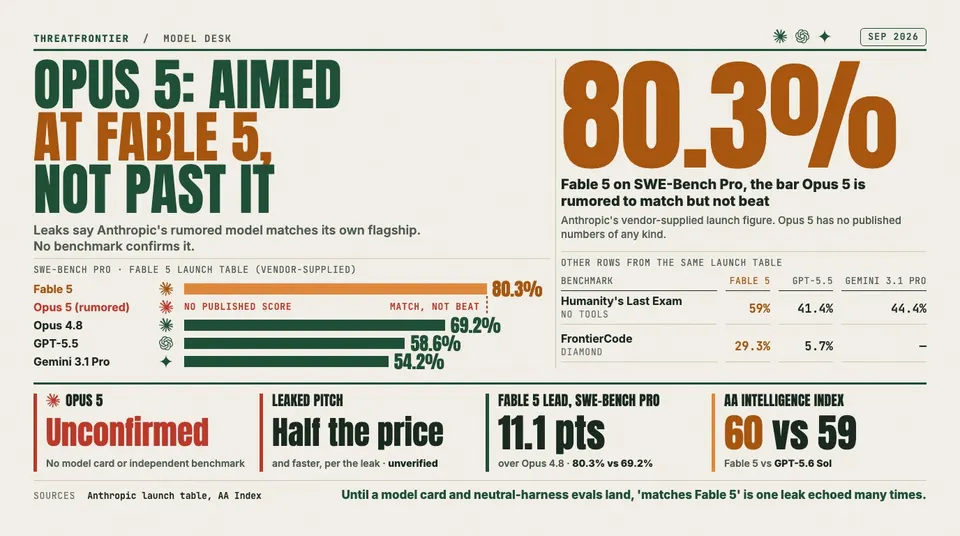
Leaks claim Anthropic's rumored "Opus 5" will match but not beat its flagship Fable 5. We scrutinize the unconfirmed benchmarks and what it means for buyers.
A wave of leaks points to Anthropic releasing a new model, informally called "Opus 5," as early as Thursday — and the striking part is not that it might rival a competitor, but that it is being framed against Anthropic's own current flagship, Fable 5. The recurring claim circulating on X is blunt: Opus 5's benchmark performance will be "comparable to Fable 5, but won't surpass it." If accurate, that is less a capability breakthrough than a pricing and positioning maneuver — and it turns the usual arms-race narrative inward.
For technical decision-makers weighing frontier models, the framing matters. The broader economics of switching models are covered in enterprise LLM pricing and the economics of model migration. When a vendor benchmarks a launch to a named system, it reveals what the market treats as the bar to clear. Here, that bar is Fable 5, and the tell is that Anthropic's rumored value model is reportedly being built to reach it from below rather than leap past it. Before that narrative hardens into accepted fact, it deserves scrutiny — because as of this writing, every Opus 5 performance figure is unconfirmed.
What is actually being claimed — and what is confirmed
Start with the verification status, because it is the crux. There is no first-party Anthropic announcement, no model card, and no independent benchmark for Opus 5. The parity claim traces to a cluster of near-identical social-media posts — from accounts including @alesscavaz, @Policifyai, @iqtauhid and @nomad_remy — repeating the same line about a Thursday launch with performance "comparable to Fable 5, but won't surpass it." Several posts add that Opus 5 would be "faster and at half the price." That is one leak echoed many times, not multiple independent confirmations.
Skepticism is already surfacing. The practitioner account @OmedVibeCodes, testing a fast, cheap model against the leading tier, wrote that calling it "Fable 5 level is just not accurate based on my testing," adding it was "not even Opus 4.8 or GPT-5.6 Sol level." Whether that test refers to the same model is unclear — but it is a useful reminder that "matches X" claims routinely deflate under independent evaluation.
Background: Fable 5 is the flagship, "Opus" is the older tier
The naming is where casual readers get confused. Fable 5 is Anthropic's current public flagship — the first widely released "Mythos-class" model, launched 9 June 2026, which the company billed as its most powerful model yet and state-of-the-art on nearly all tested benchmarks. "Opus" is Anthropic's older, lower model class. In fact, Fable 5 automatically routes conversations about cybersecurity, biology and AI-model distillation down to Claude Opus 4.8, with Anthropic claiming 95% of sessions never hit that fallback.
So a rumored "Opus 5" that matches but never beats Fable 5 looks like a cheaper tier positioned deliberately below the halo product. The community framing on r/Anthropic captures the tension: how can a new Opus 5 compete without undermining the pricey Fable 5?
The metrics: partly standardized, largely vendor-curated
At launch, Anthropic reported the following for Fable 5 — figures that are vendor-supplied and should be read as such:
| Benchmark | Fable 5 | Opus 4.8 | GPT-5.5 | Gemini 3.1 Pro |
|---|---|---|---|---|
| SWE-Bench Pro (real-world SW eng) | 80.3% | 69.2% | 58.6% | 54.2% |
| FrontierCode (Diamond) | 29.3% | — | 5.7% | — |
| Humanity's Last Exam (no tools) | 59% | — | 41.4% | 44.4% |
| Humanity's Last Exam (with tools) | 64.5% | — | — | — |
SWE-Bench Pro and Humanity's Last Exam are public, community benchmarks, but the launch table itself is vendor-curated. We compare real coding cost and benchmarks across GPT-6 Astra vs Claude Fable 5.1 vs Opus 5.5. The one genuinely independent anchor is Artificial Analysis, whose Intelligence Index ranked Fable 5 at the top of the field. Opus 5 has no published numbers of any kind.
A critical caveat runs through all of it: benchmarks are harness-dependent. As one analysis put it, these scores "aren't just testing the AI model itself, they're also testing the toolkit it's given." SWE-Bench Pro — fixing a specific bug in an existing codebase — and Terminal-Bench — operating a whole workflow — reward different skills. A model can win one and lose the other.
The trade-offs "parity" hides
Even a verified intelligence match would say nothing about the dimensions where these models actually diverge for buyers. Fable 5 is powerful but expensive and comparatively slow: independent measurement pegs it near the costly end of the market, with a large 1M-token context window but middling throughput. Whether that expense is worth it under Anthropic's plan is covered in is Claude Max worth it now Fable 5 is permanent. That steep cost is precisely why a cheaper, faster Opus 5 makes commercial sense — and why "matches but doesn't surpass" is exactly what a value tier looks like.
The competitive context reinforces the point. Just over a week after Fable 5 returned to full availability, OpenAI unveiled GPT-5.6 Sol, Terra and Luna. OpenAI says Sol tops the Artificial Analysis Coding Agent Index at 80, while using less than half the tokens and time and costing roughly a third as much — about two-thirds cheaper — for comparable intelligence. But the indices should not be conflated: on the broader Artificial Analysis Intelligence Index, Fable 5 still narrowly leads, 60 to 59. And Fable 5 remains decisively ahead on SWE-Bench Pro, 80.3% to Sol's 64.6%. OpenAI evaluated Sol with its own tuned "Codex" harness, which flatters those coding results; on a neutral toolkit the gap likely narrows. Japan's Sakana claims its Fugu orchestrator reaches Fable-5-level output as a sovereignty hedge, and Chinese labs Moonshot (Kimi K3) and Zhipu (GLM-5.2) benchmark to Fable 5 too. Everyone is measuring against the same target. Grok took that comparison further at launch: see Grok 4.7 matches Claude Fable 5.1 Max on SpaceXAI's own scorecard.
Reliability and supply-chain risks
Benchmark parity ignores two operational wildcards. First, guardrail routing: Fable 5 silently falls back to Opus 4.8 on sensitive topics, with users reporting false-positive downgrades. Any Opus 5 would need its own, untested safety story. Second, availability: Fable 5 and Mythos 5 were pulled globally for 19 days, from 12 June to 1 July 2026, amid a U.S. export-control dispute that briefly treated Anthropic as a supply-chain risk. Parity is worthless if a model can vanish overnight.
What evaluators should demand
Before trusting any parity claim, buyers should wait for: a first-party Anthropic model card; an independent Artificial Analysis placement for Opus 5 against Fable 5's ranking; neutral-harness results on both SWE-Bench Pro and Terminal-Bench; cost-per-completed-task rather than per-token price; documented safety-routing behavior; and third-party practitioner tests.
The rumored Thursday release, if it holds, will be the first real test. Watch whether Anthropic frames Opus 5 against its own flagship — and whether independent evals confirm a match, or quietly walk it back.
Related reading
- Claude Opus 5.5 Is Anthropic's Strongest Cyber Model Yet, So Most Security Work Goes to Opus 4.8
- xAI Releases Grok 4.6 With 500k Context Window, Challenging Frontier Pricing While Coding Deficits Persist
- Kimi K3 vs. Claude and Codex: Can China's Biggest Open Model Really Replace Your Coding Assistant?