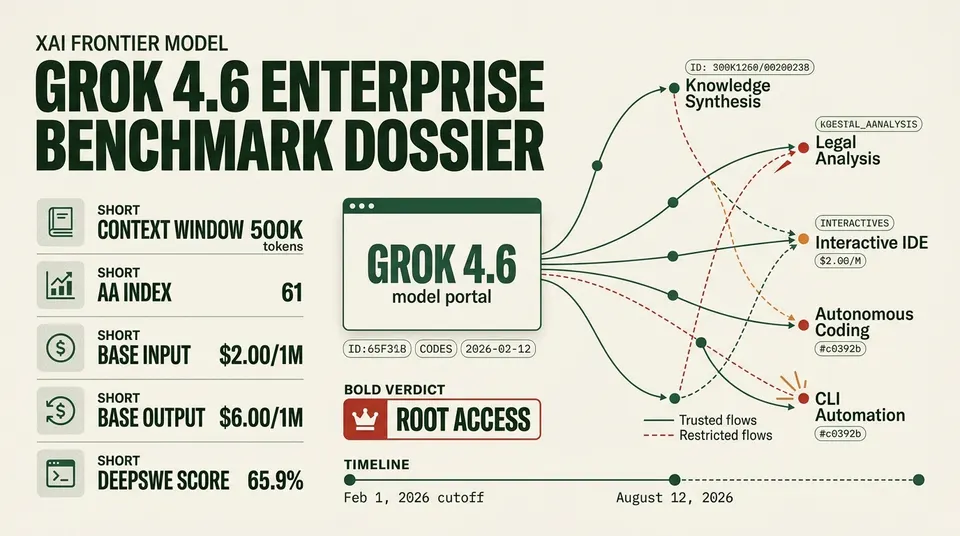
xAI launches Grok 4.6 with a 500k context window and aggressive pricing, matching GPT-5.6 Sol in knowledge work while trailing in autonomous coding benchmarks.
SAN FRANCISCO — Just five weeks after deploying Grok 4.5, xAI released its flagship Grok 4.6 model under the SpaceXAI banner, pairing an expanded 500,000-token context window with disruptive inference pricing that undercuts OpenAI and Anthropic. Scoring a 61 on the Artificial Analysis Intelligence Index, Grok 4.6 matches OpenAI’s GPT-5.6 Sol and closes within striking distance of Anthropic’s frontier offerings.
The launch accelerates xAI's release cadence following SpaceX's corporate restructuring and its $60 billion acquisition of developer platform Cursor in June 2026. However, empirical benchmark evaluations reveal a stark divergence: while Grok 4.6 captures top honors in multi-document enterprise knowledge work and complex legal analysis, it trails leading frontier models in autonomous software engineering, command-line operations, and deterministic structured JSON outputs.
Performance Deep Dive: Knowledge Synthesis vs. Autonomous Coding
Grok 4.6 delivers its sharpest performance gains in unstructured analytical synthesis, legal reasoning, and extended multi-step workflows, jumping five points on the Artificial Analysis Intelligence Index from Grok 4.5's score of 56. The cadence continued from there: our coverage of Grok 4.7 matching Claude Fable 5.1 Max on xAI's own scorecard checks those claims against an independent harness.
| Benchmark / Evaluation | Grok 4.6 High | Grok 4.5 High | GPT-5.6 Sol Max | Claude Fable 5 Max | Workload Category |
|---|---|---|---|---|---|
| AA Intelligence Index | 61 | 56 | 61 | 62 | Composite (9 evals) |
| GDPVal-AA v2 | 1753 | 1526 | 1728 | 1741 | Professional Knowledge Work |
| AA-Briefcase (Elo) | 1577 | 1313 | 1502 | 1574 | Long-Horizon Agent Projects |
| Harvey LAB (Vals) | 15.8% | 12.9% | 2.5% | 11.3% | Complex Legal Reasoning |
| CursorBench v3.2 | 69.9% | 66.7% | 67.2% | 70.5% | IDE Code Completion |
| FrontierCode v1.1 (Ext) | 61.3% | 56.6% | 60.6% | 63.6% | Frontier Coding Tasks |
| DeepSWE v1.1 | 65.9% | 54.0% | 73.0% | 70.0% | Autonomous Software Eng. |
| Terminal-Bench v3.0 | 26.0% | 15.7% | 34.6% | 34.1% | Autonomous CLI / SysOps |
| APEX-Agents | 57.5% | 47.1% | 56.7% | 59.2% | General Multi-turn Agents |
| APEX-SWE | 56.4% | 53.6% | — | 58.8% | Multi-file Software Projects |
The benchmark data highlights two distinct operational profiles:
- Knowledge Work Leadership: Grok 4.6 takes first place outright in knowledge-intensive synthesis, scoring 1753 on GDPVal-AA v2, 1577 Elo on AA-Briefcase (+264 points over Grok 4.5), and 15.8% on Harvey LAB legal evaluations. It reliably generates complete executive briefs and cross-document analyses in fewer conversational turns than Claude Opus 5.
- The Autonomous Coding Gap: Despite marketing centered on developer workflows, Grok 4.6 lags in unassisted, repository-level engineering. On DeepSWE v1.1, its 65.9% score trails GPT-5.6 Sol (73.0%) by 7.1 percentage points and Claude Fable 5 (70.0%) by 4.1 points. On Terminal-Bench v3.0, Grok 4.6 scores 26.0%, falling 8.6 points behind GPT-5.6 Sol (34.6%). While effective for interactive IDE completion (69.9% on CursorBench v3.2), it struggles with unassisted end-to-end debugging and sysops tasks. GPT-5.6 Sol's successor since undercut both on price, as covered in GPT-6's Sol and Luna launch at half the frontier price.
Architecture: Synthetic SFT Loops and Targeted Reinforcement
The five-point index gain within five weeks stems from refined post-training pipelines. Pre-training compute allocations were expanded for continuation runs using targeted synthetic datasets focused on mathematical and logical reasoning.
To scale supervised fine-tuning (SFT), xAI deployed Grok 4.5 to generate and filter execution trajectories across varying reasoning_effort depth parameters. Model-based critique gates automatically pruned flawed execution traces and dead-end logic paths. Post-training reinforcement learning (RL) runs were then directed at verifiable targets: low-level kernel optimizations, full-stack application scaffolding, and computer-aided design (CAD) asset synthesis.
Grok 4.6 carries a February 1, 2026 knowledge cutoff, serves traffic across AWS regions us-east-1 and us-west-2, and enforces default rate limits of 150 requests per second (RPS) and 50 million tokens per minute (TPM).
Token Economics: Output Cost Disruption and Operational Caveats
Priced at $2.00 per million input tokens and $6.00 per million output tokens, Grok 4.6 introduces aggressive price-to-performance competition. DeepSeek's V4 Flash 0731 undercuts that further still, per our engineering and security playbook for DeepSeek V4 Flash 0731's agent benchmarks. Its output pricing is 80% cheaper than GPT-5.6 Sol ($30.00/1M tokens) and more than four times cheaper than Claude Opus 5 ($25.00/1M tokens). That Opus 5 price point comes with its own routing tradeoffs for security teams, covered in Opus 5's enterprise pricing and the cybersecurity routing catch.
| Metric / Endpoint | Grok 4.6 Standard | Grok 4.6 (>200k Tokens) | GPT-5.6 Sol | Claude Opus 5 |
|---|---|---|---|---|
| Base Input (per 1M) | $2.00 | $4.00 | $5.00 | $5.00 |
| Cached Input (per 1M) | $0.50 | $1.00 | $1.25 | $1.25 |
| Output (per 1M) | $6.00 | $12.00 | $30.00 | $25.00 |
| Output Cost Multiplier vs. Grok | 1.0x | 2.0x | 5.0x | 4.16x |
Production routing telemetry shows an effective incurred input cost of $0.7249 per million tokens on standard endpoints, driven by a 90.3% cache hit rate in multi-turn sessions. The model delivers average generation throughput of 94 tokens per second with a time-to-first-token (TTFT) latency of 0.62 seconds. For comparison, Ling 3.0 Flash from Ant Group claims sub-100ms latency.
from openai import OpenAI

client = OpenAI(
 api_key="xai_live_enterprise_key",
 base_url="https://api.x.ai/v1",
)

response = client.chat.completions.create(
 model="grok-4.6",
 messages=[
 {"role": "system", "content": "You are an enterprise research analyst."},
 {"role": "user", "content": "Synthesize regulatory filings across sectors."}
 ],
 temperature=0.2,
 max_tokens=4096,
 extra_body={"reasoning_effort": "high"}
)
System architects must navigate two operational pricing caveats:
- The 200k Token Pricing Cliff: Requests exceeding 200,000 prompt tokens trigger an immediate 100% price doubling across all tiers ($4.00 base input, $1.00 cached input, $12.00 output). This heavily penalizes naive context stuffing over semantic retrieval-augmented generation (RAG).
- Cache Read Inflation: Cached input reads increased from $0.30 per million tokens in Grok 4.5 to $0.50 in Grok 4.6 (+66.7%). For agentic architectures where 80% to 90% of token consumption is repeated prompt caching, this increases baseline operational costs.
Enterprise Reliability, Hallucination Vectors, and Deployment Guardrails
Evaluated on the AA-Omniscience benchmark, Grok 4.6 achieved a 48.2% accuracy score with a 65.7% non-hallucination rate on incorrect answers.
When queried beyond its internal knowledge boundary, Grok 4.6 invents an ungrounded answer 34.3% of the time—roughly one in three incorrect responses—requiring deterministic retrieval grounding in production.
Tool execution reliability demonstrates high baseline stability with a 0.08% failure rate on the standard API (0.02% on Zero Data Retention endpoints). However, the standard endpoint exhibited a 4.00% schema violation rate on structured JSON outputs. High-assurance deployments must utilize the Zero Data Retention (ZDR) tier—which recorded a 0.00% schema violation rate—or implement strict validation retry middleware.
In multi-turn support tasks, Grok 4.6 scored 50.7% on the tau³-Banking benchmark, indicating that customer-facing agent deployments continue to require structured guardrails and human-in-the-loop triage.
Ecosystem Distribution and Architecture Outlook
Grok 4.6 is available across the native xAI API, Grok Build, Cursor, OpenRouter, Vercel AI SDK, and Cloudflare AI Gateway. Google answered with its own fast-tier release, Gemini 3.7 Flash's hybrid reasoning launch, while its flagship Pro model faces delays. Following SpaceXAI's Cursor acquisition, the model features deep IDE integration with doubled subscriber usage quotas.
Because Grok 4.6 implements standard /v1/chat/completions REST endpoints and standard function calling, API-level lock-in is minimal. Engineering teams using LiteLLM or OpenRouter can seamlessly route workloads between models.
For enterprise architects, Grok 4.6 delivers market-leading cost efficiency for document synthesis, legal analysis, and high-throughput extraction pipelines. However, mission-critical terminal automation and autonomous software engineering remain better suited to specialized coding models, while production deployments require disciplined RAG architectures to constrain hallucination risks.