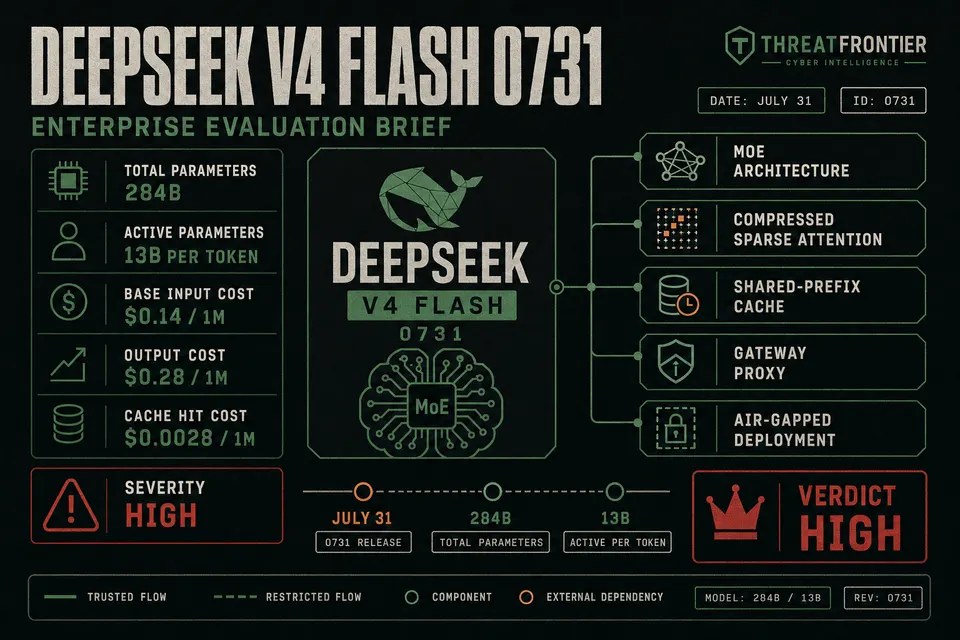
DeepSeek V4 Flash 0731 delivers low-cost agent reasoning. Explore benchmark metrics, sparse MoE architecture, economics, and enterprise security strategy.
DeepSeek has released its V4 Flash 0731 update, establishing a new efficiency benchmark for enterprise model deployments. By combining post-training optimizations with hybrid attention mechanisms, the sparse Mixture-of-Experts (MoE) system delivers high-throughput reasoning intended to rival proprietary frontier models while significantly lowering raw inference costs and latency.
However, for chief information security officers (CISOs), enterprise architects, and engineering leaders, the update brings complex operational tradeoffs. While V4 Flash 0731 offers exceptional economic efficiency for high-throughput software and security automation, its integration demands careful navigation of vendor-reported performance claims, unconfirmed initial open-weight provenance, data sovereignty requirements, and shadow AI risks.
Benchmark Analysis: Vendor Claims vs. Independent Metrics
The July 31 update to DeepSeek V4 Flash retains the underlying sparse MoE parameters of its April predecessor—284 billion total parameters with 13 billion active per token—while introducing a refined post-training pipeline. This architecture incorporates supervised fine-tuning across domain experts, reinforcement learning via Group Relative Policy Optimization (GRPO), and subsequent on-policy distillation.
When evaluating capability, technology leaders must distinguish between semi-independent evaluations and unverified vendor benchmarks. On general intelligence benchmarks, V4 Flash 0731 records a score of 50 on the Artificial Analysis Intelligence Index, placing it within one point of GPT-5.6 Luna (51), level with Gemini 3.6 Flash (50), and six points ahead of DeepSeek’s V4 Pro Preview (44). On agentic evaluations, it earns a GDPval-AA v2 Elo rating of 1559, ranking second among open-weight architectures behind Kimi K3.
Conversely, DeepSeek’s headline agentic scores—such as a 54.4 on DeepSWE and 76.7 on Cybergym—were evaluated internally on the company's proprietary test harness. As of release day, these specialized agent metrics remain unverified by third-party benchmark reproductions. Furthermore, while the Flash architecture is open-weight by design, official -0731 model weights remained unconfirmed on public repositories like Hugging Face at launch, leaving early local community quantizations subject to verification.
| Benchmark Evaluation | V4 Flash 0731 | V4 Flash Preview | V4 Pro Preview | GLM-5.2 | Claude Opus 4.8 | Verification Status |
|---|---|---|---|---|---|---|
| Intelligence Index (AA) | 50 | 40 | 44 | 51 | — | Semi-Independent |
| GDPval-AA v2 (Agent Elo) | 1559 | 1189 | — | 1510 | — | Semi-Independent |
| Terminal Bench 2.1 | 82.7 | 61.8 | 72.1 | 81.0 | 85.0 | Vendor-Reported |
| DeepSWE (Software Eng.) | 54.4 | 7.3 | 12.8 | 46.2 | 58.0 | Vendor-Reported |
| Cybergym (SecOps Auto.) | 76.7 | 38.7 | 52.7 | — | 83.1 | Vendor-Reported |
| NL2Repo (Repo Generation) | 54.2 | 39.4 | 38.5 | 48.9 | 69.7 | Vendor-Reported |
Architectural Innovations and Inference Efficiency
V4 Flash 0731 mitigates attention bottlenecks across its 1-million-token context window through structural efficiency techniques rather than raw parameter expansion.
┌─────────────────────────────────────────┐
│ Compressed Sparse Attention (CSA) Layer │
└────────────────────┬────────────────────┘
 │
 ▼
┌─────────────────────────────────────────┐
│ Heavily Compressed Attention (HCA) │
└────────────────────┬────────────────────┘
 │
 ▼
┌─────────────────────────────────────────┐
│ Manifold-Constrained Hyper-Connections │
└─────────────────────────────────────────┘
1. Hybrid Compressed Attention
The model pairs Compressed Sparse Attention (CSA) with Heavily Compressed Attention (HCA). CSA compresses the Key-Value (KV) cache along sequence dimensions prior to sparse attention processing, while HCA applies aggressive KV compression during dense attention passes. This hybrid framework reduces single-token inference FLOPs to approximately 10% and KV cache memory allocation to 7% compared to standard transformer baselines at 1 million context tokens.
2. Heterogeneous Prefix Caching
The architecture relies on on-disk shared-prefix caching. During repetitive agent loops that resend invariant system prompts, codebase trees, or API schemas, the inference engine retrieves pre-computed attention states from shared disk arrays rather than re-computing embeddings across GPU clusters.
3. Numerical Stabilization and FP4 Training
DeepSeek incorporates Manifold-Constrained Hyper-Connections (mHC) alongside the Muon optimizer to stabilize deep residual signals. FP4 quantization-aware training across MoE expert layers and indexer paths allows high-density deployment without loss of precision during multi-step tool calls.
Economics of High-Throughput Agent Workflows
V4 Flash 0731 introduces an aggressive pricing model: $0.14 per 1 million input tokens (cache miss) and $0.28 per 1 million output tokens. Its core financial advantage stems from a 98% cache-hit discount, which drops input costs to $0.0028 per 1 million tokens for matching shared prefixes.
{
  "model": "deepseek-v4-flash-0731",
  "pricing": {
    "input_cache_miss_per_m": 0.14,
    "input_cache_hit_per_m": 0.0028,
    "output_per_m": 0.28,
    "cache_discount_percentage": 98
  },
  "concurrency_limit": 2500,
  "default_mode": "thinking"
}
With support for up to 2,500 concurrent API connections—five times the capacity of standard enterprise offerings—dev teams can scale automated agent fleets across continuous integration pipelines and security analysis engines.
import os
from openai import OpenAI

# Drop-in replacement via standard OpenAI API client
client = OpenAI(
 api_key=os.environ.get("DEEPSEEK_API_KEY"),
 base_url="https://api.deepseek.com/v1"
)

response = client.chat.completions.create(
 model="deepseek-v4-flash-0731",
 messages=[
 {"role": "system", "content": "You are an enterprise code auditing agent."},
 {"role": "user", "content": "Analyze pipeline inputs for injection patterns."}
 ],
 extra_body={"thinking_budget": 1024}
)
Cost Management Warning: V4 Flash 0731 defaults to "Thinking Mode." Invisible reasoning tokens generated during chain-of-thought processing are billed at the standard output token rate ($0.28/1M). Because evaluations indicate high output verbosity (~210 million output tokens in standardized tests compared to a 62 million industry median), procurement teams must calculate cost per completed task rather than relying solely on base token pricing.
Governance, Data Sovereignty, and Shadow AI Risks
Despite its compelling economics, deploying V4 Flash 0731 exposes enterprises to key regulatory and security risks:
- Data Sovereignty Constraints: Routing prompts through third-party cloud APIs across foreign jurisdictions presents severe compliance challenges. Under Article 7 of China's 2017 National Intelligence Law, organizations operating in the region are legally obligated to assist state intelligence efforts. Previous regulatory actions, such as South Korea's Personal Information Protection Commission (PIPC) investigation into unauthorized prompt data transfers, underscore the necessity of strict data boundary enforcement.
- Shadow AI Risks: The model's low API costs and small footprint accelerate unsanctioned employee adoption. Local quantizations (such as 4-bit builds requiring 168GB RAM or 3-bit builds requiring 110GB RAM) allow engineers to execute models locally, bypassing central single-sign-on gateways and network blocks on
deepseek.com. Standard pattern-matching Data Loss Prevention (DLP) tools often fail to catch proprietary source code and algorithmic logic pasted into unmonitored local windows.
Strategic Defense Framework for Enterprise Leaders
To leverage V4 Flash 0731 securely, technology leaders should deploy a governance framework aligned with NIST AI RMF and ISO 42001 standards.
┌─────────────────────────────────┐
│ NIST AI RMF / ISO 42001 │
└────────────────┬────────────────┘
 │
 ┌──────────────┼──────────────┬──────────────┐
 ▼ ▼ ▼ ▼
┌───────────┐ ┌───────────┐ ┌───────────┐ ┌───────────┐
│ Air-Gapped│ │ Gateway │ │ Contextual│ │ Weight │
│ Hosting │ │ Proxy │ │ DLP │ │ Provenance│
└───────────┘ └───────────┘ └───────────┘ └───────────┘
- Enforce Air-Gapped Hosting for Proprietary Assets: For internal codebases and sensitive telemetry, deploy verified open-weight checkpoints within isolated private enterprise clouds, completely severing outbound external API connections.
- Implement Anonymization Proxies: When utilizing cloud API endpoints, route requests through an intermediate gateway to sanitize enterprise identifiers, customer records, and API tokens prior to data egress.
- Deploy Intent-Based Data Loss Prevention: Upgrade perimeter DLP systems from static regular expressions to contextual models capable of identifying code structures and trade secrets across developer network traffic.
- Audit Local Weight Provenance: Establish internal model registries requiring cryptographic signature verification for all GGUF and model weight files to prevent supply-chain vulnerabilities from unvetted public repositories.