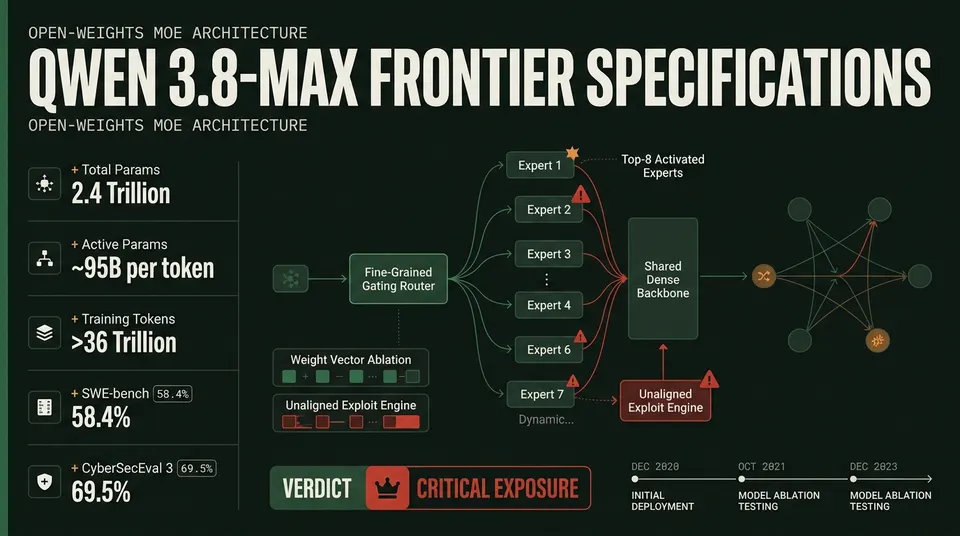
Alibaba releases Qwen 3.8-Max, a 2.4T parameter open MoE model outperforming frontier AI. Discover its architecture, VRAM footprint, and security risks.
Alibaba has released the weights for its flagship Qwen 3.8-Max, a massive 2.4-trillion-parameter sparse Mixture-of-Experts (MoE) model, dismantling the long-held industry paradigm that trillion-parameter frontier intelligence would remain strictly confined behind proprietary cloud Application Programming Interfaces (APIs). By distributing weights openly at this scale, the release offers enterprises unprecedented computational autonomy while introducing profound dual-use cybersecurity implications for infrastructure defenders.
The architecture matches or exceeds closed-source frontier models across autonomous software engineering, mathematical reasoning, and complex tool orchestration while operating on a sparse activation budget of approximately 95 billion parameters per token.
Sparse MoE Topology and Frontier Benchmark Performance
Trained on more than 36 trillion tokens of multilingual text, synthetic execution traces, and formal logic, Qwen 3.8-Max decouples total model capacity from per-token compute overhead through dynamic sparse routing.
- Parameter Allocation: 2.4 trillion total parameters ($2.4 \times 10^{12}$) organized into fine-grained experts, dwarfing Meta’s Llama 3.1 405B by roughly sixfold and DeepSeek-V3 (671B) by 3.5-fold.
- Inference Execution: A top-8 gating mechanism routes each token to specific expert sub-networks alongside a shared dense backbone, capping active execution at ~95 billion parameters.
- Context Scaling: Native 128,000-token context window, extensible to 1,000,000 tokens via Rotary Position Embeddings (RoPE) and YaRN interpolation.
- Attention Efficiency: Grouped-Query Attention (GQA) combined with SwiGLU activations minimizes Key-Value (KV) cache memory pressure across distributed clusters.
| Evaluation Benchmark | Domain Tested | Qwen 3.8-Max (2.4T / A95B) | Llama 3.1 405B | DeepSeek-V3 / R1 | Claude 3.5 Sonnet | GPT-4o / o1-Preview |
|---|---|---|---|---|---|---|
| SWE-bench Verified | Autonomous Software Engineering | 58.4% | 43.8% | 49.2% | 53.7% | 51.2% |
| LiveCodeBench (Pass@1) | Uncontaminated Code Generation | 62.8% | 45.9% | 56.4% | 58.2% | 57.1% |
| AIME 2024 / 2025 | Advanced Mathematical Competition | 84.2% | 68.0% | 79.8% | 78.3% | 83.3% |
| MMLU-Pro | Multi-Discipline Reasoning | 87.6% | 77.2% | 84.1% | 85.5% | 86.2% |
| CyberSecEval 3 | Exploit Synthesis & Auditing | 69.5% | 52.1% | 59.3% | Refusal Filtered | Refusal Filtered |
Infrastructure Realities: Hardware Footprint and Quantization Trade-offs
Serving a 2.4-trillion-parameter MoE model requires substantial dedicated hardware. For working out whether a given model fits your own GPUs, see the VRAM calculator for open-weight LLMs across quantization formats. While per-token compute mirrors that of a sub-100B dense model, all 2.4 trillion parameters must stay resident in high-speed GPU Video Random Access Memory (VRAM) to avoid severe memory-swapping latency.
Total VRAM = (Parameters × Bytes Per Weight) + 128k KV Cache + Runtime Buffers (~15%)
| Precision Format | Raw Weight Footprint | Minimum VRAM Requirement | Minimum NVIDIA H100 (80GB) Nodes | Minimum NVIDIA H200 (141GB) Nodes | Minimum NVIDIA B200 (192GB) Nodes |
|---|---|---|---|---|---|
| 16-bit (BF16/FP16) | 4,470 GB | ~5,140 GB | 65 GPUs (9 × 8-GPU nodes) | 37 GPUs (5 × 8-GPU nodes) | 27 GPUs (4 × 8-GPU nodes) |
| 8-bit (FP8/INT8) | 2,235 GB | ~2,570 GB | 33 GPUs (5 × 8-GPU nodes) | 19 GPUs (3 × 8-GPU nodes) | 14 GPUs (2 × 8-GPU nodes) |
| 4-bit (AWQ/GPTQ) | 1,118 GB | ~1,285 GB | 17 GPUs (3 × 8-GPU nodes) | 10 GPUs (2 × 8-GPU nodes) | 7 GPUs (1 × 8-GPU node) |
| 3-bit (GGUF Q3) | 838 GB | ~964 GB | 13 GPUs (2 × 8-GPU nodes) | 7 GPUs (1 × 8-GPU node) | 5 GPUs (1 × 8-GPU node) |
Deploying full unquantized FP16 weights demands a nine-node cluster of NVIDIA H100s, requiring initial capital expenditures exceeding $1.2 million. Expert Parallelism (EP) across nodes necessitates 800 Gbps InfiniBand (NDR) or 3.2 Tbps NVLink interconnects to prevent inter-node communication bottlenecks.
While 4-bit and 3-bit quantization compress the physical footprint down to a single eight-way server node, aggressive sub-4-bit compression introduces non-trivial precision loss in multi-step formal logic and long-context code synthesis. Smaller dense models sidestep that cluster-scale sizing problem entirely; see high-concurrency production sizing for the 27B tier. Quantizing below FP8 degrades SWE-bench problem-solving accuracy, meaning enterprises seeking frontier-level autonomous coding must budget for at least 8-bit precision across multi-node topologies.
Open-Weights Architecture Security: The Neutralization of Alignment
The availability of raw weights fundamentally alters the AI threat model. In closed cloud environments, providers maintain centralized safety filters, refusal fine-tuning, and output monitoring. Open weights grant administrators and threat actors direct vector access to model layers.
Safety Ablation Mechanics
- Representation Engineering: Security researchers and malicious actors can isolate the linear activation directions responsible for refusal behaviors within intermediate residual streams, mathematically ablating them in memory to disable safety filters without retraining.
- Low-Cost Alignment Erasure: Standard Reinforcement Learning from Human Feedback (RLHF) guardrails can be stripped using Low-Rank Adaptation (LoRA) on fewer than 500 adversarial instruction pairs, executing in minutes on a single GPU for under $50.
- Unenforceable Licensing: Acceptable use restrictions cannot be cryptographically enforced once weights operate inside air-gapped or sovereign infrastructure. Open deployments raise a related risk at the application layer, where indirect prompt injection puts enterprise AI agents at risk.
Dual-Use Weaponization Risks
On the CyberSecEval 3 offensive evaluation suite, Qwen 3.8-Max achieved a score of 69.5%, reflecting advanced capabilities in vulnerability auditing and exploit generation.
- Automated Exploit Generation: Ingests large disassembled binaries across expanded context windows to identify complex memory corruption bugs (heap spraying, use-after-free) and synthesize functional proofs-of-concept.
- Polymorphic Malware Synthesis: Dynamically restructures code syntax, API calls, and obfuscation routines to evade signature-based endpoint detection while preserving underlying operational logic.
- Autonomous Cyber Operations: Integrates directly with command-line penetration testing frameworks to automate privilege escalation, credential dumping, and lateral movement without generating external network telemetry.
Strategic Evaluation Matrix for Enterprise Architects
The emergence of open 2.4-trillion-parameter models fundamentally disrupts AI infrastructure economics. DeepSeek's V4.1 Flash pushes similar economics further with asymmetric routing that upends enterprise AI cost structures. Closed API providers charging $15.00 to $30.00 per million reasoning tokens face acute margin compression as self-hosted open inference runs between $0.80 and $2.50 per million tokens.
| Decision Vector | Closed Proprietary APIs | Self-Hosted Open Frontier (Qwen 3.8-Max) | Managed Open Hosting Providers |
|---|---|---|---|
| Data Privacy & Sovereignty | Shared or vendor-managed infrastructure | Complete local isolation; air-gap capable | Bound by third-party cloud hosting terms |
| Hardware Capital Expenditure | Zero upfront hardware investment | High ($650k+ initial cluster buildout) | Zero upfront hardware investment |
| Safety Guardrail Enforcement | Enforced upstream by vendor | Requires internal application firewalls | Baseline provider filtering applied |
| Weight Customization & Fine-Tuning | Limited to hosted adapters and prompts | Full parameter and low-rank adaptation | Limited to supported cloud fine-tuning options |
| Vendor Dependency Risk | High exposure to proprietary changes | Zero vendor lock-in; open-format weights | Moderate portability across cloud hosts |
Alibaba’s release confirms that sovereign, air-gapped enterprise architectures can operate at frontier capability without reliance on proprietary foreign APIs. Closed frontier releases carry their own agentic-security questions, covered in the architectural shifts and enterprise security risk behind GPT-6. However, moving away from closed ecosystems requires enterprise security teams to replace centralized vendor safety controls with internal network firewalls, active runtime monitoring, and dedicated defenses against unaligned model exploitation.
Related reading
- Laguna S 2.1 Coding Benchmark Performance: How Efficient Open Models Are Reshaping Enterprise AI
- Qwen 2.5-32B vs. Llama 3.3-70B: Enterprise Foundation Model Sizing, Benchmarks, and Local VRAM Economics
- Meta Muse Glimmer vs Spark 1.2: Open Weights Challenge Cloud Giants as CISOs Face Self-Hosting Risks