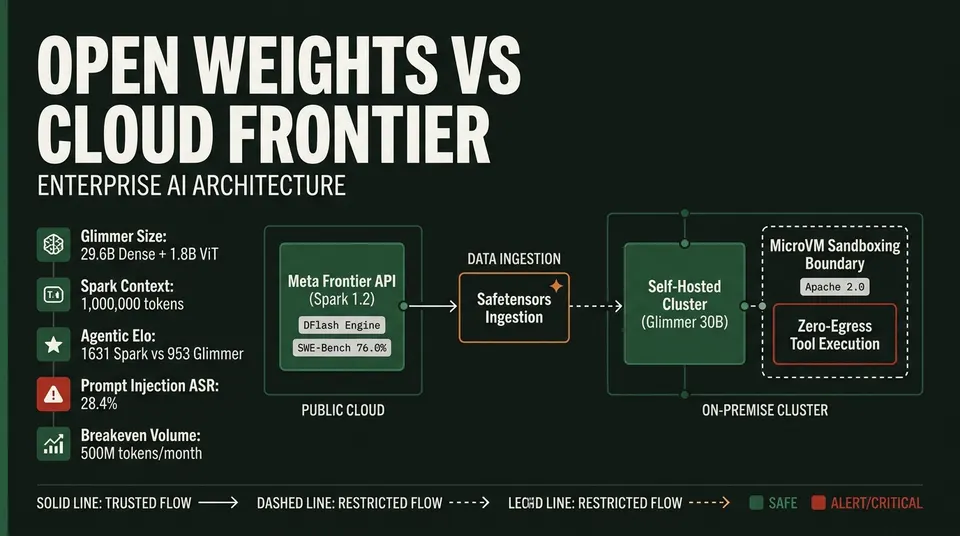
Meta unveils Muse Spark 1.2 and open-weight Muse Glimmer 30B. Compare benchmarks, TCO economics, Apache 2.0 licensing, and critical CISO security risks.
Meta has disrupted enterprise artificial intelligence deployment with the dual release of its Muse architecture, pairing a proprietary cloud frontier model with an unrestricted, open-weight foundation model under the Apache 2.0 license. The flagship hosted API, Muse Spark 1.2, provides a 1,000,000-token context window designed for multi-hop agentic reasoning, while Muse Glimmer delivers an open-weight, dense 29.6-billion-parameter multimodal model optimized for sovereign, on-premise execution on local accelerator hardware. Nvidia goes further on openness with Nemotron 3.5 Lightning and its open datasets.
This bifurcated strategy challenges proprietary cloud walled gardens by enabling zero-data-retention, air-gapped operations. However, self-hosting shifts the complete operational burden of adversarial robustness, tool sandboxing, memory isolation, and infrastructure maintenance directly onto enterprise Chief Information Security Officers (CISOs) and platform architects. The same applies to self-hosted coding agents; see hardening a DeepSeek-R1 agent harness.
Dual-Track Architecture and Benchmark Realities
Muse Glimmer features a 52-layer dense causal transformer architecture with a hidden dimension of 6,656, a SwiGLU intermediate dimension of 19,968, and an integrated 1.8-billion-parameter ViT-G/14 vision subsystem supporting 4,096 visual tokens. To maintain computational efficiency across its 131,072-token native context window, Glimmer employs a repeating hybrid attention mechanism—three local sliding-window layers (2,048 tokens) to one global attention layer—paired with a 16:1 Grouped-Query Attention (GQA) ratio.
To accelerate local execution, Glimmer integrates the DFlash speculative drafter, a 5-layer block-diffusion engine that increases inference throughput from 75 tokens per second to over 233 tokens per second on single-workstation GPUs.
Benchmark Evaluation Matrix
| Benchmark / Capability | Muse Glimmer (Open 30B) | Muse Spark 1.2 (Frontier API) | Industry Baseline (Gemma4-31B / Qwen3.6-27B) |
|---|---|---|---|
| GDPval-AA v2 (Agentic Elo) | 953 | 1,631 (#5 Globally) | 811 – 1,141 |
| MCP-Atlas (Tool/Schema) | 75.5% | Frontier Multi-Hop Baseline | 54.2% – 62.5% |
| SWE-Bench Verified | 76.0% | ~82.0% | 66.6% – 77.2% |
| SWE-Bench Pro | 51.2% | ~55.0% | 36.9% – 50.2% |
| TerminalBench 2.1 | 51.7% | 80.0% | 43.4% – 60.7% |
| AIME 2026 (Math) | 94.7% | Frontier Baseline | 89.2% – 94.1% |
| GPQA Diamond | 83.5% | ~88.0% | 84.2% – 85.7% |
| Charxiv Vision Reasoning | 78.8% | ~84.0% | 77.7% – 78.4% |
Benchmark results reveal stark capability divergence. While Glimmer achieves near-parity with commercial frontier models on deterministic code generation (76.0% on SWE-Bench Verified) and tool schema parsing (75.5% on MCP-Atlas), it trails significantly on broad agentic knowledge routing. On GDPval-AA v2, Muse Spark 1.2 commands a top-tier Elo of 1,631, compared to Glimmer's 953, reflecting the performance gap between compact distilled edge weights and multi-hundred-billion-parameter cloud systems. DeepSeek's own dual-tier approach shows a similar split, laid out in its V4 Flash agent benchmarks and enterprise security playbook.
Licensing and Governance: The Apache 2.0 Shift
Departing from the restrictive terms of historical Llama Community Licenses, Meta has distributed Muse Glimmer under the standard Apache 2.0 license. This transition eliminates the legacy 700-million monthly active user threshold, removes non-compete clauses, and permits unrestricted commercial embedding into proprietary enterprise software.
While Apache 2.0 delivers complete architectural sovereignty, it removes vendor-provided indemnification, leaving enterprise operators to independently shoulder copyright, data residency, and operational liability. Furthermore, export controls, ITAR/EAR compliance, and training-data legal exposure shift entirely to the deploying organization. Frontier closed models raise a related but different risk profile, examined in GPT-6's enterprise security risk from its architectural shifts and agentic vectors.
Cybersecurity Threat Vectors and Runtime Sandboxing
Self-hosting open-weight models fundamentally alters the enterprise threat model, replacing cloud vendor availability concerns with critical runtime execution vulnerabilities.
Key Risk Vectors
- Safety Alignment Removal: Open weights are susceptible to post-release guardrail ablation. Threat actors can neutralize refusal boundaries via Low-Rank Adaptation (LoRA) or representation engineering using fewer than 100 adversarial samples.
- Indirect Prompt Injection: When deployed within autonomous Model Context Protocol (MCP) agents, Glimmer processes untrusted external data. On Siren AgentDojo benchmarks, Glimmer recorded a 28.4% Attack Success Rate (ASR) under prompt injection, creating exposure to unauthorized tool calls. That risk isn't unique to Glimmer: indirect prompt injection puts enterprise AI agents at risk across the board, and filters alone will not stop it.
- Contextual Integrity Violations: Glimmer registered a 26.4% violation rate on Contextual Integrity evaluations, demonstrating a tendency to leak privileged system context and database schemas across multi-turn sessions.
- Supply Chain Deserialization: Ingesting unverified community checkpoints risks execution of embedded backdoors and malicious tensors.
To mitigate runtime execution risks, tool calls must be isolated inside non-root microVM boundaries:
# Enterprise Security Baseline: MicroVM Isolation Wrapper
import subprocess
from dataclasses import dataclass

@dataclass(frozen=True)
class ExecutionPolicy:
 max_memory_mb: int = 2048
 timeout_seconds: float = 5.0
 allow_network_egress: bool = False

def execute_agent_tool_isolated(command: list[str], policy: ExecutionPolicy) -> str:
 """Executes agent-generated commands inside an unprivileged microVM sandbox."""
 sanitized_env = {"PATH": "/usr/bin:/bin", "LANG": "C.UTF-8"}

 isolation_wrapper = [
 "bwrap",
 "--ro-bind", "/usr", "/usr",
 "--ro-bind", "/lib", "/lib",
 "--ro-bind", "/lib64", "/lib64",
 "--tmpfs", "/tmp",
 "--unshare-all",
 "--die-with-parent"
 ]
 if not policy.allow_network_egress:
 isolation_wrapper.append("--unshare-net")

 result = subprocess.run(
 isolation_wrapper + ["--"] + command,
 capture_output=True,
 text=True,
 timeout=policy.timeout_seconds,
 env=sanitized_env,
 check=False
 )
 return result.stdout if result.returncode == 0 else result.stderr
Enterprise Economics and Total Cost of Ownership
Evaluating self-hosted open weights versus managed cloud APIs depends on compute density, memory footprint, and monthly query volume. A dedicated total cost of ownership blueprint for 27B LLMs walks through that math in more detail.
Hardware Sizing Matrix (Muse Glimmer 30B)
| Deployment Profile | Quantization | VRAM Envelope | Target Hardware Configuration | Throughput | Primary Workload |
|---|---|---|---|---|---|
| Local Workstation | 4-bit (K-Quant) | 24 GB | 1x NVIDIA RTX 4090 / 5090 (24GB) | ~233 tok/s (DFlash) | Local engineer assistant, edge worker |
| Departmental Node | 4-bit Dynamic | 32 GB | 1x NVIDIA RTX 5090 (32GB) / L40S | 120–250 tok/s | Internal micro-service, batch RAG |
| Production Node (BF16) | 16-bit Full | 64 GB – 80 GB | 1x NVIDIA H100 (80GB) / 2x A100 | 300+ tok/s (batched) | Multi-tenant agents, fine-tuning host |
Economic Breakeven
The Muse Spark 1.2 managed API is priced at $1.25 per 1M input tokens, $4.25 per 1M output tokens, and $0.15 per 1M cached tokens (a blended average of $2.80 per million tokens). A dedicated self-hosted NVIDIA H100 instance incurs a compute floor of approximately $1,600 per month ($2.20/hour), excluding site reliability engineering costs.
- Below 500 Million Tokens/Month: The managed API is more economical, avoiding infrastructure maintenance overhead.
- At 500 Million Tokens/Month: Breakeven zone; self-hosting achieves cost parity while securing sovereign data isolation.
- Above 5 Billion Tokens/Month: Self-hosting delivers over 70% cost reduction compared to standard API consumption.
Operational Safeguards and Strategic Synthesis
Enterprise security teams deploying Muse Glimmer should establish a three-tiered defense framework:
- Artifact Verification: Enforce automated SHA-256 checksum validations against official Meta repositories, restricting ingestion exclusively to audited
.safetensorsand signed GGUF binaries. - Runtime MicroVM Sandboxing: Confine code execution, shell interactions, and external connectors to ephemeral microVMs (such as Firecracker or gVisor) with mandatory Human-in-the-Loop gates for state-modifying actions. That containment strategy is one piece of architecting zero-trust MCP to mitigate tool poisoning and sampling injection more broadly.
- Defensive Guardrails: Filter external agent inputs through dual-model classifiers (e.g., Llama-Guard) to neutralize indirect prompt injection payloads before processing.
Meta’s dual-track AI strategy establishes a compelling hybrid blueprint. Rather than selecting an exclusively closed or open paradigm, leading organizations route high-volume coding sub-tasks, local document indexing, and edge automation to Muse Glimmer 30B, while reserving Muse Spark 1.2 for complex multi-hop reasoning, long-context document analysis, and enterprise-wide orchestration.