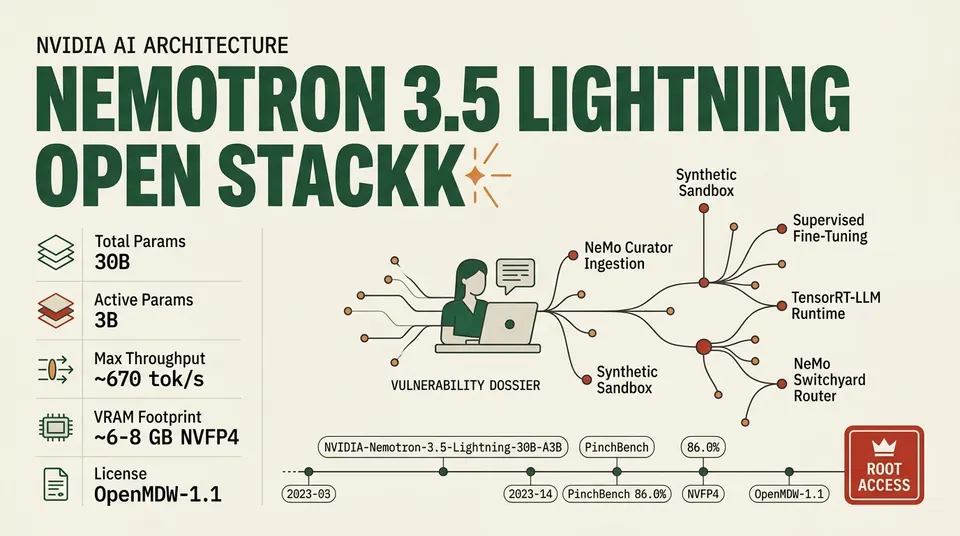
Nvidia launches Nemotron 3.5 Lightning with transparent datasets and a sparse 30B MoE architecture, delivering high-speed, auditable AI for enterprise agents.
SANTA CLARA, Calif. — In a decisive departure from the industry convention of distributing artificial intelligence models as opaque binary files, Nvidia has released Nemotron 3.5 Lightning alongside its complete pre-training datasets, curation pipelines, and post-training alignment recipes. The release introduces a sparse Mixture-of-Experts architecture designed specifically for high-throughput enterprise agent execution while handing Chief Information Security Officers and DevSecOps engineers the transparent data lineage required to audit models for security vulnerabilities, copyright liabilities, and regulatory compliance.
The new model, officially designated NVIDIA-Nemotron-3.5-Lightning-30B-A3B, pairs 30 billion total parameters with just 3 billion active parameters per token. By coupling sparse parameter activation with native Multi-Token Prediction heads, the system delivers the analytical depth of mid-tier enterprise models at the operational latency of lightweight language engines.
Nvidia is releasing the entire pipeline code under the permissive OpenMDW-1.1 standard established in partnership with the Linux Foundation and the PyTorch Foundation. This strategic move directly challenges the semi-open licensing paradigms of rivals like Meta and Mistral, positioning Nvidia's software framework as an auditable, enterprise-grade operating system for autonomous agents.
Technical Architecture and Benchmark Execution
Nemotron 3.5 Lightning addresses the core bottleneck of autonomous enterprise agents: repetitive, latency-sensitive sub-tasks such as executing terminal commands, parsing unstructured JSON, resolving shell errors, and querying corporate databases. Standard dense models often stall when running long tool-calling loops, accumulating latency across multi-step plans.
The 30B-A3B architecture activates only 3 billion parameters during any single forward pass, substantially reducing compute overhead. To accelerate token generation further, Nvidia integrated native speculative decoding directly into the architecture via two specialized draft engines:
- DSpark: A lightweight speculative drafting model configured for low-concurrency edge setups and developer workstations.
- DFlash: A high-throughput speculative decoding engine tuned for high-batch enterprise clusters running on Hopper and Blackwell silicon.
| Evaluation Metric / Benchmark | Nemotron 3.5 Lightning (30B-A3B) | Comparable Dense Baselines (30B–35B) | Operational Advantage |
|---|---|---|---|
| Artificial Analysis Index | Score: ~24 (Pareto Frontier) | Score: ~20–22 | Frontier task precision at up to 4x generation speed |
| PinchBench (Agent Execution) | 86.0% Task Accuracy | ~85.0%–86.0% (Qwen-3.5 35B) | Multi-step workflows complete 30% faster |
| Max Throughput (NVFP4) | Up to ~670 tokens/second | ~150–220 tokens/second (BF16) | Near-instantaneous sub-agent loops in TensorRT-LLM |
| VRAM Footprint | ~6–8 GB (NVFP4) / ~18–20 GB (BF16) | ~60 GB (BF16 Dense) | Runs on single prosumer GPUs or sliced H100s |
On agentic execution benchmarks, Nemotron 3.5 Lightning achieved an 86 percent success rate on PinchBench, matching leading 35B dense baselines while completing multi-step autonomous workloads 30 percent faster. When compiled in the TensorRT-LLM runtime with native NVFP4 (4-bit floating point) quantization, single-stream throughput scales up to 670 tokens per second. For the tradeoffs between this format and its rivals, see NVFP4 vs FP8 vs MXFP4 quantization formats explained.
The Open-Recipe Paradigm: Data Provenance and Synthetic Alignment
Where competing foundation models publish only post-trained weights accompanied by high-level marketing papers, Nvidia has open-sourced the underlying dataset pipeline, enabling reproducible inspection of every token stage.
Pre-training corpora were filtered using NeMo Curator, an open-source pipeline executing heuristic quality filtering, exact and MinHash/LSH fuzzy deduplication, and domain classification. The framework applies automated Personal Identifiable Information (PII) scrubbing and toxicity filtering, providing enterprise compliance teams with verifiable data hygiene rules.
# Sample NeMo Curator data ingestion and deduplication command
python -m nemo_curator.cli.deduplicate \
 --input-data-dir /data/raw_corpora \
 --output-dir /data/curated_corpora \
 --minhash-threshold 0.85 \
 --filter-pii \
 --language en
For agentic tool use, Nvidia published the Nemotron-RL Agentic Terminal Pivot v1 dataset on Hugging Face. This repository supplies verified multi-turn bash execution traces, recovery trajectories, and shell state transitions. Training on verified terminal state machines rather than unvalidated web scrapes significantly curtails CLI command and argument hallucinations during tool execution.
Synthetic generation recipes draw on the Nemotron-4 340B framework and HelpSteer2 preference alignment datasets. Every synthetically generated reasoning trajectory was validated through deterministic sandboxes—including live Python compilers and test harnesses—prior to inclusion in the supervised fine-tuning mix.
For enterprise engineering teams, genuine software openness in artificial intelligence requires inspecting training distributions and alignment code rather than trusting an opaque binary checkpoint.
Enterprise DevSecOps, Supply Chain Security, and Compliance
For security leaders, the open-recipe structure transforms model evaluation from black-box behavioral testing into verifiable software supply chain auditing.
- AI Software Bill of Materials (SBOM): Transparent dataset splits enable DevSecOps teams to inspect training shards for poisoned data injections, hidden backdoor triggers, or unauthorized source material.
- Regulatory Compliance Readiness: The documentation provided with the data curation stack fulfills transparency criteria mandated for General-Purpose AI (GPAI) under the European Union AI Act, including data provenance documentation, energy consumption tracking, and risk assessment reporting. Anthropic took a different route with global token watermarking for Article 50.
- Air-Gapped Privacy: Because the NVFP4-quantized model consumes under 8 gigabytes of VRAM, organizations in defense, healthcare, and finance can deploy local execution workers entirely within on-premise infrastructure or isolated virtual private clouds, eliminating data exfiltration risks inherent to commercial cloud API endpoints.
- Execution Layer Sandboxing: Integrated with NemoClaw and NeMo Guardrails, the system supports programmatic policy enforcement, blocking unauthorized shell commands or privilege escalation attempts at the inference layer. That kind of sandboxing matters because filters alone cannot stop indirect prompt injection attacks on enterprise AI agents.
Two-Tier Agent Architectures and Hardware Orchestration
In enterprise production environments, Nemotron 3.5 Lightning operates as a dedicated execution engine within a tiered routing topology governed by NeMo Switchyard. Alibaba's competing open-weight release takes a similar sparse-execution approach — see Qwen3.8-27B's hybrid architecture.
Under this split-architecture deployment, large frontier models handle broad multi-step planning, while localized Nemotron 3.5 Lightning instances execute individual sub-tasks—such as linting code, running regular expressions, parsing server logs, and executing SQL migrations—at hardware speed.
On Nvidia Blackwell (B200 and GB200) architectures, native Tensor Core micro-scaling leverages NVFP4 to maximize batch concurrency without precision degradation. On workstations equipped with an RTX 5090 or DGX Spark, developers can host local execution agents alongside development environments without saturating system memory. A full deployment walkthrough for that card sits in the RTX 5090 32GB local LLM deployment blueprint.
Commercial Licensing and Deployment Verdict
Nvidia’s adoption of the OpenMDW-1.1 license establishes a distinctly permissive commercial framework. Unlike Meta's community license, which enforces a 700-million monthly active user threshold and restricts using model outputs to improve competing models, OpenMDW-1.1 imposes no commercial user caps across weights, pipeline recipes, and alignment data.
The primary operational consideration lies in software infrastructure. While Nemotron 3.5 Lightning remains functionally compatible with open-source runtimes like vLLM and SGLang, unlocking peak throughput of 670 tokens per second and native speculative decoding requires compiling the model within Nvidia's TensorRT-LLM environment. Choosing among those three serving engines is covered in SGLang vs vLLM vs TensorRT-LLM for production inference.
For enterprise decision-makers evaluating long-running autonomous workflows, the Nemotron 3.5 Lightning release represents a viable, auditable alternative to opaque commercial APIs. By combining sparse MoE efficiency, complete data provenance, and permissive licensing, Nvidia has established a new benchmark for transparent, production-grade enterprise AI infrastructure.