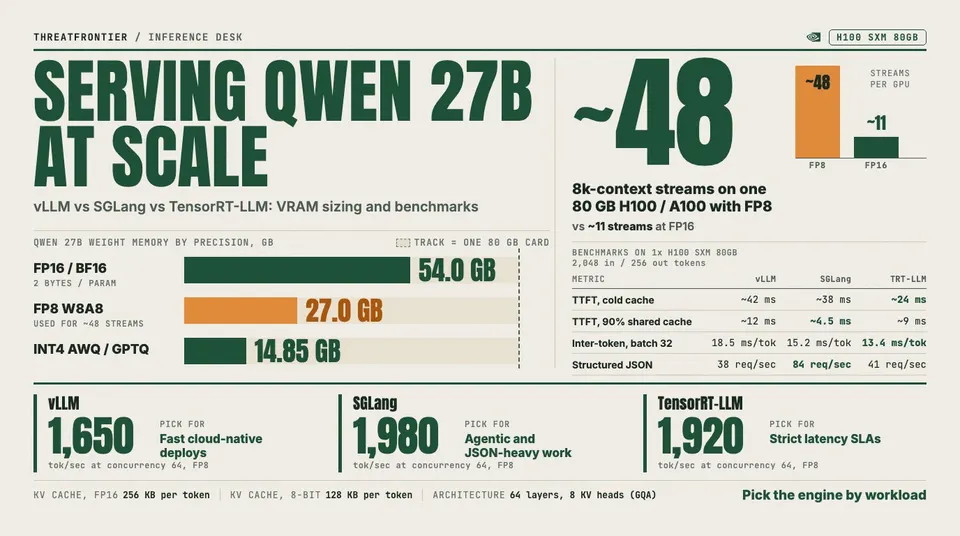
Master high-concurrency Qwen 27B inference. Compare vLLM, SGLang, and TensorRT-LLM benchmarks, GPU memory sizing, FP8 quantization, and hardware topologies.
The 27-billion parameter tier has emerged as the definitive enterprise sweet spot in open-weights artificial intelligence, delivering reasoning and coding performance competitive with legacy 70B models while operating within cost-effective single- and dual-GPU hardware footprints. However, transitioning a dense 27B architecture from single-batch evaluation to high-concurrency production requires precise memory engineering and kernel optimization to prevent key-value (KV) cache exhaustion and inter-token latency spikes under synthetic load.
Deploying dense transformer architectures at scale forces infrastructure engineers to balance memory virtualization, batch scheduling, and runtime compilation. The full total-cost-of-ownership math behind that balance is worked out in the enterprise inference economics TCO blueprint for 27B LLMs. Evaluating the three leading high-throughput serving runtimes—vLLM, SGLang, and TensorRT-LLM—reveals distinct operational advantages depending on whether workloads prioritize cold-start agility, complex agentic branching, or raw static compute density.
Sizing and Hardware Topologies for Qwen 27B
Accurate memory capacity planning begins with the structural parameters of the dense transformer architecture: 64 layers ($L$), a hidden dimension of 5,120 ($H$), 8 key-value heads under Grouped-Query Attention ($H_{KV}$), and a head dimension of 128 ($D$).
GPU memory allocation divides into three non-negotiable pools: static model weights, dynamic execution buffers (CUDA graphs and activation scratchpads), and the dynamic paged KV cache.
+-------------------------------------------------------------------------------+
| GPU VRAM Allocation Budget (80 GB) |
+--------------------------+-----------------------+----------------------------+
| Model Weights: | CUDA Graphs & Buffer: | Dynamic Paged KV Cache: |
| FP16 (54 GB) / FP8 (27GB)| 2 - 4 GB | 22 GB (FP16) - 49 GB (FP8) |
+--------------------------+-----------------------+----------------------------+
Model weight memory consumption scales directly with numerical precision:
- 16-bit Floating Point (FP16/BF16): Consumes 2 bytes per parameter, requiring 54.0 GB baseline VRAM.
- 8-bit Floating Point (FP8 W8A8): Consumes 1 byte per parameter, requiring 27.0 GB baseline VRAM.
- 4-bit Weight-Only (INT4 AWQ/GPTQ): Consumes ~0.55 bytes per parameter with scales, requiring 14.85 GB baseline VRAM.
Dynamic KV cache memory per token scales according to:
$$\text{KV Cache per Token (Bytes)} = 2 \times L \times H_{KV} \times D \times \text{Precision Bytes}$$
In FP16 precision, the cache demands 256 KB per token ($250\text{ MB per 1,000 tokens}$). Enabling 8-bit KV caching cuts this footprint to 128 KB per token ($125\text{ MB per 1,000 tokens}$).
| Hardware Topology | Total VRAM | Optimal Quantization | Available KV Cache VRAM | Max Concurrency (8k Context) | Architectural Profile |
|---|---|---|---|---|---|
| 1x H100 / A100 (80GB SXM) | 80 GB | FP16 / FP8 | ~22 GB (FP16) / ~49 GB (FP8) | ~11 streams (FP16) / ~48 streams (FP8) | Single-GPU standard; eliminates inter-GPU communication latency. |
| 1x L40S / RTX 6000 Ada (48GB) | 48 GB | FP8 / INT4 AWQ | ~17 GB (FP8) / ~29 GB (AWQ) | ~16 streams (FP8) / ~28 streams (AWQ) | Cost-effective single node; unquantized FP16 exceeds physical VRAM. |
| 2x RTX 4090 / 3090 (24GB, TP=2) | 48 GB | INT4 AWQ / FP8 | ~14 GB total | ~14 streams (AWQ + FP8 KV) | Edge deployment; PCIe bandwidth limits tensor parallel scaling. |
| 2x L40S (48GB, TP=2) | 96 GB | FP16 Native | ~38 GB total | ~18 streams (FP16) / ~38 streams (FP8) | Enterprise throughput; fast interconnect supports unquantized weights. |
| 4x L4 (24GB, TP=4) | 96 GB | FP16 / FP8 | ~36 GB total | ~17 streams (FP16) / ~36 streams (FP8) | High tensor parallelism overhead; suitable for batch processing pipelines. |
Production Engine Architecture: vLLM vs. SGLang vs. TensorRT-LLM
The underlying engines diverge across three technical dimensions:
1. Memory Virtualization & Prefix Caching
- vLLM structures memory via PagedAttention, allocating physical blocks mapped through a virtual table. Its Automatic Prefix Caching (APC) matches identical token sequences using hash tables, though high cache churn can trigger page eviction thrashing.
- SGLang implements RadixAttention, managing the KV cache as a dynamic Radix Tree across request lifetimes. Retained nodes follow a Least Recently Used (LRU) policy, preserving branch histories across complex agent workflows and shared system prompts.
- TensorRT-LLM utilizes static workspace allocation with C++ paged KV buffers, maximizing pointer arithmetic efficiency at the cost of dynamic runtime flexibility.
2. Batch Scheduling & Chunked Prefill
Continuous batching executes generation iterations across dynamic request sets. In long-context setups, prompt prefill can starve active generation (decode), causing inter-token latency spikes. vLLM and SGLang implement chunked prefill to co-schedule prompt chunks and generation tokens in identical execution steps, while TensorRT-LLM manages chunking directly within fused CUDA streams.
3. Constrained Decoding
Accelerating structured JSON generation requires grammar-guided token masking:
- vLLM compiles regular expressions into deterministic finite automata via Outlines and XGrammar.
- SGLang pairs Compressed Finite State Machines (FSM) with jump-forward decoding, evaluating static structural tokens in batches without invoking forward model passes.
- TensorRT-LLM enforces grammars through C++ validation wrappers inside Triton Inference Server.
Production Deployment Configurations
Deployment scripts target standardized dense 27B checkpoints (such as custom enterprise fine-tunes or 27B-class checkpoints) configured for high-concurrency workloads. Producing such a fine-tune on one card is covered in fine-tuning 27B-32B models on a single 24GB GPU. For a coding-focused evaluation at a neighboring size, see Qwen2.5-Coder-32B evaluated for enterprise software engineering.
1. vLLM Engine Deployment
docker run --gpus all --ipc=host -p 8000:8000 \
 -v ~/.cache/huggingface:/root/.cache/huggingface \
 vllm/vllm-openai:latest \
 --model Qwen/Qwen-27B-Instruct \
 --tensor-parallel-size 1 \
 --gpu-memory-utilization 0.92 \
 --max-model-len 32768 \
 --max-num-seqs 64 \
 --enable-chunked-prefill true \
 --max-num-batched-tokens 2048 \
 --enable-prefix-caching \
 --kv-cache-dtype fp8 \
 --port 8000
2. SGLang Engine Deployment
docker run --gpus all --ipc=host --shm-size 32g -p 30000:30000 \
 -v ~/.cache/huggingface:/root/.cache/huggingface \
 lmsysorg/sglang:latest \
 python3 -m sglang.launch_server \
 --model-path Qwen/Qwen-27B-Instruct \
 --tp 1 \
 --mem-fraction-static 0.88 \
 --context-length 32768 \
 --enable-flashinfer \
 --chunked-prefill-size 2048 \
 --kv-cache-dtype fp8_e5m2 \
 --schedule-policy lru \
 --port 30000
3. TensorRT-LLM Build and Execution
# 1. Convert checkpoint and generate FP8 scales
python3 /app/tensorrt_llm/examples/qwen/convert_checkpoint.py \
 --model_dir ./Qwen-27B-Instruct \
 --output_dir ./tllm_checkpoint_qwen27b_fp8 \
 --dtype bfloat16 --fp8_gemm --fp8_kv_cache

# 2. Compile ahead-of-time execution engine
trtllm-build \
 --checkpoint_dir ./tllm_checkpoint_qwen27b_fp8 \
 --output_dir ./engine_qwen27b_fp8 \
 --gemm_plugin fp8 --gpt_attention_plugin fp8 \
 --tokens_per_block 64 --paged_kv_cache enable \
 --max_batch_size 64 --max_input_len 8192 --max_seq_len 16384
Latency, Throughput, and Concurrency Benchmarks
Empirical profiling on a single NVIDIA H100 SXM 80GB GPU processing a 27B model with 2,048 input context tokens and 256 generated output tokens demonstrates clear performance boundaries across the three runtimes:
| Benchmark Metric | vLLM (v0.6+) | SGLang (v0.4+) | TensorRT-LLM (v0.14+) | Performance Driver |
|---|---|---|---|---|
| TTFT (Cold, Zero Cache) | ~42 ms | ~38 ms | ~24 ms | TRT-LLM fused prefill kernels minimize kernel launch overhead. |
| TTFT (90% Shared Cache) | ~12 ms | ~4.5 ms | ~9 ms | SGLang RadixTree accelerates lookup across shared prompt prefixes. |
| Inter-Token Latency (Batch=1) | 11.2 ms/tok | 10.8 ms/tok | 8.1 ms/tok | TRT-LLM C++ runtime and GEMM plugins maximize single-stream speed. |
| Inter-Token Latency (Batch=32) | 18.5 ms/tok | 15.2 ms/tok | 13.4 ms/tok | FlashInfer and CUTLASS kernels prevent decoding degradation. |
| Throughput @ Concurrency=16 | 780 tok/sec | 940 tok/sec | 1,050 tok/sec | TRT-LLM leads in raw compute pipeline efficiency. |
| Throughput @ Concurrency=64 (FP8) | 1,650 tok/sec | 1,980 tok/sec | 1,920 tok/sec | SGLang concurrency scaling handles high-volume cache pressure. |
| Structured JSON Requests/Sec | 38 req/sec | 84 req/sec | 41 req/sec | SGLang Jump-Forward FSM skips static JSON key evaluations. |
Quantization Mechanics: FP8 vs. INT4 AWQ
Quantization strategy must align with the target GPU microarchitecture: For the full breakdown of formats and their VRAM math, see NVFP4 vs FP8 vs MXFP4 quantization formats explained.
- Hopper (H100) and Ada Lovelace (L40S, RTX 4090): FP8 (W8A8) is strictly superior. Native FP8 Tensor Cores execute matrix multiplication directly with minimal perplexity degradation ($< 0.2%$) and zero dynamic dequantization overhead.
- Ampere (A100, RTX 3090): Lacks native FP8 compute units. INT4 AWQ or Marlin kernels represent the optimal compression path, reducing memory footprints despite on-the-fly dequantization penalties.
Operational Architecture and Decision Matrix
Production Selection Criteria:
- Select SGLang for multi-turn agentic workflows, heavy retrieval-augmented generation (RAG) with shared document prefixes, and high-frequency JSON schema validation where RadixAttention maximizes aggregate throughput. For a budget single-GPU path to the same model class, see the 24GB hardware blueprint for local 27B deployment.
- Select TensorRT-LLM for dedicated enterprise endpoints with strict sub-15ms inter-token latency SLAs and static batch envelopes running on homogenous H100 clusters.
- Select vLLM for cloud-native Kubernetes environments requiring fast deployment cycles, immediate cold starts without ahead-of-time compilation, and dynamic LoRA adapter switching. For a hands-on production tool-calling setup on that stack, see mastering local agent orchestration with Qwen 27B and vLLM.